

Subscribe to our WhatsApp Channel
Ever since the Central Bank of Sri Lanka released a new 2000 Rupee currency note in 2025, it has been the subject of various misleading posts on social media.
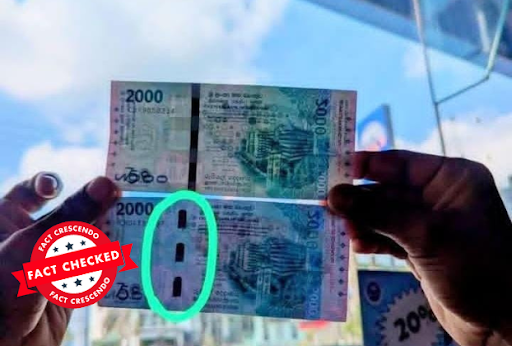
Recently, we came across a viral image, shared as an advisory message, requesting the public to be wary of a purported fake 2000 Rupee note in circulation. Let’s look at the viral claim in detail.
Social Media Posts :
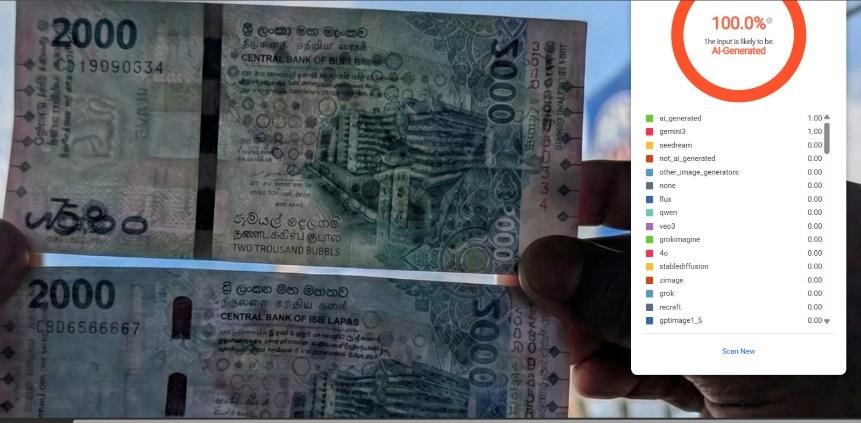
A photo comparing two Rs. 2000 notes exposed to sunlight show discrepancies in both notes and suggest the genuine note has a single security line, while the counterfeit one has a broken line.
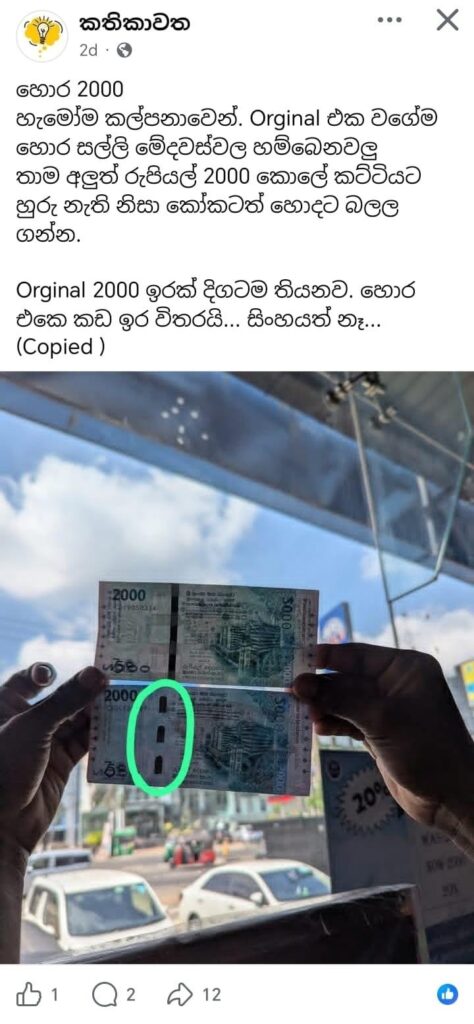
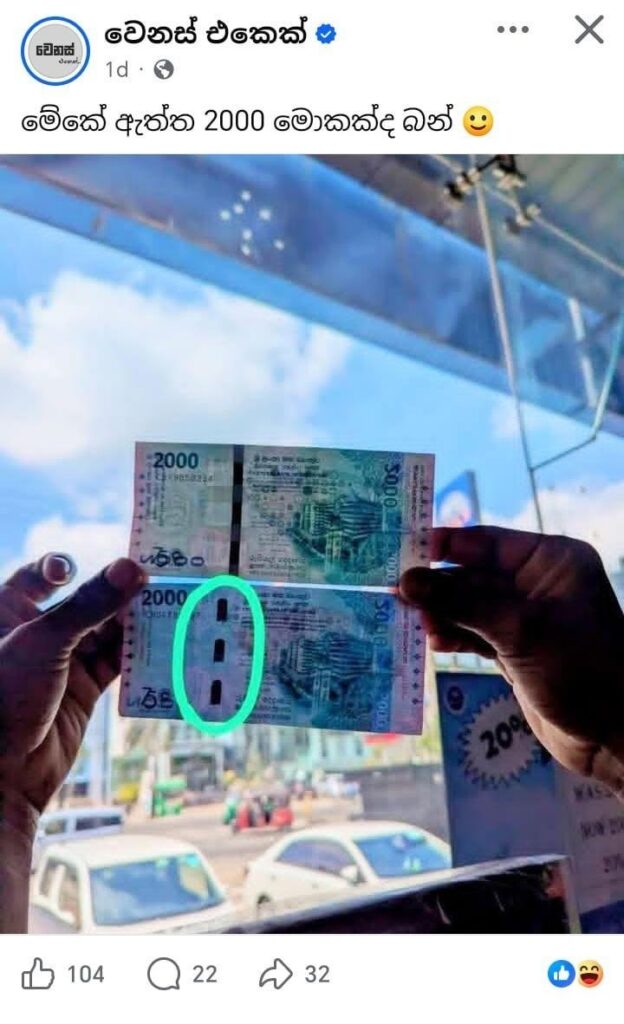
The above-mentioned social media posts suggest that a large number of counterfeit Rs. 2000 notes are circulating these days and have instructed people to hold the note up to the sunlight and check it before use.
To assess the credibility of this post, we conducted a fact-finding investigation.
Fact Check :
The Central Bank of Sri Lanka issued a new Rs. 2000 note for public circulation from 29th August 2025 to mark its 75th anniversary, but the Central Bank announced that it was a limited issue of 50 million notes. Here is a fact check we conducted regarding the 2000 Rupee note in September 2025.
The Central Bank also released an official document explaining all the features of the front and back of the new Rs. 2000 note.
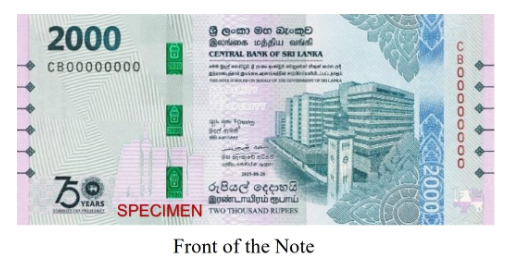
What are the signs and special security features on the new Rs. 2000 note?
The front of the note features a reflection of the Central Bank of Sri Lanka’s main office building and the Old Colombo Lighthouse, as well as new buildings added to the city of Colombo, reflecting recent urban developments, and the 75th anniversary logo.
A colour-changing security thread has been incorporated to enhance security and make it easier for the public to identify valid banknotes. To assist visually impaired people in identifying the note, six raised stripes with a diamond shape at the end of each stripe are printed on both the left and right edges of the note.
The reverse of the note features a creative depiction of the map of Sri Lanka, a lotus flower, and the Central Bank’s vision statement, symbolising the Central Bank’s commitment to economic resilience and progress.
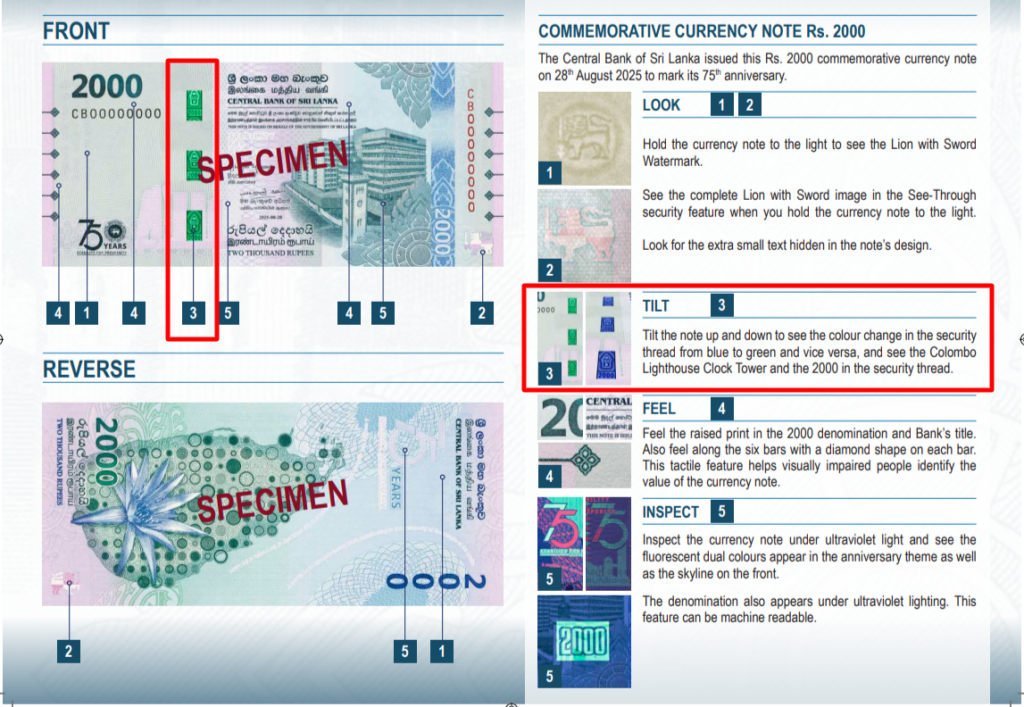
It can be observed that the three stripes that are the subject of this debate on social media are visible on the left-hand corner of the front of the official banknote, as shown above.
The Special security thread on the Rs. 2000 note.
The explanation in that section states, “Tilt the note up and down to see the colour change in the security thread from blue to green and vice versa, and see the Colombo Loghthouse Clock Tower and the 2000 in the security thread.”
The Central Bank of Sri Lanka has also released a detailed video regarding the newly introduced Rs. 2000 banknote. The video, describing all the features of the front and back of the banknote, also clearly identifies the three stripes on the front of the banknote. The video is available here.
Central Bank’s Take on The Viral Images
We also inquired with the Central Bank of Sri Lanka regarding this matter. They also confirmed that the original Rs. 2000 has three security stripes on the front, which appear as a single stripe when held up to the light, which is a common feature for other notes as well.
Furthermore, they explained that it is not possible to determine whether a banknote is counterfeit or not using only this method. Therefore, they instruct the public to follow several security measures, since people who print counterfeit notes use various methods.
It was also stated that the Central Bank of Sri Lanka is conducting further investigations into the background of the circulated social media post.
An image created through artificial intelligence
When comparing the original Rs. 2000 note, as stated on the Central Bank website, and the Rs. 2000 note in the social media post, various unnatural features can be seen.
The spelling of the phrase “Sri Lanka Central Bank, Two Thousand Rupees” is clearly incorrect in both the notes published in the social media post. Considering this, we checked this photo with an Artificial Intelligence content recognition tool, and it became clear that they were created using Google Gemini AI.
There is no indication regarding a special police notice informing the public to be aware of the circulation of counterfeit Rs. 2000 notes.
Although the police issued a warning about the circulation of counterfeit currency notes during the last festive season, recently they haven’t issued a special warning regarding counterfeit notes, or regarding the Rs. 2000 currency note.
While advising to be aware of the counterfeit currency notes, Police Media Spokesperson ASP F.U. Wutler stated on December 16 that they seized several counterfeit currency notes over 2025, namely 535 counterfeit Rs. 5000 notes, two counterfeit Rs. 2000 notes, 401 counterfeit Rs. 1000 notes, and 109 counterfeit Rs. 500 notes. You can refer to the full report here.
Police Media Unit Confirms That There Have NOT been any reports of circulation of counterfeit 2000 Rupee notes!
We also inquired with the Police Media Unit regarding this matter, and they stated that while there is a buzz on social media regarding the exchange of counterfeit 2000 rupee notes, no definitive confirmation has yet been made in this regard, nor has such a situation been officially reported to the Police Media Unit so far.
The Police Media Unit further stated that the Police Media Spokesperson had previously informed the public regarding the exchange of counterfeit Rs. 5,000 notes, and when in doubt, can follow the same procedure to identify any possible counterfeit notes.
How to distinguish between a counterfeit currency note and a real currency note?
To curb the printing of counterfeit currency notes, all currency notes issued by the Central Bank of Sri Lanka are printed with several advanced security features, such as a watermark, security thread, beveled corners, transparent mark, very small letters, and a mark for the visually impaired, etc., to enable the distinction between a real currency note and a counterfeit note. Details about this can be found here.
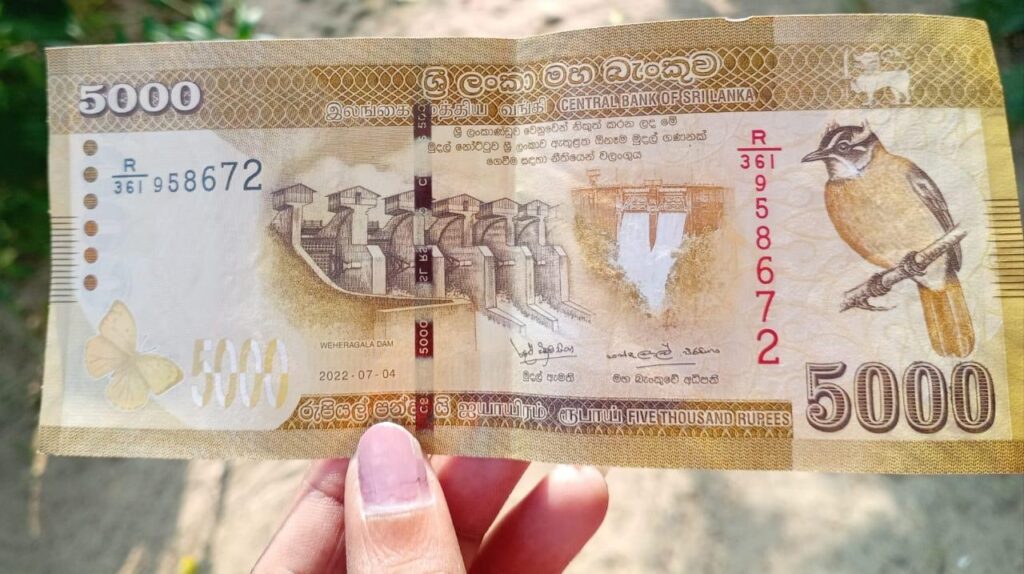
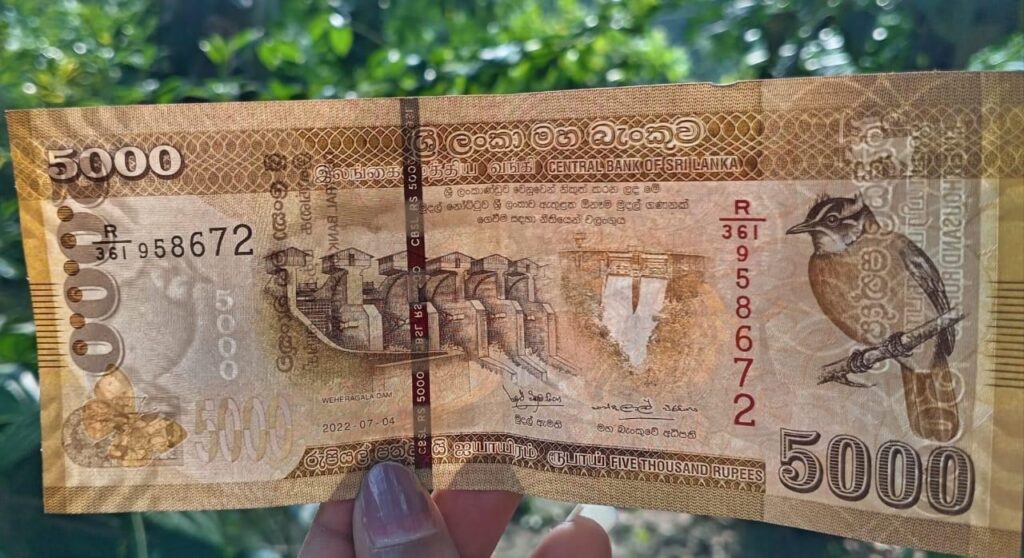
To illustrate this clearly, we have stated below a comparison of how the Rs. 5000 note looks normally and how it looks after being exposed to sunlight. It can be seen that the security features of the note exposed to sunlight are clearly visible.
The security thread on banknotes
The security thread varies from note to note. The higher denomination notes, i.e., Rs. 5000, Rs. 2000, Rs. 1000, Rs. 500, etc., have a vertical “Star Chrome” security thread that appears in alternating colours, such as red and green. The thread used in the Rs. 100, Rs. 50 and Rs. 20 notes are completely embedded in the note and are seen as a continuous line.
When the note is held up to the light, the two-colour numerals on the front of the note (near the butterfly) align with the corresponding numerals on the back of the note, appearing as complete numbers, which is known as the “transparent mark” on the notes.
How can counterfeit notes with a forged security thread be identified?
While the security thread of a valid real currency note is inserted during the production of the banknote, in counterfeit banknotes, it is usually glued from the inside or outside. Therefore, one can identify whether it is counterfeit or not upon careful observation.
The security thread on counterfeit banknotes does not change colour in most cases, and the value of the banknote is often not mentioned on the thread.
Furthermore, the security thread embedded in counterfeit notes is not continuous.
Here is an article regarding identifying counterfeit notes.
What should you do if you receive a counterfeit banknote?
Banknotes and coins issued for circulation by any person or institution other than the Central Bank of Sri Lanka are considered counterfeit currency. Counterfeit banknotes should not be used as a means of payment.
Intentionally using counterfeit notes for transactions is a serious crime and is punishable by imprisonment and/or a fine. Even possessing a counterfeit note is an offence.
If a person recognises a counterfeit note, he/she should refuse to accept it. A person who has already accepted such a note should try to remember how he/she obtained it and should immediately inform the Counterfeit Note Bureau of the Criminal Investigation Department (CID) of the Sri Lanka Police; Hotline: 0112422176 or 0112326670, and act on their instructions or inform the nearest police station.
The Central Bank of Sri Lanka has explained what to do if you come across a suspected counterfeit note during a financial transaction.
Join us to learn more about our investigative fact findings.
Facebook | Twitter | Instagram | Google News | TikTok
Conclusion:
Our investigation shows that the social media post that compares two Rs. 2000 notes is an image created using artificial intelligence.
However, as a basic security feature to distinguish between a real banknote and a counterfeit banknote, the method of observing the security thread can be used. When the note is exposed to sunlight, the security thread does not appear as a continuous line in a counterfeit banknote in most cases, whereas it is visible in a real banknote.
The Police Media Division confirmed that there have been no reports of counterfeit notes similar to the new Rs. 2000 note being circulated in large numbers in society, or any arrests being made in this regard.
Therefore, while it is good practice to create informative posts to highlight security features on currency noted for public awareness, using misleading AI images in this way can create undue fear in society.

Title:A counterfeit currency note identical to the new Rs.2000 note?
Fact Check By: Fact Crescendo TeamResult: Misleading