



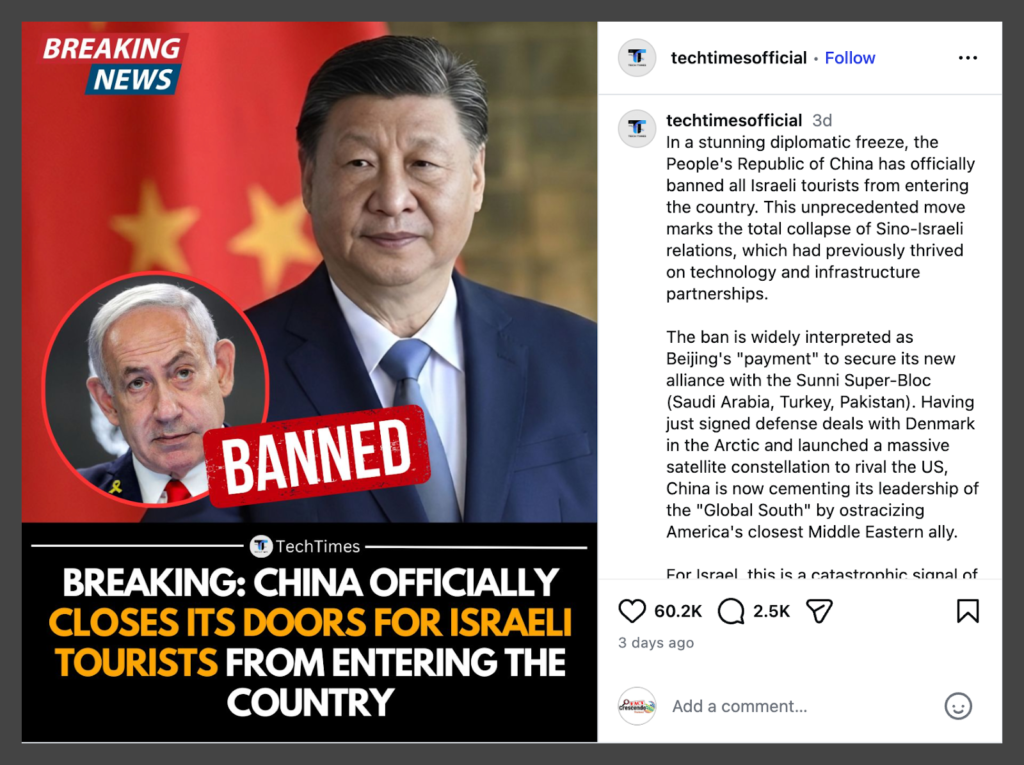
A claim circulating widely on social media platforms alleges that China and Japan have “officially banned all Israeli tourists” from entering their countries. The posts often use urgent language such as “BREAKING” or “officially closes its doors,” implying the existence of formal government decisions or legal measures. However, after reviewing, we found this claim to be false.
Social Media Claims
Posts on Facebook, Instagram and X claim that China and Japan have enacted nationwide bans on Israeli tourists.


Fact Check
China and Israeli Tourists: No Official Ban
There is no evidence that China has imposed a ban on Israeli tourists. No statement from China’s Ministry of Foreign Affairs, the National Immigration Administration, or any Chinese embassy or consulate announces such a policy.
China’s visa policy is publicly documented and structured by visa category, length of stay, and general security screening, rather than by political disputes with specific countries. Official visa information pages confirm that Israeli citizens remain eligible to apply for Chinese visas through embassies and visa centers, including via the China Online Visa Application System launched for applicants in Israel in June 2025, which would be illogical if a ban were in force
Similarly, the Embassy of China in Israel continues to publish routine visa notices, such as reductions in visa service fees and exemptions from fingerprint collection for certain applicants, without any Israel-specific restrictions. None of these communications reference a prohibition on Israeli passport holders.
What has changed is China’s outbound travel advice for its own citizens. In 2024-2025, Chinese authorities issued advisories urging Chinese nationals to reconsider travel to Israel due to security concerns. These advisories apply to Chinese citizens traveling to Israel, not Israeli citizens entering China. (Source)
Japan and Israeli Tourists: Visa-Free Entry Remains in Place
According to the Japanese Embassy in Israel, Israeli nationals are among citizens of dozens of countries who may enter Japan visa-free for short-term stays of up to 90 days, and this information remained in place as of January 2026. Japan’s Ministry of Foreign Affairs likewise lists Israel among countries eligible for short-term visa exemption for ordinary passport holders.
Hotel Incidents in Japan: The claim appears to stem from specific incidents involving individual hotels in Japan. In late 2025 and early 2026, ADVT NGO reported that a hotel in Tokyo required an Israeli guest to sign a declaration stating they had not committed war crimes, and that a lodging facility in Hakuba, Nagano, refused reservations from Israeli citizens, citing opposition to Israel’s actions in Gaza.
These incidents drew public attention and were not endorsed as official government policy. Local authorities in Nagano issued verbal warnings to the operators, noting that refusing guests based on nationality could constitute prohibited discrimination. This indicates that Japan’s official stance does not support such exclusions. (Source)
These cases involve private businesses rather than border control or immigration authorities. No Japanese ministry has instructed hotels to refuse Israeli guests, and no national regulation requires such actions.
Travel Advisories, Not Entry Bans: Another source of confusion is the adjustment of travel warnings by countries such as China, Japan, and the United Kingdom regarding travel to Israel. In late 2024, some of these advisories were eased following a ceasefire with Hezbollah, prompting renewed media attention.
Travel advisories regulate the safety guidance a government gives to its own citizens traveling abroad. They do not determine who is allowed to enter that government’s country. Conflating outbound advisories with inbound entry bans is a common error in viral geopolitical misinformation. (Source)
A Real Ban for Contrast: The Maldives
For comparison, the Maldives enacted an official ban on Israeli tourists in April 2025. The Maldivian government amended its Immigration Act to prohibit entry for individuals holding Israeli passports. The decision was publicly announced by the president’s office and cited solidarity with Palestinians as the rationale. This policy was documented through official legal amendments and widely reported. No equivalent announcement, legal amendment, or official directive has been issued by China or Japan regarding Israeli tourists. (Source: Africa News, Times of Israel)
Conclusion
The claim that China and Japan have “officially banned” Israeli tourists is false. Neither country has enacted any government policy, legal amendment, or official directive prohibiting Israeli passport holders from entering their territory. While isolated incidents at private hotels in Japan have occurred, and while China has issued travel advisories for its own citizens regarding travel to Israel, these do not constitute entry bans against Israeli tourists.

Title: Viral Claims that China and Japan Have Banned Israeli Tourists is False
Fact Check By: Cielito WangResult: False