



Subscribe to our WhatsApp Channel
The ongoing hot weather has become a topic that people across almost all areas are feeling these days. Even mainstream media is widely reporting on the prevailing high temperatures, and within this context, various messages related to the hot weather are also being shared across social media platforms. Here is a fact check we conducted regarding one such misleading statement that is being widely circulated on several social media platforms.
Social Media Posts :
A message that is being widely shared via WhatsApp claims that the temperature in the country will rise to between 45°C and 55°C, and that the Department of Meteorology has advised people not to go outdoors from 10 a.m. to 3 p.m. from April 29 to May 12. Accordingly, the long message also includes a set of instructions said to be issued by the Department of Meteorology and a “Civil Defense Directorate” for the public to follow. The WhatsApp message being circulated appears as follows.
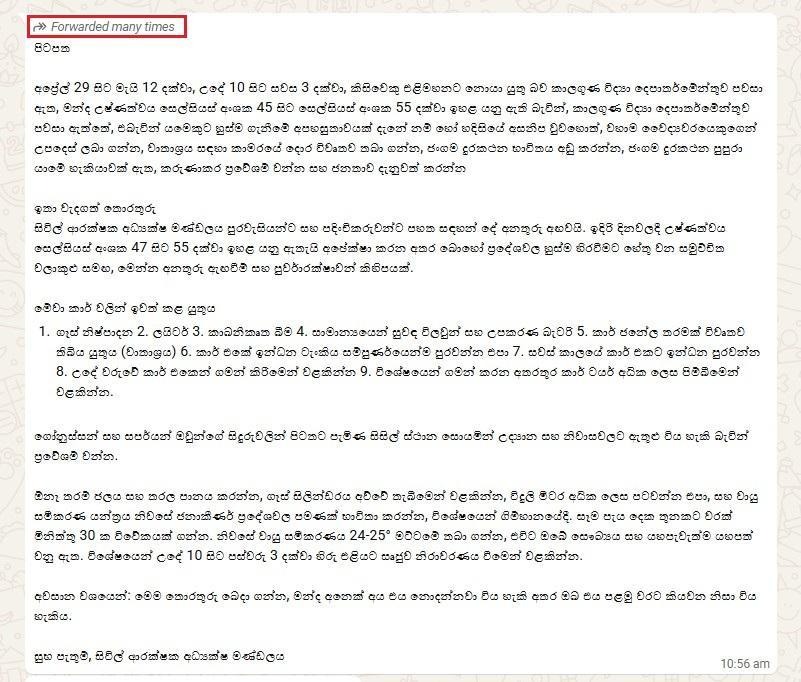
Posts containing this WhatsApp message have also been shared on Facebook, as follows.
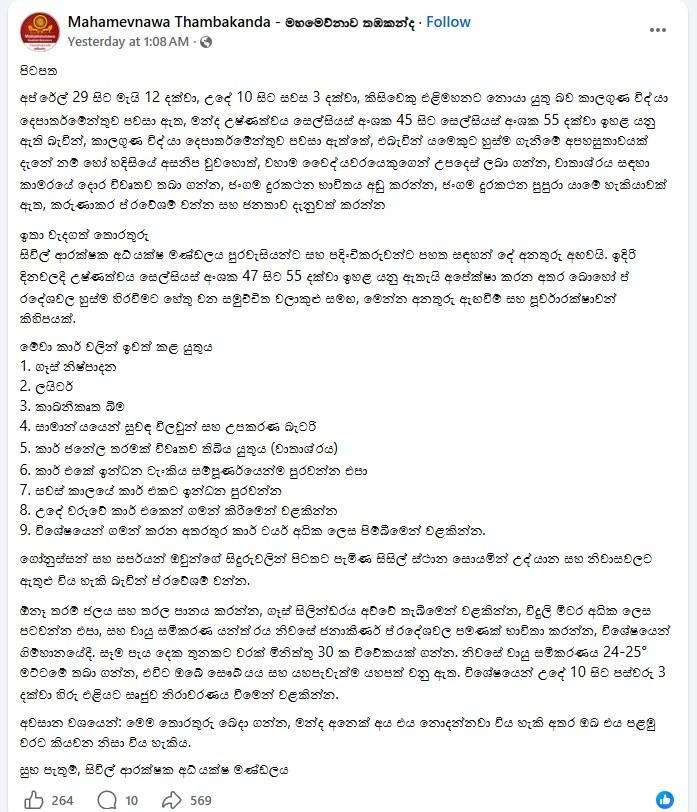
Here are some more posts that were widely shared on Facebook along with the message. Here | Archived Link
Another English version circulating on Facebook and WhatsApp can be seen below.
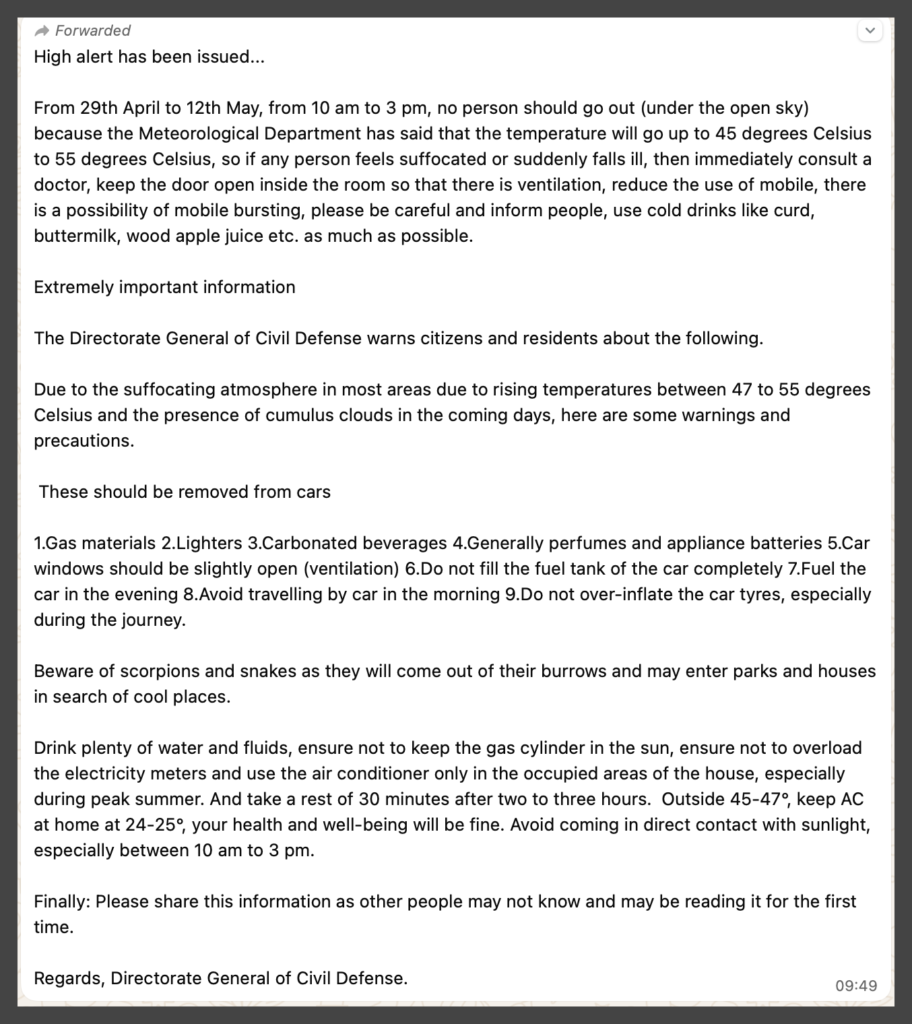
The message related to high temperatures has been widely shared both as a WhatsApp message and on Facebook. In response to readers’ requests to verify the accuracy of the claims mentioned in this message, we proceeded to conduct a fact check on this matter.
Fact Check :
The official body responsible for issuing weather conditions, forecasts, warnings, and related information in the country is the Department of Meteorology. Mainstream media has been informing the public about the current hot weather conditions and future forecasts based on information from this department, as shown here, here, here, and here. However, no mainstream media has reported any message similar to the one circulating on social media.
Department of Meteorology official website
There is no official announcement published on the Department of Meteorology’s website stating that temperatures will rise to 45°C–55°C from April 29 to May 12, or advising people to avoid going outdoors between 10 a.m. and 3 p.m. during that period.
Meanwhile, the weather forecast issued for 31 March states that the prevailing hot conditions will continue. Showers or thundershowers may occur at a few places after around 2:00 p.m. in the Western and Sabaragamuwa provinces and in the Galle and Matara districts, while mainly dry weather will prevail in other parts of the island.
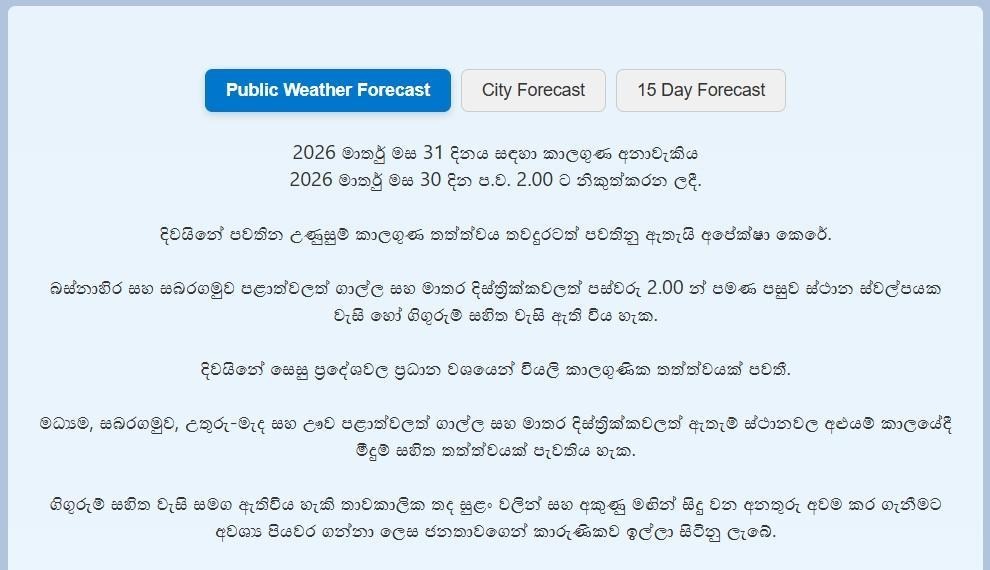
In addition, the Heat Index Advisory issued on March 31 by the Department’s Early Warning Center states that in parts of the Western, Sabaragamuwa, Southern, Eastern, North Western, Northern, and North Central provinces and in the Monaragala district, the heat index (the temperature felt by the human body) may reach caution levels between 39°C and 45°C. Accordingly, a set of guidelines has been issued, based on advice from the Ministry of Health, on how to take precautions at workplaces, at home, in vehicles, and outdoors.
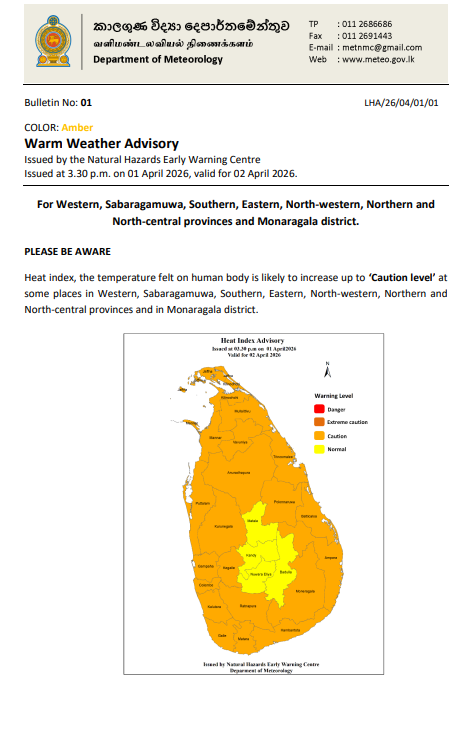
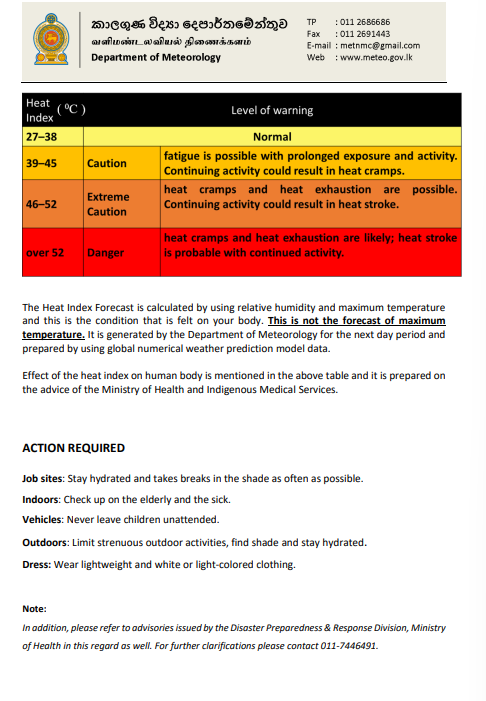
However, as mentioned in the social media message, there is no mention in any official statements by the Department of Meteorology about temperatures rising to 45°C- 55°C or the other instructions listed in that message.
Department of Meteorology scientists
To further verify the claims in the message about extreme temperatures circulating on social media, we contacted several scientists from the Department of Meteorology. Meteorologist Keerthi Pasquel stated that the message circulating on WhatsApp and other social media platforms, or any similar warning, has not been issued by the department. He also mentioned that no forecast has been made predicting temperatures of 45°C- 55°C.
He further explained that the current hot weather conditions in the country are not unusual, and that during the inter-monsoon period in March and April, temperatures generally tend to rise in areas such as Ratnapura, Mattala, and Kurunegala. Although people may feel increased heat, this is not considered an extreme or rare phenomenon of rise in temperature. However, he added that, as in previous years, the department advises the public to take precautions against the heat, such as limiting time spent outdoors.
We also contacted Deputy Director of Climate Studies and Training, Gayana Hendawitharana, to confirm further details. She stated that there is no scientific basis for temperatures rising to the levels mentioned in the social media message. According to computer models and climate forecasts, there is no indication that Sri Lanka will experience such extreme temperatures in April or May. She also mentioned that while people may feel temperatures above 40°C, this does not reflect the actual air temperature.
She added that there is about a 70% probability of El Niño conditions developing around June, which may affect weather patterns. However, even under such conditions, temperatures reaching the levels mentioned in the social media message are not expected.
The social media message also refers to another institution called the “Civil Defense Directorate” in addition to the Department of Meteorology, claiming that it issued guidelines as well. However, our investigation confirmed that no such institution operates in Sri Lanka. Therefore, the message circulating on social media appears to be either artificially created or a translation of a message from another country.
Temperature in Sri Lanka
Due to its location near the equator, Sri Lanka experiences a generally warm climate throughout the year. In most lowland and coastal areas, daytime temperatures usually range between 26°C and 32°C, with high humidity making conditions feel even warmer. In the dry zone, including the North Central and Eastern provinces, temperatures are generally higher and can rise to around 34°C–35°C during hot periods.
The period from March to May is usually the hottest time in Sri Lanka, with temperatures reaching their peak across the island. Especially in inland areas away from the coast, conditions can be very hot and dry before the onset of monsoon rains. Sri Lanka’s climate is mainly influenced by two monsoon systems: the Southwest monsoon from May to September and the Northeast monsoon from December to February. With the arrival of these monsoons, daytime temperatures decrease while humidity increases.
However, areas in the central highlands, including Nuwara Eliya and Kandy, remain relatively cooler due to their higher elevation. Daytime temperatures in these regions usually range between 15°C and 25°C, and can drop to around 10°C at night. Overall, although Sri Lanka has a warm and humid climate, experiencing temperatures as high as 40°C is very rare and not typical of the country’s usual weather patterns. Details regarding this can be found here, here, and here.
A previous fact check we conducted regarding the country’s weather conditions is given below.
Will El Nino Arrive in May? Does Today’s Heat Signal Heavy Rain Ahead?
Join us to learn more about our fact-checking investigations
Facebook | Twitter | Instagram | Google News | TikTok
Conclusion :
Our investigation shows that the message circulating on WhatsApp and other social media platforms claiming that temperatures in the country will rise to 45°C-55°C, along with instructions to follow during that period, was not issued by the Department of Meteorology. It also confirms that an institution called the “Civil Defense Directorate” mentioned in the message does not exist in Sri Lanka. According to meteorological authorities, the island is currently experiencing weather conditions that are typical for this time of the year.

Title: Has an Official Warning Been Issued Claiming Temperatures Will Reach 55°C?
Fact Check By: Fact Crescendo Team
Result: False