

A claim circulating widely across platforms alleges that an Italian scientist has discovered an enzyme capable of clearing arterial plaque and reversing heart disease without the need for surgery. These posts often present the claim as a major medical breakthrough. However, after reviewing scientific literature, clinical trial data, and credible medical sources, we found this claim to be misleading.
Social Media Posts
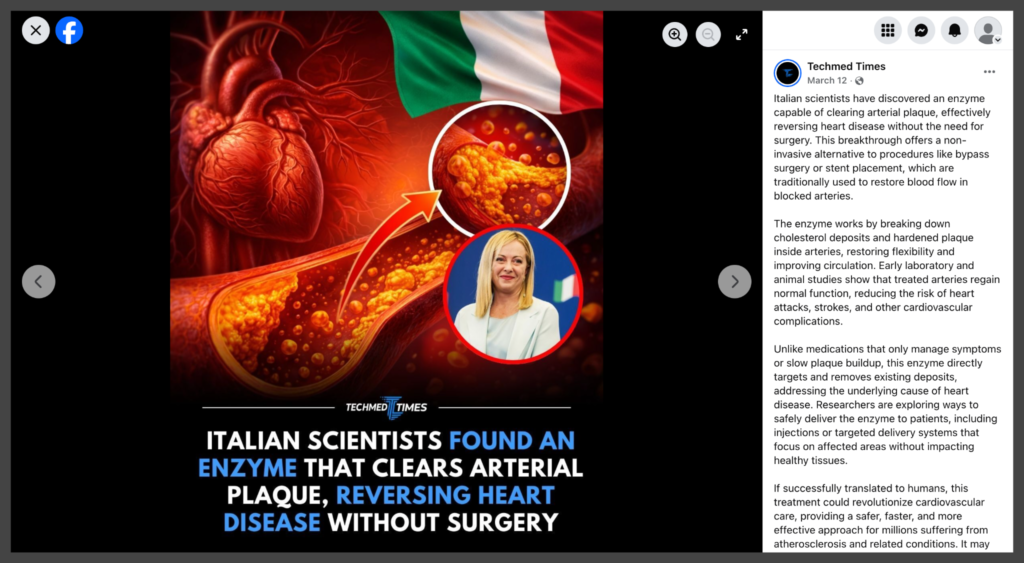
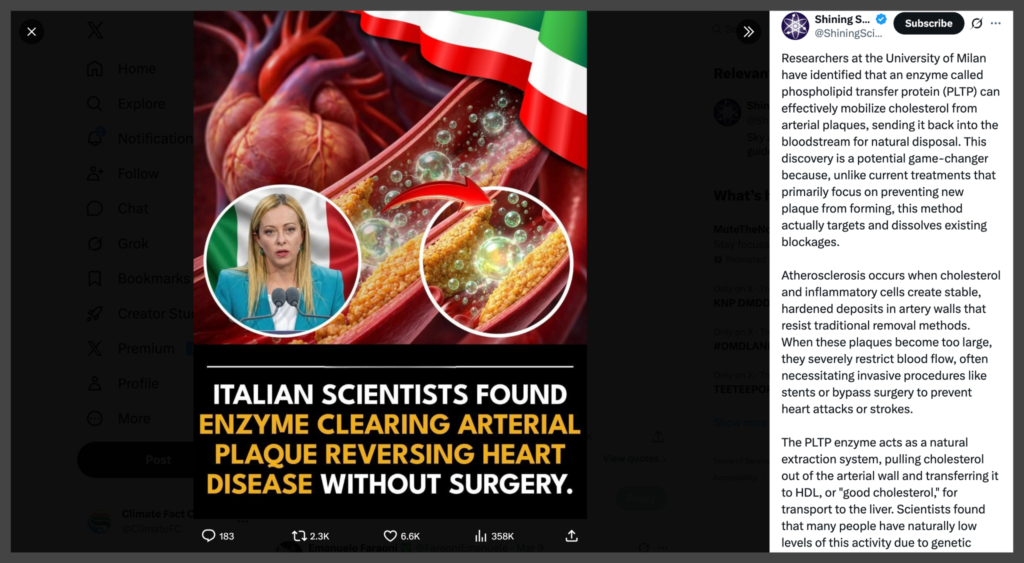
The claim appears in multiple viral posts, often with similar wording, suggesting that “Italian scientists have discovered an enzyme that dissolves plaque in arteries” and implying a non-invasive cure for heart disease. Examples include posts shared on Facebook and X, as follows:
Fact Check
No Clinical Evidence of a “Plaque-Clearing Enzyme”
To date, evidence from human clinical trials and mainstream medical literature has not established an enzyme-based treatment that can safely and consistently “dissolve” arterial plaque and reverse atherosclerosis on its own. Research indicates that plaque progression can often be slowed or stabilized and, in some cases, reduced modestly, but substantial reversal remains challenging and depends on multiple factors.
For example, large-scale clinical evidence reported in journals such as JAMA shows that lipid-lowering therapies can reduce cardiovascular risk, but they do not function as a simple, targeted “plaque-clearing” enzyme. Major health organizations also generally recommend managing significant heart disease with a combination of medications and lifestyle changes, and, when appropriate, procedures such as stents or bypass surgery.
Misinterpretation of ApoA-I Milano Research
One of the key scientific concepts frequently misrepresented in these claims is ApoA-I Milano, a rare genetic variant first identified in a population in Limone sul Garda, Italy. Early studies suggested that this variant of HDL (high-density lipoprotein) may help reduce atherosclerosis risk.
However, this research does not involve a simple enzyme that “dissolves plaque.” Instead, it focuses on complex lipid transport mechanisms. A historical report from the Los Angeles Times explains that ApoA-I Milano research involved synthetic protein infusions and experimental therapies, not a universally applicable cure.
Clinical trials of ApoA-I-based therapies have definitively failed to demonstrate plaque regression in humans. The MILANO-PILOT trial testing MDCO-216 (recombinant ApoA-I Milano) failed to show sufficient effects on atherosclerotic plaque and was discontinued in 2016. Similarly, the CARAT trial testing another HDL therapy failed to reduce plaque volume. After more than 20 years of research, no ApoA-I Milano therapy has proven viable for clinical use.
Laboratory Proteins Are Not Clinical Treatments
Some social media posts cite scientific-sounding terms, such as phospholipid transfer protein (PLTP) or enzymes like CD39, and present them as evidence that researchers have identified a direct way to “clear” plaque. These molecules are real and are studied because they influence processes like cholesterol transport and immune signaling.
However, research on a molecule does not by itself amount to an available treatment. Much of this work is early-stage (often in cells or animals) and has not been shown to translate into an approved therapy for people with heart disease.
For example, the ScienceDaily coverage discusses proteins that influence how cells handle cholesterol, but this is basic research rather than evidence of a proven medical intervention. Another report describes new findings in cardiovascular biology, but it does not demonstrate an available treatment that reverses heart disease without procedures. These studies can help explain how disease processes work, but developing safe, effective therapies typically requires many years of clinical testing.
Recent viral posts from March-April 2026 specifically claim that Italian researchers discovered a PLTP (phospholipid transfer protein) enzyme achieving 40% plaque reduction, with human trials imminent. This fundamentally misrepresents PLTP research. Scientific evidence shows PLTP actually promotes atherosclerosis rather than preventing it; studies demonstrate that PLTP destabilizes atherosclerotic plaques and increases plaque vulnerability. In humans, high PLTP activity is associated with increased cardiovascular risk, not decreased risk. No credible evidence supports 40% plaque reduction claims or legitimate clinical trials testing PLTP as a plaque-clearing treatment.
The Gap Between Lab Research and Human Medicine
A common pattern in health misinformation is the exaggeration of early-stage research. Findings observed in cell cultures or animal models often do not translate into effective human therapies. According to biomedical research standards, treatments must undergo multiple phases of clinical trials to establish safety, dosage, and efficacy before being approved.
Even promising approaches can fail at later stages. Cardiovascular therapies targeting plaque reduction have repeatedly shown limited or inconsistent results in large human trials, underscoring the complexity of the disease.
Established Treatments for Heart Disease
Current medical consensus, supported by organizations such as the American Heart Association, emphasizes that heart disease management relies on a combination of evidence-based approaches, including medications, lifestyle changes, and interventional procedures when necessary. According to the American Heart Association, lowering cholesterol, particularly LDL cholesterol, is a central strategy for reducing cardiovascular risk, typically through diet, physical activity, and medications such as statins.
Clinical guidelines developed by the American College of Cardiology (ACC) and the American Heart Association further highlight that aggressive LDL reduction is essential for preventing heart attacks and strokes, with specific target levels depending on patient risk profiles.
In practice, treatments such as statins not only lower cholesterol but also help stabilize arterial plaque and reduce the likelihood of rupture, which is a major cause of heart attacks. (Source)
Similarly, Mayo Clinic notes that treatment for coronary artery disease typically includes cholesterol-lowering medications, antiplatelet drugs, and, in more severe cases, procedures such as angioplasty or bypass surgery.
Patients should be aware that delaying evidence-based medical treatment while waiting for unvalidated enzyme therapies can increase risk of heart attack, stroke, and death. Individuals encountering claims about enzyme cures should consult healthcare providers before making any treatment changes.
Conclusion
Current evidence does not indicate that an Italian scientist has identified an enzyme that can clear arterial plaque and reverse heart disease without surgery. Although some posts reference real research, such as work on ApoA‑I Milano and other cholesterol-related proteins, these areas of study have not led to a clinically proven enzyme treatment that reliably dissolves plaque in humans. Heart disease management is typically based on established approaches, including medication, lifestyle changes, and, when appropriate, procedures; an enzyme-based therapy has not been shown to replace these standard treatments.

Title: Fact Check: No “Italian Enzyme” Has Been Proven to Dissolve Arterial Plaque and Reverse Heart Disease Without Surgery
Fact Check By: Pranpreeya
Result: Misleading