
Subscribe to our WhatsApp channel
Social media circles in Sri Lanka were abuzz with claims that the current government has increased the Value Added Tax (VAT) for all goods and services, as per the VAT Amendment Act, which is scheduled to come into effect on July 1st. We have investigated these claims and found that, while there are a few changes proposed to the VAT structure for financial services and the introduction of VAT to digital services, the posts implying that VAT has been increased to 20.5% for all goods and services are misleading.
Social Media Posts:
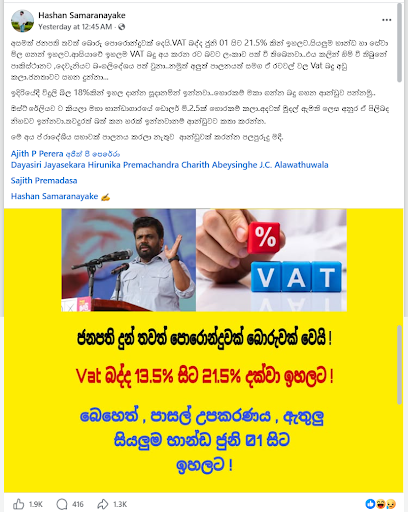
Social media posts claimed that the Value Added Tax (VAT) had been increased to 20.5%, which would cause the prices of goods to rise.
Among the tax reforms proposed to strengthen the country’s economy are measures like increasing the Value Added Tax (VAT) to 20.5% and applying it to digital services, a change that would directly impact your daily life. Tax is embedded in every product or service purchased. This means that, often without explicit awareness, a portion of what you pay is remitted to the government as tax. What, then, would be the impact of an increase to 20.5%?
Consider the following example:
Item price: Rs. 1,000
Previous VAT (15%): Rs. 150 → Total: Rs. 1,150
New VAT (20.5%): Rs. 205 → Total: Rs. 1,205
This represents an additional Rs. 55 for the same item, which, when accumulated across daily expenses, results in a significant financial burden.
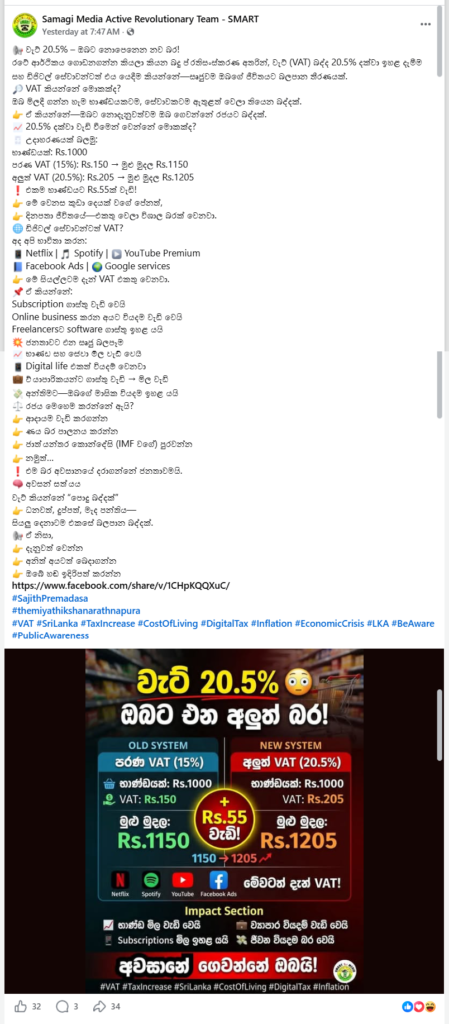
Various posts on this theme were widely shared on Facebook. Below are a few of them.
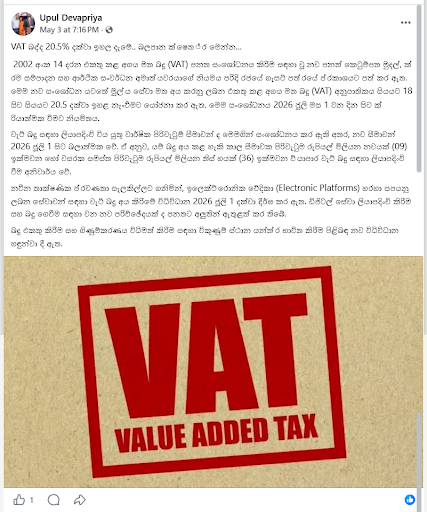
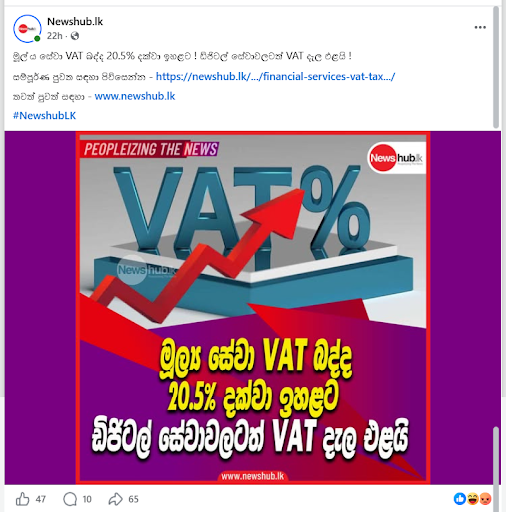
This news was also reported by the mainstream media.
We investigated this matter following several requests for clarification on whether the proposed VAT increase would, in fact, lead to higher prices for goods and services.
Fact-Check:
The new draft Bill seeking to amend the Value Added Tax (VAT) Act, No. 14 of 2002, has been published in the Government Gazette pursuant to the directives of the minister of Finance, Planning and Economic Development. Our attention was primarily drawn to the percentage of the VAT increase being discussed in society. The details of the Act are as follows:
What does the VAT Amendment Act entail?
The amendment, first proposed on January 1, 2022, replaces the previous 18% VAT rate with a new rate of 20.5%, effective from July 1, 2026.
The annual turnover threshold for general VAT registration will be reduced from Rs. 60 million to Rs. 36 million (equivalent to Rs. 9 million per quarter), effective July 1, 2026. Additionally, penalties for tax evasion or fraudulent recovery attempts have been increased to Rs. 1 million, alongside potential imprisonment for up to six months. The act also proposes mandatory use of secure Point of Sale (POS) machines to streamline collection and enhance transparency.
However, concerns have been raised regarding the effective increase in VAT rates, particularly due to the consolidation of a ‘financial services tax’ and a perceived lack of clear justification for the shift from 18% to 20.5%.
Clarification from the Ministry of Economic Development
The Ministry clarified that the government decided to consolidate two separate financial services taxes to simplify the tax structure. Consequently, the bill combines the existing 18% VAT and the 2.5% Social Security Contribution Tax into a single unified VAT mechanism.
Statement from the Deputy Minister
Deputy Minister of Economic Development Nishantha Jayaweera addressed misleading reports regarding the VAT implementation scheduled for July 1st.
He stated that claims of a general VAT increase from 18% to 20.5% are false. Instead, this measure is part of a broader policy framework by the National People’s Power Party aimed at simplifying the tax system.
VAT is applied to both general and financial services, with the latter paid by banks and financial institutions. This specific amendment applies only to those entities, adjusting their rate to 20.5% effective July 1, 2026.
He emphasized that this is not a new tax increase but a consolidation. Essentially, the 18% VAT and 2.5% Social Security tax previously levied on these institutions are being merged into a single 20.5% rate.
As a result, banks and financial institutions will no longer pay the Social Security Contribution Levy separately. The Minister noted that this combined rate ensures a more streamlined process without imposing an additional tax burden on other goods or parties.
The proposal for consolidation actually originated from the financial sector to reduce administrative complexity. Previously, institutions had to file multiple reports for different taxes. This reform simplifies reporting, improves administrative efficiency, and, as clarified, does not increase the cost of general goods.
The following section provides a detailed explanation sourced from the Tax Advisor YouTube channel.
- Value Added Tax (VAT)
Value Added Tax (VAT) in Sri Lanka is an indirect tax imposed on the consumption of goods and services. Its current framework, as amended in 2026, is outlined below.
- Current VAT Rates
Most goods and services are subject to VAT at 18%. However, with effect from 1 July 2026, the VAT applicable to banks and financial institutions has been increased to 20.5%, representing the consolidation of the previous 18% VAT and the 2.5% Social Security Contribution Levy (SSCL). Exported goods and services remain exempt from taxation.
- Registration Threshold
The 2026 Budget has reduced the annual turnover threshold for VAT registration from Rs. 60 million to Rs. 36 million. Accordingly, businesses with an annual turnover exceeding Rs. 36 million, or a quarterly turnover exceeding Rs. 9 million, are required to register for VAT.
- New Tax Amendments (2026)
Digital Services: It has been decided to impose an 18% VAT on foreign digital service providers, such as Netflix, Facebook Ads, and Google, with effect from 1 July 2026. In addition, VAT will now also be applied to imported coconut oil, palm oil, and textiles, which were previously exempt from taxation.
Exemptions
Wheat and wheat flour, infant formula, medicines and prescription drugs (excluding hospital room charges), educational services and books, public transport services, as well as other essential goods and services, are further exempted from VAT.
For further details on this, you can visit the website of the Department of Inland Revenue.
In fact, VAT is an indirect tax, whereby the ultimate burden is borne by the consumer purchasing the goods or services. Once businesses exceed the Rs. 36 million threshold, they are required to register and act as tax collectors on behalf of the Government. Accordingly, one of the primary reasons the general public bears VAT is that the final consumer effectively becomes the taxpayer. That is, the VAT paid by a business in the course of producing or selling a product is incorporated into the final price of that product. Accordingly, the tax is included within the amount paid by the consumer when purchasing the product from a retailer.
For example, from the time a product is produced until it reaches the consumer, tax is levied on the value added in one step: farmer > factory > wholesaler > retailer. Finally, the total amount of all those taxes is collected from the consumer.
The Government requires substantial revenue to maintain public infrastructure and essential services such as schools, hospitals, and roads. In countries such as Sri Lanka, where comparatively fewer individuals contribute through direct taxation, including income tax, greater reliance is placed on indirect taxes such as VAT as a means of generating state revenue. Very small businesses are exempted due to the administrative difficulties associated with tax filing and compliance. However, whenever goods or services are purchased from supermarkets or other VAT-registered businesses, the consumer effectively becomes the taxpayer. In essence, while the business remits the tax to the Government, the financial burden is ultimately borne by the general public.
Banks and other financial institutions Social Security Contribution Levy (SSCL)
Social Security Contribution Tax is paid to the government because they are classified as “service providers” by law. The main objective of this tax, introduced by the Social Security Contribution Tax Act No. 25 of 2022, is to find the necessary provisions for building the national economy and social security programs. Some of the main factors that affect the payment of this tax by banks are,
Legal Requirement: This Act applies to individuals or entities providing any type of service in Sri Lanka.
Financial Services Tax: Most financial services that are subject to VAT are also subject to SSCL.
Turnover threshold: Since a bank’s annual turnover generally exceeds Rs. 120 million, they must legally register for and pay this tax.
Tax rate: Banks must pay tax at a rate of 2.5% on their taxable turnover.
Contributing to the economy: The government uses this money mainly for welfare activities and economic recovery in the country. Information on this can be found here.
Digital Service Tax
An 18% VAT on a range of online services provided by foreign companies, which has been under discussion since last year and had not previously been subject to taxation, is scheduled to come into effect from 1 July.
The above Gazette notification states that new provisions have been introduced to bring foreign digital service providers within the Sri Lankan tax framework. Accordingly, non-resident entities that do not maintain a permanent place of business in Sri Lanka, but provide services through electronic platforms or similar means, are required to register for VAT if their annual turnover exceeds Rs. 36 million or their quarterly turnover exceeds Rs. 9 million.
A customer is considered a Sri Lankan customer and is taxed based on the fact that their billing address is in Sri Lanka, payments are made through a Sri Lankan bank, or their IP address is located in Sri Lanka.
Entertainment: Streaming services like Netflix, Spotify, and YouTube Premium.
Online commerce: E-commerce platforms like Amazon, AliExpress and Facebook/Google advertising (Digital Ads) services.
Technology Services: Cloud computing, software (SaaS), and AI services (e.g. ChatGPT Plus)
Other: Platforms such as hotel booking apps (booking.com) and ride-sharing (Uber)
For additional details on taxable digital services, you may refer to information provided by the BBC or access a convenient summary via Ada Derana Biz.
We invite you to explore our fact-checking efforts.
Facebook | Twitter | Instagram | Google News | TikTok | Youtube
Conclusion:
Our investigation found that social media posts claiming the Value Added Tax (VAT) has been increased to 20.5% are misleading. The tax scheduled for July 1 is a composite VAT, introduced to simplify the tax system by consolidating two separate taxes—the existing 18% VAT and the 2.5% Social Security Contribution Levy (SSCL)—into a single 20.5% rate. This composite rate applies exclusively to banks and financial institutions. Crucially, this amendment does not affect the existing 18% VAT imposed on general goods and services.

Title: Has VAT been increased by 2.5% for general services?
Fact Check By: Pavithra Sandamali
Result: Missing Context