

A claim circulating on social media platforms suggests that high-dose vitamin D can help the body convert excess calories into muscle instead of fat, implying that increasing vitamin D intake could fundamentally alter body composition and improve fitness outcomes. However, a closer review of the scientific evidence shows that this claim is misleading.
Social Media Posts
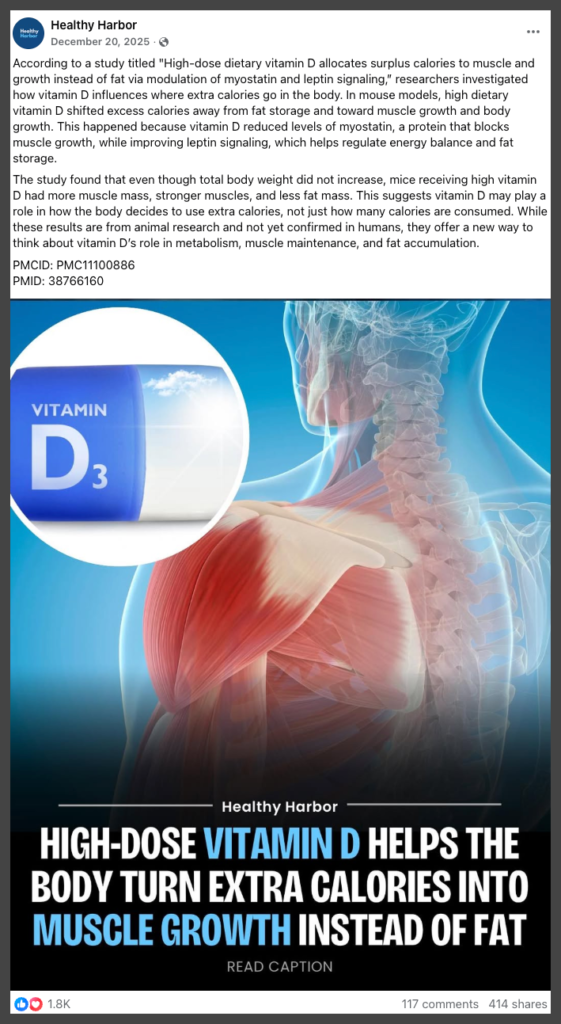
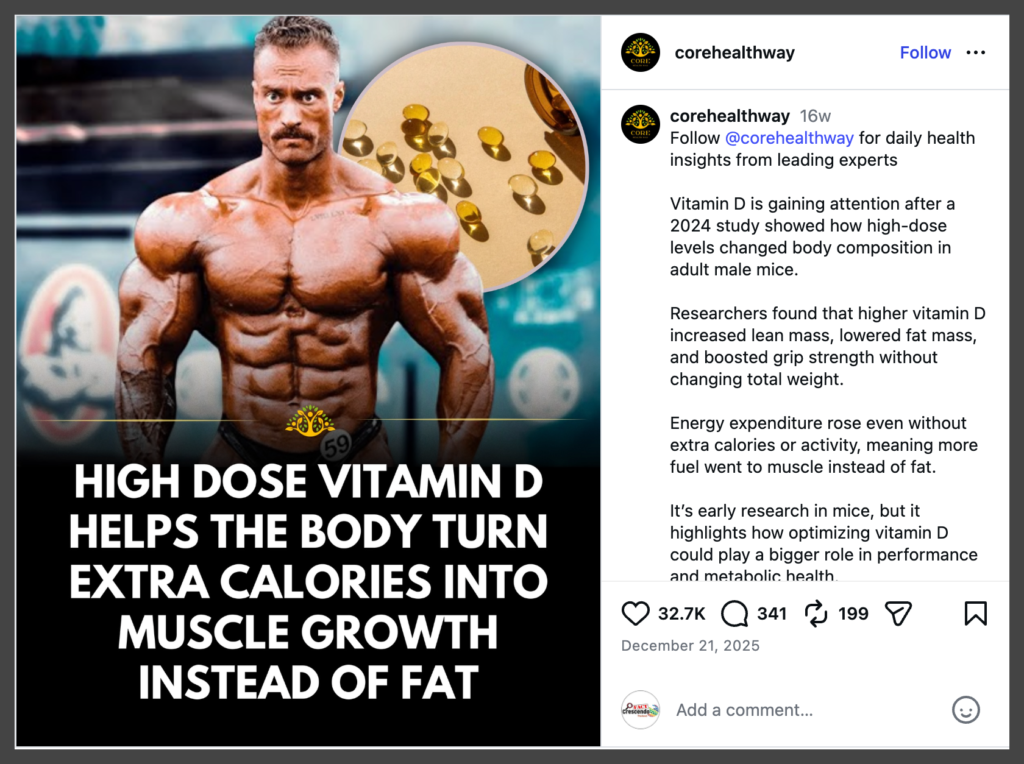
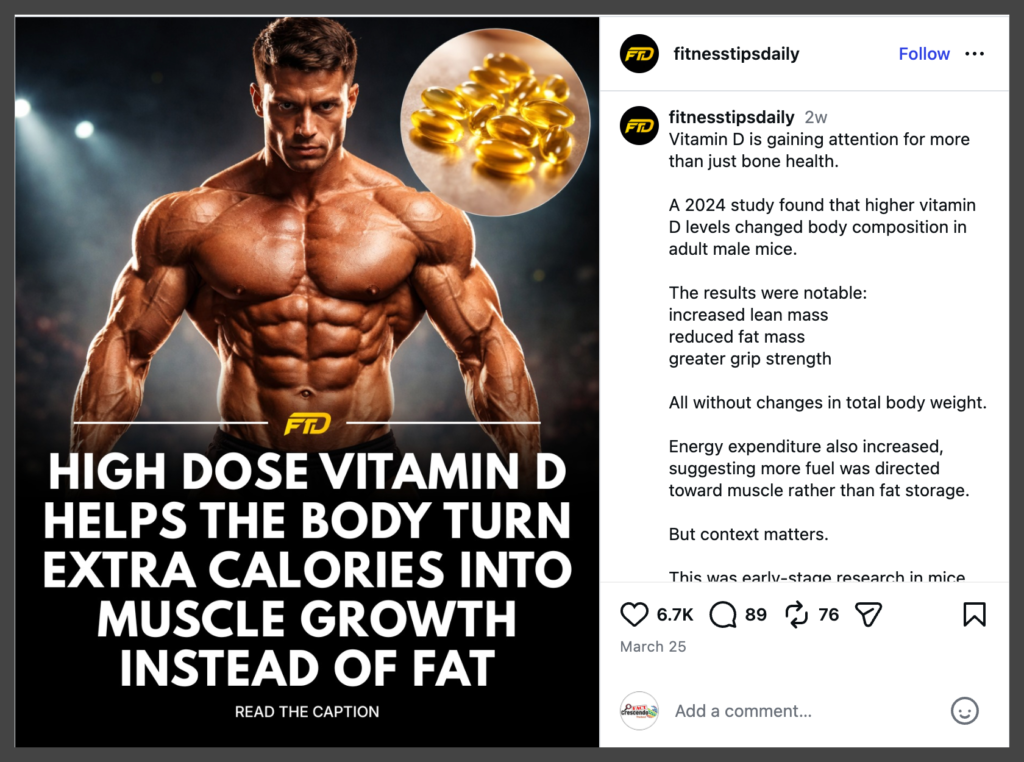
Posts shared widely online claim that “high-dose vitamin D redirects calories toward muscle growth instead of fat storage,” and the claim is gaining traction on both Facebook and Instagram.
Fact Check
The claim originates from a preclinical study conducted in mice. In this experiment, researchers fed mice different levels of vitamin D and observed that very high doses appeared to increase lean mass and strength while reducing fat proportion.
The proposed mechanism involved biological pathways such as reduced myostatin (a protein that inhibits muscle growth) and altered leptin signaling, which may influence energy expenditure and fat storage. Supporting discussion of these mechanisms also appears in related biomedical literature.
However, this study has two critical limitations. First, it has not yet been peer-reviewed, meaning the findings have not undergone full scientific validation. Second, and most importantly, the results are based entirely on animal models, not humans.
Lack of Evidence in Humans
There is currently no clinical evidence demonstrating that vitamin D can redirect calories toward muscle instead of fat in humans. Large, well-conducted randomized controlled trials do not support this claim.
For example, the VITAL trial, which included over 25,000 participants taking 2,000 IU of vitamin D daily for several years, found no significant effect on body weight, fat mass, or lean mass. Similarly, analyses of the same cohort confirm that vitamin D supplementation does not modify body composition in humans (Source).
Other clinical trials and meta-analyses also show limited or inconsistent effects. While some studies report modest improvements in muscle strength, particularly in people with vitamin D deficiency, they do not demonstrate meaningful changes in fat-to-muscle ratio or overall body recomposition (Source). In some cases, supplementation had no effect on lean mass or even reduced strength under certain conditions. (Source)
Overall, the human evidence indicates that vitamin D may support normal muscle function, especially in deficient individuals, but does not act as a metabolic switch that redirects calories into muscle growth.
Risks of High-Dose Vitamin D
Another key issue is dosage. The mice in the study received extremely high levels of vitamin D (around 10,000 IU per kilogram of diet), which would translate to hundreds of thousands of IU per day in humans. Such levels are far beyond safe intake.
According to the U.S. National Institutes of Health, the tolerable upper intake level for adults is 4,000 IU per day. Exceeding this limit can lead to toxicity.
High-dose vitamin D supplementation carries real health risks. Excess intake can cause hypercalcemia, a condition where calcium levels in the blood become dangerously high. Symptoms include nausea, vomiting, kidney stones, confusion, and in severe cases, kidney failure or cardiac arrhythmias (Source). A systematic review also found that doses in the range of 3,200-4,000 IU per day were associated with an increased risk of adverse events, including hypercalcemia and hospitalization.
These risks highlight that high-dose supplementation is not a safe or evidence-based strategy for altering body composition. Such doses are not only unsafe but also not achievable in real-world human supplementation practices.
Some smaller trials in overweight or vitamin D-deficient individuals have reported reductions in fat mass, particularly when combined with calorie restriction. However, findings remain inconsistent, and none demonstrate the specific mechanism claimed—that vitamin D redirects calories into muscle growth. Even in studies with positive outcomes, vitamin D appears to function as a supportive factor rather than a primary driver of fat loss or muscle gain. (Source)
Conclusion
The claim that high-dose vitamin D helps the body convert excess calories into muscle instead of fat is misleading and not supported by current evidence. While a mouse study suggests this effect may occur under experimental conditions, there is limited evidence that it applies to humans. Large clinical trials generally find that vitamin D supplementation does not significantly change body composition, fat mass, or muscle mass.
Additionally, the doses used in the animal study are far above typical safe human limits and may pose health risks. For these reasons, vitamin D is best viewed in the context of its established role in bone health and normal muscle function, rather than as a strategy for body recomposition.

Title: Can High-Dose Vitamin D Turn Calories Into Muscle Instead of Fat?
Written By: Pranpreeya P
Result: Misleading