

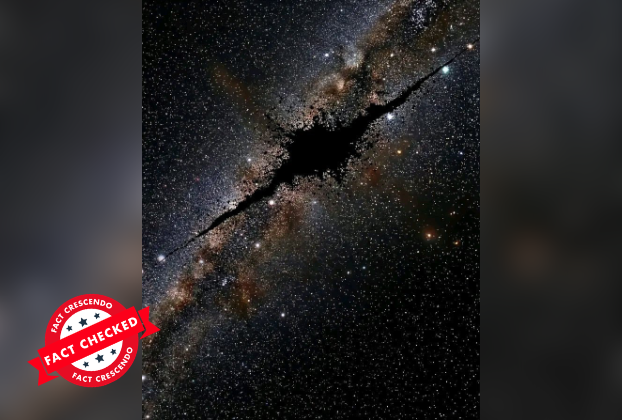
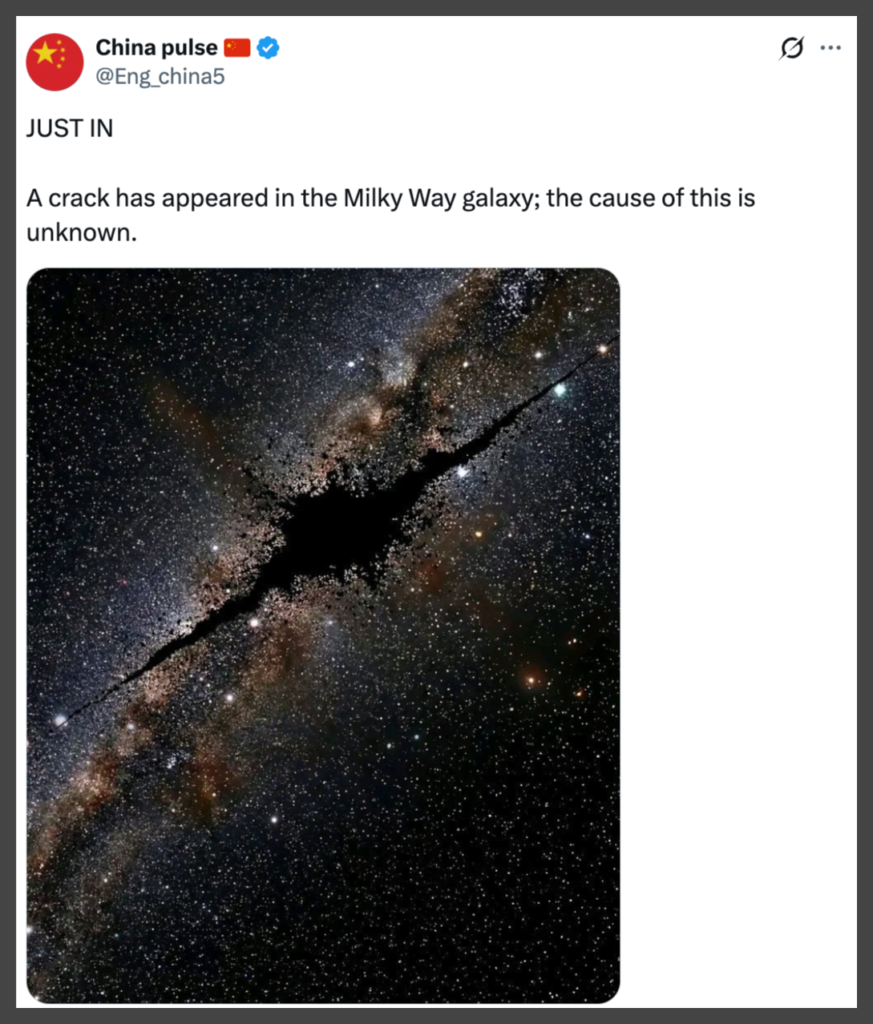
A claim circulating on social media states that astronomers have detected a mysterious “cosmic crack” in the Milky Way. According to viral posts, an unseen force moved through part of the galaxy without emitting light, heat, or any visible signal, leaving behind a 230-light-year “fracture.” However, the viral image depicting a dark rip in space is not an authentic NASA or Chandra image. It is an unrelated AI-generated artwork being used misleadingly. Therefore, the scientific finding is real, but the viral visual representation and framing as a mysterious “cosmic crack” are misleading.
Social Media Posts
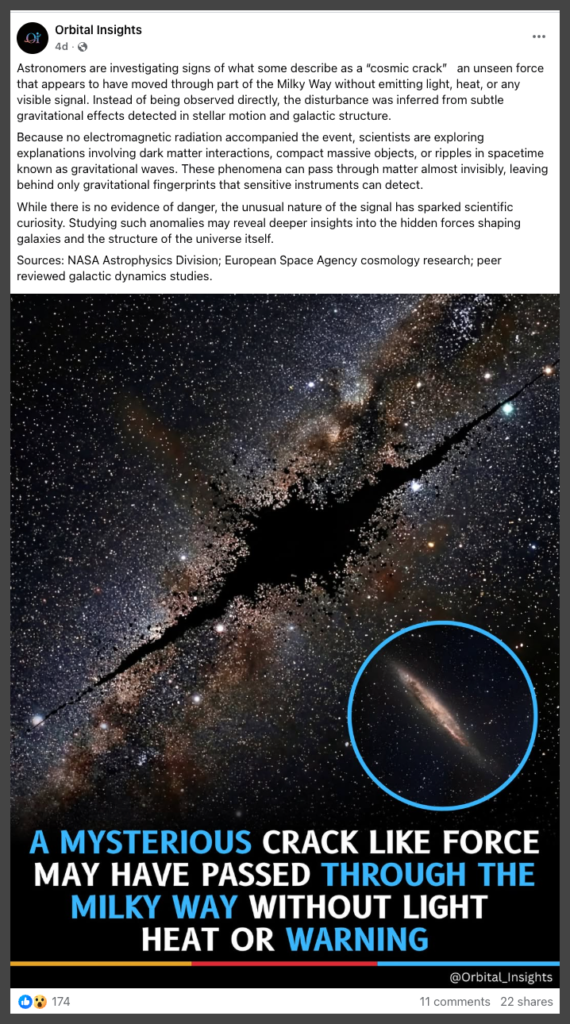
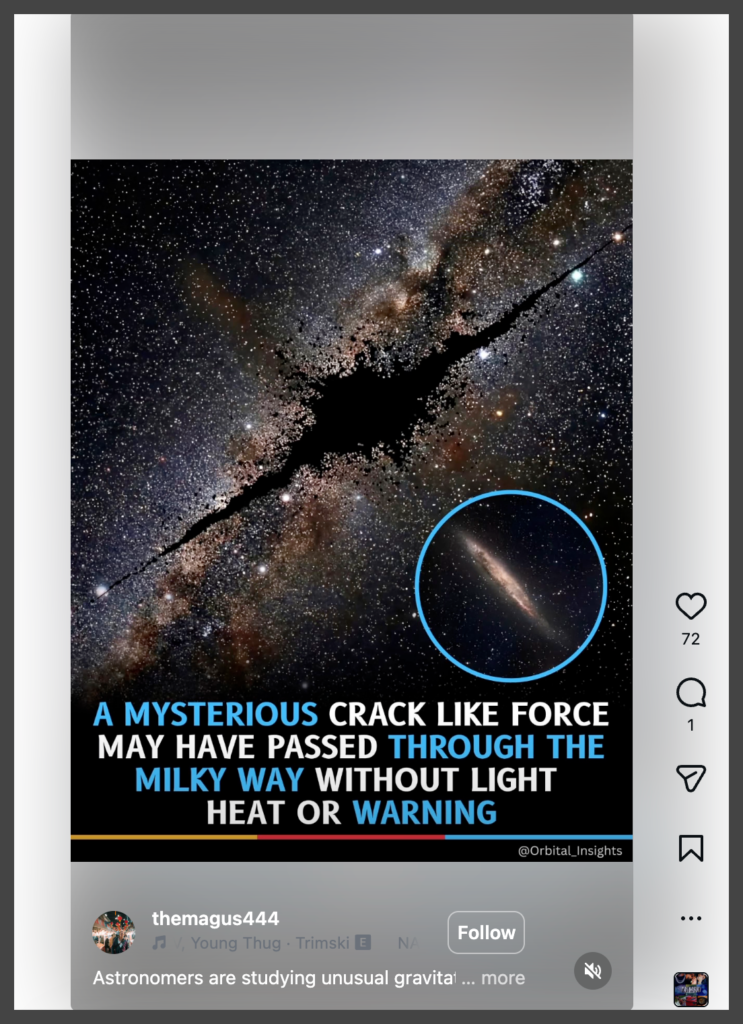
Posts circulating online claim that “Astronomers are investigating signs of what some describe as a ‘cosmic crack’, an unseen force that appears to have moved through part of the Milky Way without emitting light, heat, or any visible signal.”
The image and claim are spreading widely on Facebook, Instagram, and X.
Fact Check
Visual Analysis
We analyzed the viral image using Hive Moderation, an AI detection tool. The results indicated a high likelihood that the image was generated using artificial intelligence.
A check using Gemini also indicated that this image was generated or edited with Google AI, and the image contains a digital watermark, known as SynthID, which is used to identify content created by Google’s AI tools. The image depicts a space-like scene, and the central “crack” effect and specific star patterns are consistent with AI-generated imagery rather than a direct photograph of the night sky.
What NASA Actually Reported
NASA’s Chandra X-ray Observatory published findings in 2025 (see here) describing a fracture in a long, thin structure near the center of the Milky Way. The filament, designated G359.13 and nicknamed “the Snake,” stretches approximately 230 light-years and is located about 26,000 light-years from Earth near the Galactic Center.
According to NASA’s official release, titled “NASA’s Chandra Diagnoses Cause of Fracture in Galactic ‘Bone'” (2025), the feature is not a crack in space itself, but a distortion in a radio-bright filament traced by magnetic fields and high-energy particles. NASA explains that the fracture was likely caused by a fast-moving pulsar, a highly magnetized neutron star, which slammed into the filament and warped its magnetic structure.
Space.com similarly reported that Chandra data, combined with radio observations, revealed a kink or break in the filament consistent with a pulsar impact, not an unknown invisible force.
Official NASA and Chandra materials consistently refer to the feature as a “fracture” or “kink” in a galactic filament. No official source uses the phrase “cosmic crack.” The term “cosmic bone” refers metaphorically to the filament’s elongated shape and does not imply a literal structural break in the fabric of space. No official scientific publication describes this phenomenon as a rupture in spacetime or as evidence of an unknown cosmic force.
What Is a Galactic Center Filament?
Galactic center filaments are long, narrow structures of gas and relativistic particles threaded by strong magnetic fields near the Milky Way’s core. They are typically tens to hundreds of light-years long but only about one to three light-years wide. These filaments emit radio waves through synchrotron radiation, produced when high-energy electrons spiral along magnetic field lines.
NASA’s HEASARC archive describes the Snake filament as a non-thermal radio filament whose brightness arises from energetic particles confined within magnetic structures.
Research published by Northwestern University has shown that nearly 1,000 such filamentary strands have been identified near the Galactic Center, suggesting a magnetically complex environment shaped by black hole activity, supernovae, and compact objects. These are not cracks in spacetime. They are magnetized structures within interstellar gas.
The Pulsar Explanation
NASA’s report states that a high-velocity pulsar traveling between roughly 450 and 900 kilometers per second likely struck the filament, distorting its ordered magnetic field and creating the visible kink.
Phys.org reported that the pulsar’s motion, estimated at up to 2 million miles per hour, compressed and twisted the magnetic field lines, producing the observed deformation.
The evidence includes multi-wavelength data from Chandra X-ray observations and radio telescopes such as MeerKAT and the VLA. The pulsar-impact explanation is considered plausible based on current data, though not yet definitively confirmed.
Importantly, this event involves known astrophysical processes. It does not require invoking unknown invisible forces or gravitational anomalies.
The Viral Image Is Not Authentic
The dramatic black “rip in space” image circulating online does not match official NASA or Chandra releases. The authentic composite images show a relatively straight gray filament with a small kink and bright blue X-ray points, not a jagged gash through a star field.
NASA’s official image archive and Chandra press materials contain only composite radio and X-ray visuals consistent with scientific imaging standards.
Context: Recent Discoveries from Chandra
The fracture discovery is part of a broader series of scientific results from the Chandra X-ray Observatory in 2025-2026. Recent highlights include:
Chandra observed a young solar-type star, HD 61005, nicknamed “the Moth,” revealing an extended X-ray-bright astrosphere or stellar wind bubble roughly 200 times the Earth–Sun distance in size.
A newly released all-sky catalog now includes approximately 1.3 million X-ray detections accumulated over 22 years, providing extensive data on black holes, neutron stars, and galaxy clusters.
These verified discoveries demonstrate that Chandra continues to produce high-quality scientific data. None involve cracks in spacetime or invisible cosmic rifts.
Conclusion
The claim that NASA discovered a mysterious “cosmic crack” in the Milky Way is misleading. While NASA’s Chandra X-ray Observatory did report a 230-light-year fracture in a galactic filament near the Milky Way’s center, this is not a literal crack in space but rather a distortion in a magnetized gas structure, likely caused by a fast-moving pulsar. The viral image depicting a dramatic black rip through space is AI-generated and does not represent authentic NASA imagery.

Title: Viral “Cosmic Crack” Image Is AI-Generated, Not Real NASA Discovery
Fact Check By: Pranpreeya P
Result: False