

Claims have circulated on social media that a recent study has found the human Y chromosome is “slowly disappearing,” raising concerns that male births could eventually cease, suggesting a possible male-less future. However, current scientific evidence does not support the conclusion that the Y chromosome is imminently disappearing or that male births are under threat.
Social Media Posts
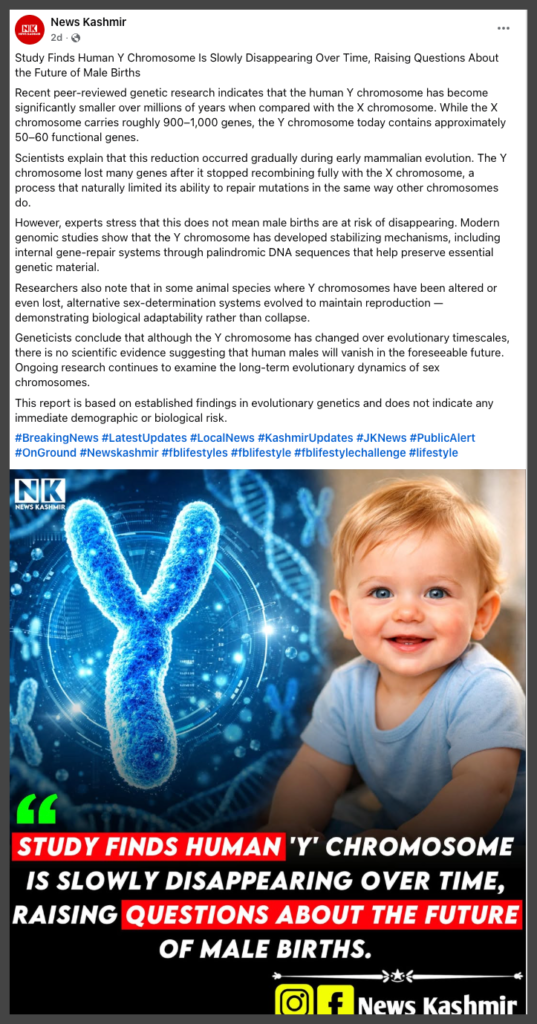
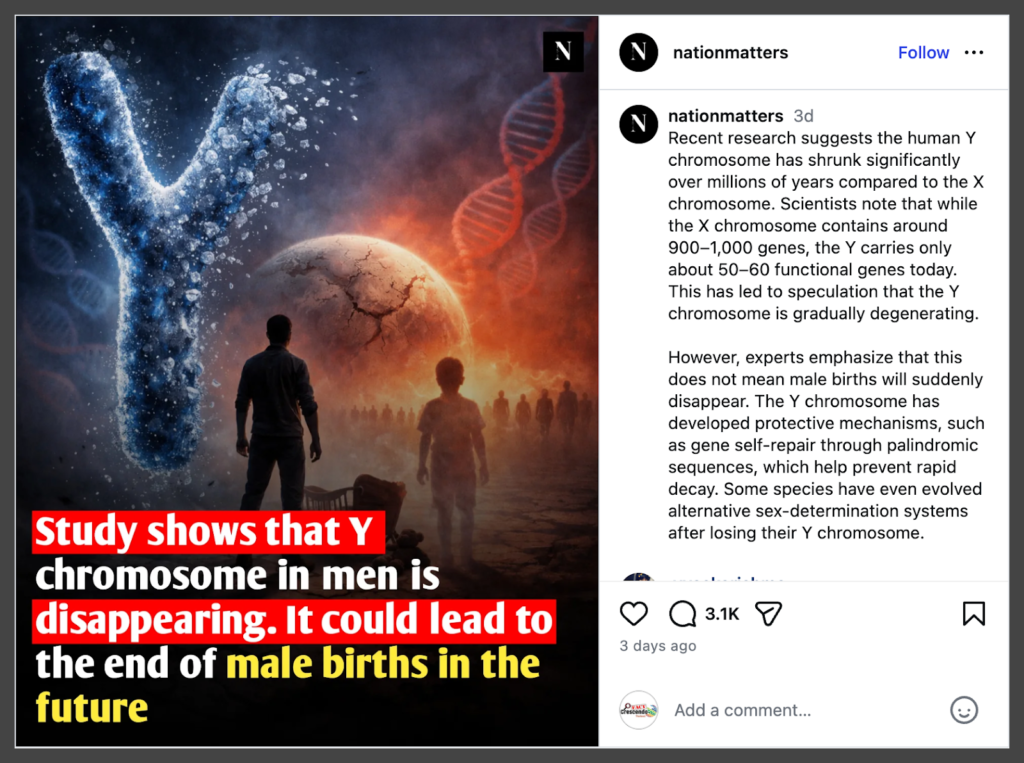
Posts circulating on Facebook, Instagram, and other platforms claim that “scientists have confirmed the Y chromosome is disappearing”.
Fact-Check
The Y Chromosome: Smaller Than the X, But Not Evidence of Imminent Loss
It is true that the human Y chromosome is much smaller than the X chromosome and contains far fewer genes. The X chromosome carries roughly 900 protein-coding genes, while the Y chromosome carries around 45–60 protein-coding genes, with much of its sequence consisting of repetitive, non-coding DNA.
Comparative genomic analyses show that mammalian Y chromosomes have lost most of their ancestral genes since sex chromosomes first evolved hundreds of millions of years ago. One review estimates that the human Y has lost about 1,393 of its estimated 1,438 original genes over approximately 300 million years of sex chromosome evolution. This long-term degeneration occurred over deep evolutionary time and does not indicate imminent disappearance in the present or foreseeable future. (Source)
Gene Loss Has Slowed or Stabilized in Recent Evolution
While early stages of Y chromosome evolution involved rapid gene loss, more recent studies indicate that gene loss has slowed considerably and may have plateaued. A key piece of evidence is comparative research showing that the human Y chromosome has experienced virtually no gene loss in the past ~25 million years of primate evolution. This finding suggests that the current gene set on the human Y may be stable and conserved by natural selection.
Research by evolutionary geneticists such as Melissa Wilson Sayres, Rasmus Nielsen, and others indicates that many of the remaining genes on the Y chromosome are under purifying natural selection, meaning harmful mutations are removed, which may help preserve the function of Y-linked genes important for sperm production and male viability.
Scientific Debate on Y Chromosome Evolution
Some evolutionary biologists, such as Jenny Graves, have proposed that if historical rates of gene loss were extrapolated linearly into the future, the Y chromosome might theoretically lose all its genes in a few million years. Graves’s estimate, based on early degeneration rates, projected the Y could vanish in roughly 5–11 million years if decay continued at that pace. Other scientists who study comparative primate genomics note that such linear models may not accurately reflect the actual evolutionary dynamics of the Y chromosome.
Recent comparative studies of the scientific literature (here and here) indicate that gene loss has substantially slowed in recent evolutionary time, and many core Y-linked genes are conserved due to their essential roles in reproduction. This conservation suggests that the remaining Y chromosome genes may be stable over evolutionary timescales.
Evidence from Reputable Science Reporting (BBC Article)
A 2012 report from BBC News discussed these scientific findings, drawing on research that compared human, chimpanzee, and rhesus macaque Y chromosomes. The article noted that no genes were lost from the human Y in the last ~6 million years, and only one gene out of many ancient ancestral genes was lost in the last ~25 million years, evidence that gene loss has been minimal in recent primate evolution. According to this reporting, one of the researchers, Dr. Jennifer Hughes, stated that the Y chromosome “is not going anywhere and gene loss has probably come to a halt,” based on comparative genomic data. This finding suggests that projections of Y chromosome “extinction” may not align with current evolutionary patterns.
Medical Phenomenon: Mosaic Loss of Y in Aging Men
It is important to distinguish between long-term evolutionary changes to the Y chromosome and a separate medical phenomenon called mosaic loss of Y (mLOY). In mLOY, some blood cells in older men lose the Y chromosome as they age, a condition that has been associated with increased risks of cancer and cardiovascular disease.
However, mLOY affects somatic (body) cells, not the germline cells (sperm) that determine whether a child inherits a Y chromosome. It does not indicate long-term evolutionary loss of the Y chromosome or a decline in male births.
(Source: PubMed Central, ScienceAlert)
No Evidence Male Births Are At Risk
There is currently no peer-reviewed study demonstrating that male births are declining due to Y chromosome shrinkage. While birth sex ratios can fluctuate due to demographic or environmental factors, these variations are not linked to long-term evolutionary gene loss on the Y chromosome. Furthermore, even if the Y chromosome were to degrade very gradually over millions of years, new sex-determining mechanisms, like those seen in some rodents, could theoretically evolve as alternative solutions, meaning births of males would still occur through other pathways (Source).
Conclusion
Claims that the human Y chromosome is “slowly disappearing” and that male births are under threat are misleading and not supported by current scientific evidence. While it is true that the Y chromosome has lost many genes over hundreds of millions of years of evolution, recent comparative genomic studies show that gene loss has slowed dramatically or stopped entirely in the past 25 million years of primate evolution.
The remaining genes on the Y chromosome appear to be stable and conserved by natural selection, indicating that the Y chromosome is not on the verge of disappearing, and there is no evidence that male births are at risk.

Title:No, the Y Chromosome Is Not Disappearing and Male Births Are Not at Risk
Fact Check By: Cielito WangResult: Misleading