

Subscribe to our WhatsApp Channel
As Sri Lanka moves to block dozens of illegal betting websites, a screenshot began doing the rounds on Facebook and other platforms claiming the government had swept up Binance and Bybit, the crypto exchanges thousands of Sri Lankans use, in the same ban. For anyone who trades or holds crypto here, that would be a big deal. We investigated. Here is what we found.
Social Media Posts
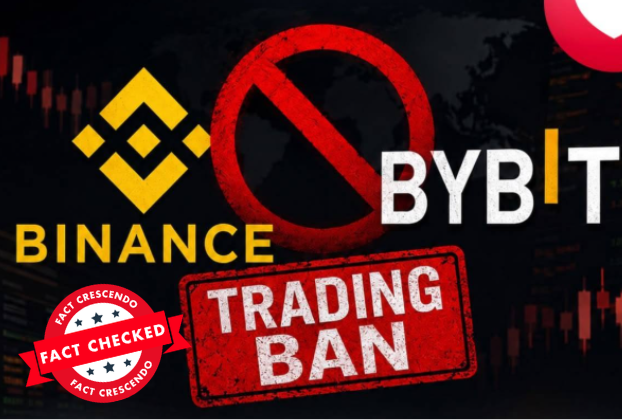
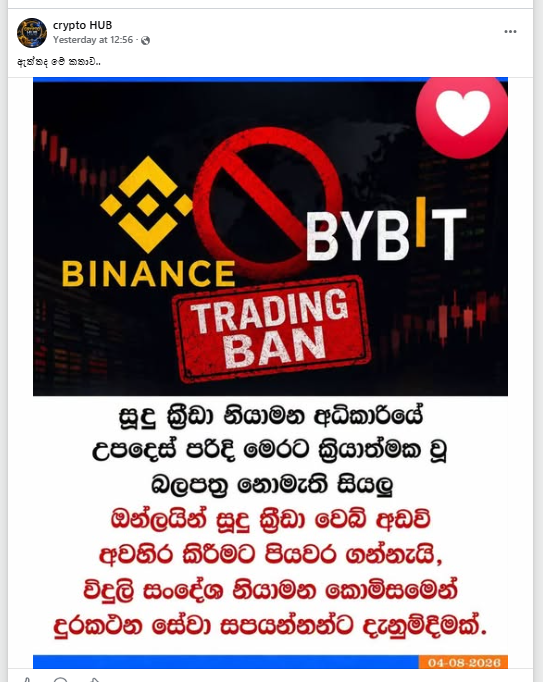
The post read: “The government has taken action to stop illegal gambling operations across the country. Since last night, steps have been taken to ban all gambling websites.” Its background image, however, prominently displayed the Binance and Bybit logos alongside the words “TRADING BAN,” framing the two exchanges as “gambling” platforms.

The same claim also spread inside crypto-focused Facebook groups, as shown below.
Fact-Check
According to an official statement from the Ministry of Digital Economy, 24 illegal online gambling and betting websites operating without valid local licences were blocked with immediate effect.
Acting on notification from the Gambling Regulatory Authority (GRA), established under the Gambling Regulatory Authority Act, No. 17 of 2025, the Telecommunications Regulatory Commission of Sri Lanka (TRCSL) directed all telecommunications service providers to block these websites.
The 24 illegal online gambling and betting websites ordered blocked with immediate effect
1. 1xbet.com
2. bet365.com
3. stake.com
4. betway.com / betway.com/en-lk
5. 22bet.com
6. melbet.com
7. unibet.com
8. betfair.com
9. dafabet.com
10. 1win.com
11. spinbetter.com
12. 10cric.com
13. bc.game
14. megapari.com
15. pin-up.bet
16. mostbet.com
17. parimatch.com
18. betwinner.com
19. linebet.com
20. 4rabet.com
21. rajabets.com
22. dbbet.com
23. coldbet.com
24. WinWin
No cryptocurrency exchange website (Binance or Bybit) appears anywhere on the list.
The Central Bank of Sri Lanka (CBSL) does not recognise cryptocurrency as legal tender within the country and has issued risk advisories about its use. But no new law has been passed prohibiting Sri Lankans from trading on platforms such as Binance.
That said, “not banned” should not be mistaken for “regulated” or “safe.” Crypto trading remains, yet, unregulated by law in Sri Lanka, and no government or legal protection exists if funds are lost. Under the Foreign Exchange Act, No. 12 of 2017, using bank-issued debit and credit cards for cryptocurrency transactions is prohibited.
And while cryptocurrency holds no legal-tender status, the government has clarified that earnings from it remain subject to income tax, as reported here.
Binance is the world’s largest crypto exchange – not a gambling site
Binance is the world’s largest and most popular cryptocurrency exchange by daily trading volume. It lets users buy, sell, and store hundreds of cryptocurrencies, including Bitcoin and Ethereum.
In Sri Lanka, the platform’s Peer-to-Peer (P2P) network is its most widely used feature, letting Sri Lankans buy and sell crypto directly in rupees (LKR) through bank accounts (Commercial Bank, HNB, Sampath) or local methods such as EzCash and mCash.
It also offers spot trading, futures trading and Binance Earn, which pays interest on deposited crypto.
In 2023, Binance reached a record US$4.3 billion settlement with the U.S. Department of Justice over money-laundering and sanctions-violation charges, and its founder pleaded guilty. Futures and leveraged trading carry a substantial risk of loss for retail traders.
Bybit is a leading global exchange, not on the blocklist
Bybit is a leading global cryptocurrency exchange that has grown quickly, both worldwide and in Sri Lanka. Like Binance, it enables crypto trading, but it is best known for its fast, high-grade futures and derivatives technology.
Bybit also runs a thriving LKR P2P market. When Sri Lankan traders hit account-verification (KYC) issues or legal restrictions on Binance, many turn to Bybit as their main alternative. Its customer support is highly efficient, and it leads on listing new coins through its Launchpad.
Because bank cards remain blocked, Sri Lankans transact on both platforms only through the legally secure P2P route – direct, person-to-person bank transfers.
In February 2025, Bybit suffered the largest crypto theft in history, with US$1.5 billion in Ethereum stolen by North Korea’s Lazarus Group. No exchange is entirely secure: deposit vulnerabilities, hacking and withdrawal limits are all real risks.
What the Central Bank and government have actually done on online gambling
The Central Bank of Sri Lanka (CBSL) and the Ministry of Finance are jointly enforcing strict measures to protect the financial system and curb the illegal outflow of foreign exchange. The Central Bank’s Financial Intelligence Unit (FIU) is working with commercial banks to prevent money laundering and illegal transfers abroad through online gambling websites.
Central Bank rules restrict the direct use of Sri Lankan bank-issued credit and debit cards, and other local electronic payment channels, for foreign online gambling sites.
Through its Be Scam Proof campaign, the Central Bank continues to warn the public about the financial harm caused by online fraud and gambling-site “investments.”
Join us to learn more about our fact-check investigations.
Facebook | Twitter | Instagram | Google News | TikTok
Conclusion
The posts circulating on social media are misleading. The government and regulators have banned only unlicensed online gambling and betting websites, as confirmed by the Ministry of Digital Economy and the TRCSL acting on the Gambling Regulatory Authority. Cryptocurrency platforms such as Binance and Bybit have not been banned.
However, “not banned” does not mean “safe” or “legally protected.” As the Central Bank of Sri Lanka has repeatedly cautioned, crypto remains a system without a proper regulatory framework, and crypto trading must be undertaken entirely at one’s own risk.
Title: Crypto Crackdown? Debunking Claims That Binance and Bybit Are Banned in Sri Lanka
Fact Check By: Pavithra Sandamali
Result: Misleading