
Subscribe to our WhatsApp Channel
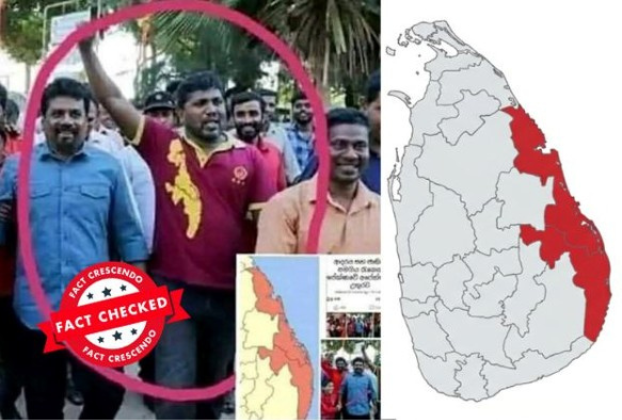
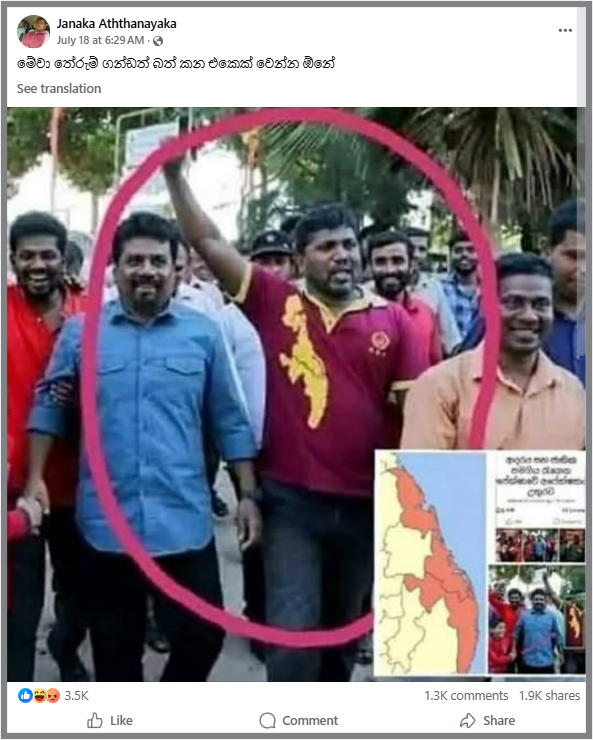
Every so often, a single photograph resurfaces in Sinhala feeds with an explosive caption: at a rally beside President Anura Kumara Dissanayake stands a man in a T-shirt “symbolising Eelam,” supposedly proof that separatists back the President. The image has been recycled for years, each time under a new theme. We ran it down. Here is what the picture actually shows.
Social Media Posts
Framing it as the reason groups that call for a separate Eelam state supposedly favour President Anura, these posts have circulated repeatedly over the past several years under various themes, as shown below.
Facebook | Archived Link | Facebook
Judging from the comments, users read the image as a photo taken during a northern visit by President Anura Kumara Dissanayake, claimed the man beside him wore a shirt printed with a portion of Sri Lanka’s map marked off, and shared it as though it showed a pro-Eelam march in Jaffna.
The photo is real – but it is from a 2019 NPP event in Jaffna
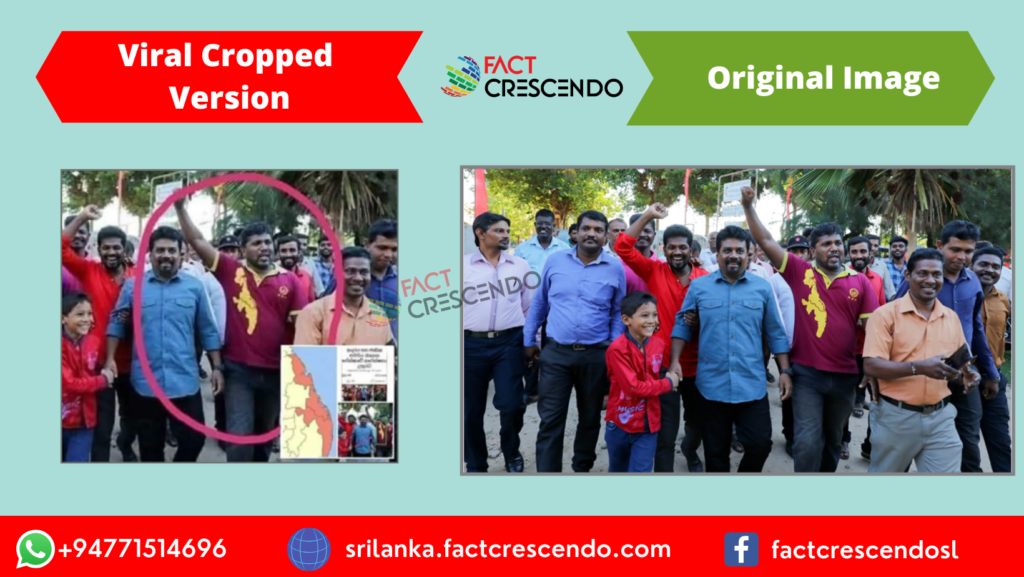
To find out when the photograph was taken and its true context, we ran a reverse image search. It traced back to 2019, when Anura Kumara Dissanayake attended an event in Jaffna. Specifically, the image was captured at a reception during a conference at Jaffna’s Timmer Hall on 2 October 2019, roughly a month before the presidential election, which Dissanayake attended as the National People’s Power (NPP) candidate. Link | Archived
The version shared on social media is a cropped section of the original image. A comparison with the full photograph is shown below.
A report still live on the JVP’s official website carries a full series of photographs from that occasion, including the original from which the viral crop was taken. Several other images from the event, attended by figures including current Minister Ramalingam Chandrasekar alongside NPP supporters, appear below. All can be viewed here.
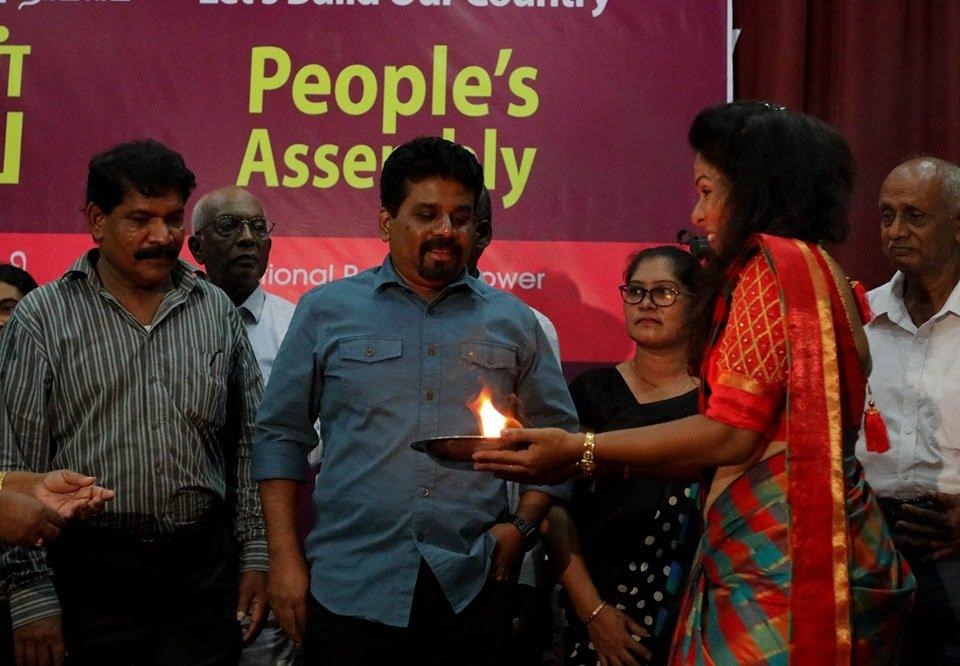
Aside from the individual discussed online, we found no evidence of anyone else at the event wearing that particular kind of T-shirt.
The T-shirt shows the Eastern Province, not Eelam
The design printed on the man’s shirt does not depict Sri Lanka’s Northern Province or any area called “Eelam.” While Sinhala-language posts present it as representing a demand for an Eelam state, what is actually printed on the shirt is Sri Lanka’s Eastern Province. Map
Under Sri Lanka’s Provincial Councils Act, the Eastern Province comprises three administrative districts: Batticaloa, Trincomalee and Ampara. Yet the photograph has been circulated as though the shirt were a symbol of a demand for Eelam.
What the Eelam map is, and whether it is in effect
The Eelam map is a political and geographical map used to mark out a territory covering Sri Lanka’s Northern and Eastern provinces. It is a theoretical map advanced during the LTTE’s armed struggle and by movements advocating Tamil Eelam, an independent state for Sri Lanka’s Tamil people.
Under that map, the Northern and Eastern provinces together are treated as the ancestral homeland of the Tamil people:
- Northern Province: Jaffna, Kilinochchi, Mullaitivu, Mannar and Vavuniya districts
- Eastern Province: Trincomalee, Batticaloa and Ampara districts
This combined eight-district territory is commonly labelled “Tamil Eelam” or “Eelam,” and some interpretations extend the claim as far as Puttalam, as shown here. The difference between Sri Lanka’s Eastern Province and the map of Tamil Eelam is shown below.
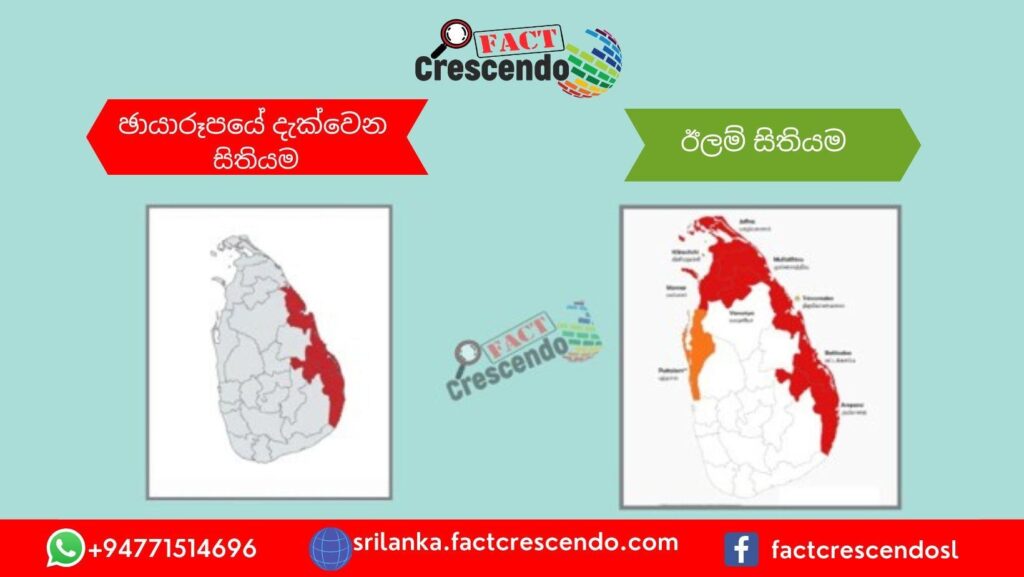
It is therefore clear that the man in the viral photograph was not wearing a shirt depicting Tamil Eelam; the design was Sri Lanka’s Eastern Province.
Historical background
Sri Lankan Tamil political parties and militants have long argued that the North and East, home to a Tamil majority for decades and rich in language, culture and tradition, form their ancestral homeland.
From the 1957 Bandaranaike–Chelvanayakam Pact and the 1965 Dudley–Chelvanayakam Pact onward, the demand to merge the Northern and Eastern provinces became a central theme of Sri Lanka’s national question. After the 1970s and 1980s, as organisations including the LTTE intensified the call for a separate Tamil Eelam, this merged North-Eastern territory came to be known within Tamil nationalist politics as the “Eelam map.”
Political and legal stance: As Sri Lanka is a unitary state under its Constitution, the government has rejected the Eelam map, and any merger of the North and East, as a threat to national sovereignty and a divisive theory undermining the country’s unity.
Indo-Lanka Accord (1987): Under the Rajiv Gandhi–J.R. Jayewardene Accord, the Northern and Eastern provinces were temporarily merged into the “North-Eastern Provincial Council.” Following a Supreme Court ruling, that merger was legally invalidated on 16 October 2006, and the two were again separated into distinct provinces.
Current status: Today the Eelam map exists only as a broad political symbol – one recalling the historical rights, right to self-determination and political aspirations of Sri Lanka’s Tamil people – rather than any independent state or administrative territory that actually exists within Sri Lanka. Link
What the Person who actually wore the shirt says
The debate arose because a man attending the 2019 Jaffna conference, where the JVP leader spoke, wore a shirt depicting the Eastern Province.
Continuing our investigation, we found that this individual, identified as Puyal Nesan, had posted the very same photograph on his Facebook page with a caption stating that his position had not changed, that he is not a “political vendor,” and describing himself as an independent writer.
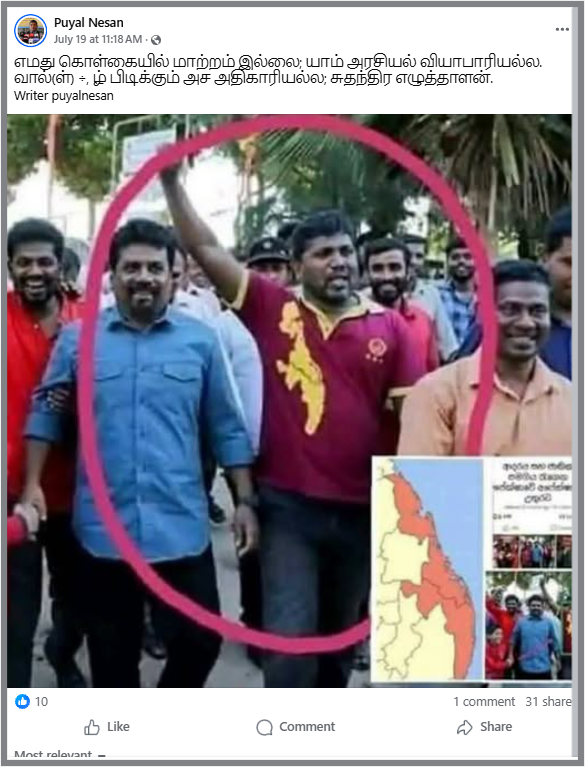
We reached Puyal Nesan by phone to ask about the shirt and the 2019 Jaffna event. He explained that he had worked as a teacher and that a fellow teacher had given him the shirt. It had been printed for the North-Eastern National Sports Festival in 2002, when the Northern and Eastern provinces were still merged, and the logo it bore stood for exactly that: NEP (Northeastern Province).
He added that in 2019 no one at the meeting was given special clothing to wear; he had simply happened to wear that shirt that day, by coincidence.
He said he had seen posts using the photo to suggest it represented Eelam and to show division, which is precisely why he published his clarifying post. He reiterated that the design showed not Eelam but the Eastern Province.
Because the shirt was tied to a national sports tournament held over two decades ago, in 2002 – before today’s social media and mobile photography were widespread – he was unable to locate photographs from the event despite searching again. Searching online for the 2002 festival, we identified a Daily News archived report documenting it but could not obtain photographs from the occasion. Records of the 2002 festival also appear on the Department of Sports Development’s website, but again with no photographs from the event.
A 2019 clarification, corroborated by Minister Ramalingam Chandrasekar
Running the shirt photo through a reverse image search led us to a post featuring images of the same shirt on a Facebook page called JVP Canada. Here | Archived
When the photograph first went viral in 2019, a post presented carrying statements from Minister Ramalingam Chandrasekar included several close-ups of the shirt and an image of its reverse side. It stated that the shirt’s front showed the Eastern Province along with the North-Eastern Province emblem, that it was the attire worn by athletes at a national sports tournament, and that these T-shirts were issued to players representing the North and East when the two provinces were merged – with every competing athlete wearing a shirt bearing their own province’s emblem. Photographs from that post appear below.
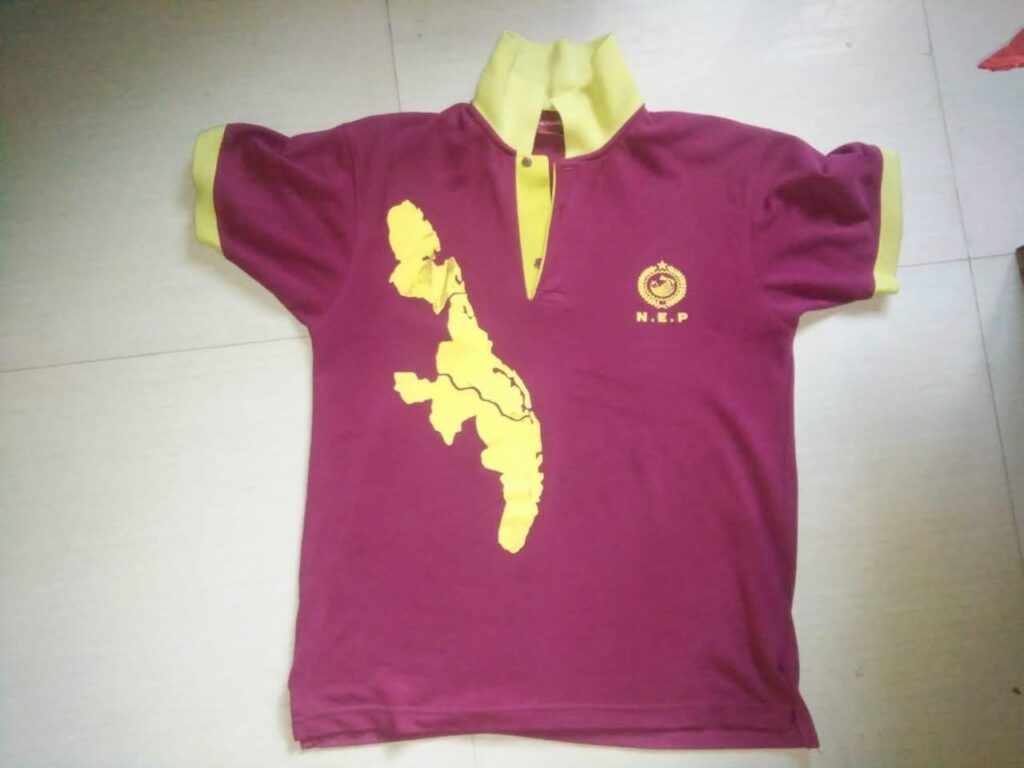
A comparison with the T-shirt worn by the man in the viral photograph is shown below.
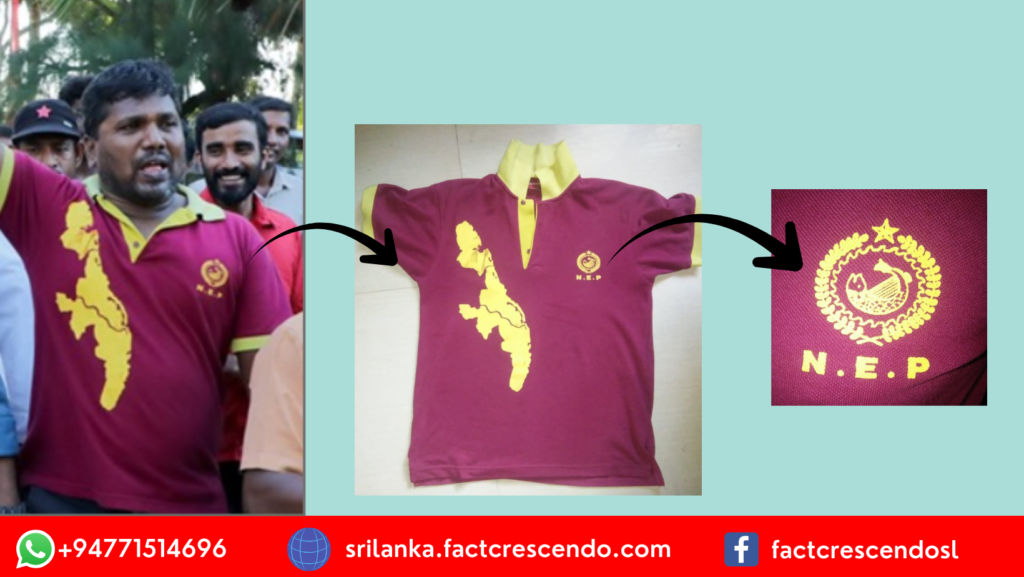
Because photographs from the occasion confirm that Minister Ramalingam Chandrasekar himself attended the 2019 JVP-NPP gathering in Jaffna, we contacted him by phone for more details.
He confirmed the photograph was genuine, taken at the 2019 event attended by President Anura Kumara Dissanayake under the NPP’s leadership. He clarified that the shirt was not specially printed for that occasion and that no one else present that day wore a similar one.
He noted that because the shirt had already sparked significant discussion in 2019, an investigation was carried out then and the findings released, and that the shirt the man happened to wear is now being recirculated with a distorted meaning for political gain. The Minister emphasised that the NPP government has never supported demands for an independent state and continues to lead the country on the principle that all citizens are equal.
He further explained that the shirt had been worn by athletes at the National Sports Festival before 2006 to represent the Eastern Province – a fact that emerged during his own 2019 investigation, corroborated by a Facebook post published at the time.
The ‘NEP’ emblem belongs to the pre-2006 merged North-Eastern Province
Since the “NEP” emblem on the shirt matches the one used when the Northern and Eastern provinces were merged, we investigated further. We identified documentation on the Northeastern Province’s flag, used before 2006 (also here). The flag, adopted in 1987 and discontinued in 2006, can be viewed at those links.
We also found that the Northeastern Provincial Zonal Department of Education used the very logo on the shirt in its own publications. The logo appeared in a publication from a Tamil-language festival in the Northeastern Province, as seen here. This suggests the emblem is connected to that education department. A comparison with the shirt logo is shown below.
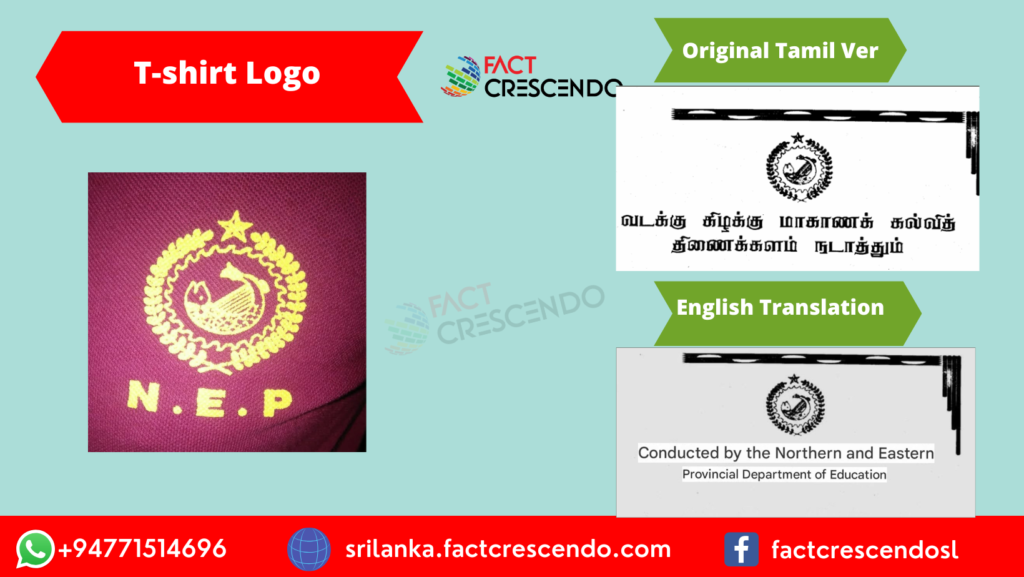
Further checking showed the emblem was used in several publications by the education department affiliated with the merged province before 2006. After the 2006 separation, publications were issued bearing the emblem still used today for the Eastern Province, as shown here.
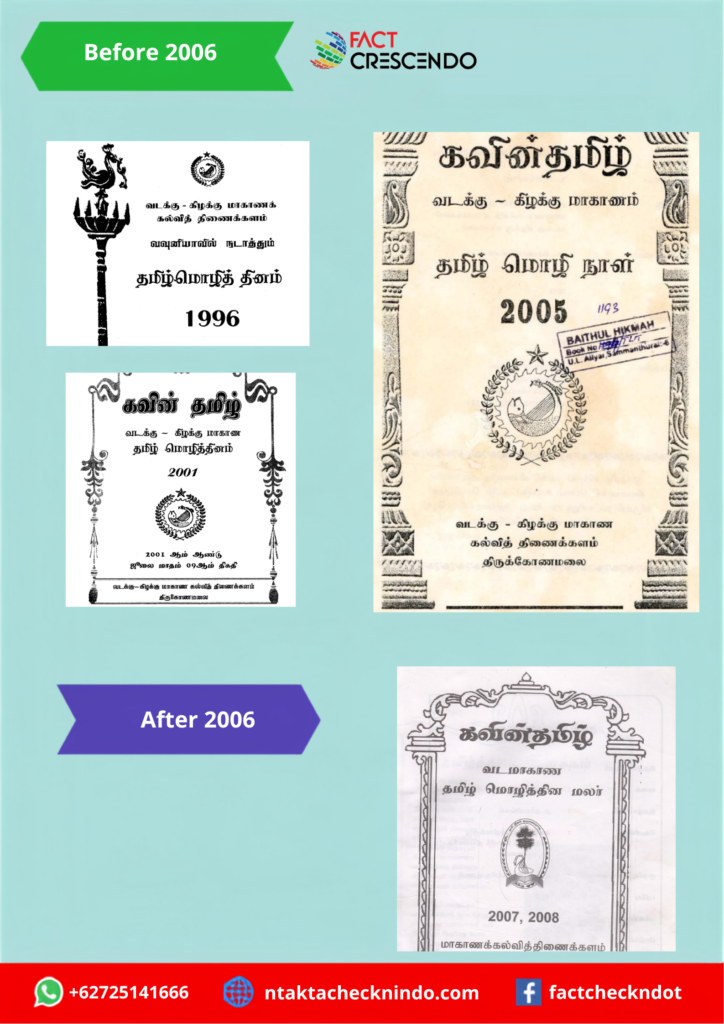
Eastern Provincial Council: records from 2002 no longer held
Since the shirt was reportedly worn by athletes at the 2002 National Sports Festival to represent the Eastern Province, we contacted the Education and Sports Department of the Eastern Provincial Council. The coordinating officer who responded said only records from roughly the past 10 years are held there, and that no records survive from 2002; records may also have been separated after the 2006 division. Asked specifically about the emblem, he said no documentation on it currently exists but that he would investigate it and get back to us. We intend to update this article once he responds.
Join us to learn more about our fact-check investigations.
Facebook | Twitter | Instagram | Google News | TikTok
Conclusion
The photograph circulating for years, purportedly showing a man in a T-shirt “representing Eelam” beside President Anura Kumara Dissanayake, is misleading. The image is genuine – taken on 2 October 2019, before the presidential election, at an NPP gathering in Jaffna – but the design on the shirt is not the Eelam map. It is Sri Lanka’s Eastern Province (Batticaloa, Trincomalee and Ampara), and the “NEP” emblem it bears dates to the pre-2006 period when the Northern and Eastern provinces were merged.
The shirt’s wearer, Puyal Nesan, a retired teacher, confirmed by phone that it was printed for the 2002 North-Eastern National Sports Festival, given to him by a colleague, and worn that day by coincidence. Current Minister Ramalingam Chandrasekar corroborated this, confirming the shirt was not designed for the occasion and that the NPP has never supported demands for an independent state. Our own checks found the emblem in pre-2006 education-department publications from the merged province. Presenting the photo as “evidence of Eelam’s support for Anura” is a genuine image shared with a politically distorted meaning.

Title: Old Photo, New Lies: The Truth Behind a Recurring Eelam–Anura Claim
Fact Check By: Pavithra Sandamali
Result: Insight