
Subscribe to our WhatsApp Channel
After a horrific late-night crash in Katana killed two young riders, and the driver of the container truck involved told reporters that two NS 200s had come at what looked like 150–200 km/h, social media lit up with posts claiming that Sri Lanka had officially banned the popular NS 200 motorcycle. For thousands of riders and owners, that was alarming. We investigated. Here is what we found.
Social Media Posts
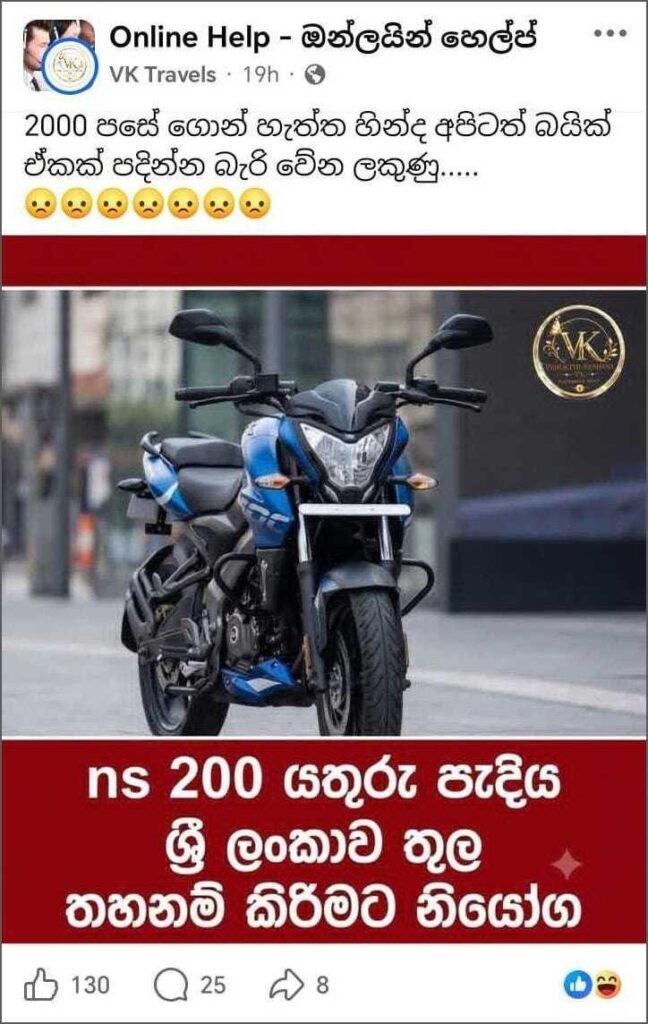
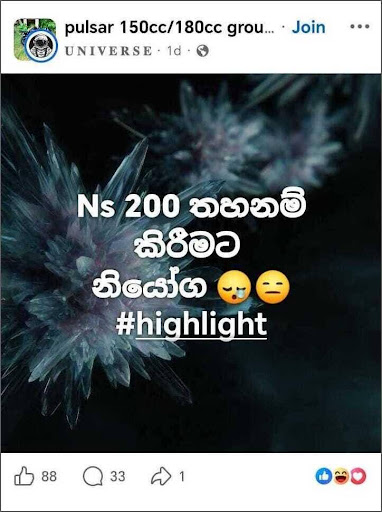
Fact Check
Had the NS 200 been banned in Sri Lanka, the Sri Lanka Police and mainstream media would have informed the public officially. Our investigation found no confirmation of any such ban from any official source, so we sought clarification directly from the relevant authorities.
Sri Lanka Police
In response to our inquiry, the Police Media Division confirmed that the motorcycle has neither been banned nor is any ban being considered.
Ministry of Transport, Highways and Urban Development
In response to our inquiry, the Media Secretary to the Minister of Transport, Highways and Urban Development, Bimal Rathnayake, said that social media claims alleging the NS 200 has been banned are false, and confirmed that there are no plans to ban it.
The claim began circulating after a fatal accident in Katana. At around 11:00 p.m. on July 29, 2026, two young men riding separate motorcycles were killed in a collision in the Bolawalana area of Dagonna, Katana. In a statement to the media, the driver of the container truck involved said, “Two NS 200 motorcycles came at what seemed to be around 150–200 km/h.”
This is what sparked the online controversy around the NS 200s involved in the crash. Further details can be seen here and here.
David Peiris Motor Company (DPMC)
Bajaj motorcycles and spare parts, including the Bajaj Pulsar NS 200, are imported and distributed in Sri Lanka by the David Peiris Motor Company (DPMC), so if the model had been banned, the company would have been aware of it. In response to our inquiry, DPMC confirmed that the social media posts claiming the NS 200 has been banned are completely false, and its management said that imports of the model are continuing without any interruption.
The NS 200’s normal top speed is between 136 and 140 km/h. Pushing the motorcycle beyond these limits can cause the engine to surge suddenly, which is difficult to control and can be dangerous. Prolonged high-speed riding can also overheat the engine and burn out the clutch plates, which can make the bike stall or judder mid-ride and set the stage for accidents.
Although the motorcycle is fitted with dual-channel ABS and a large disc brake (a 300mm front disc) to stop the wheels skidding at high speed, exceeding the top speed can still make braking hard to control and lead to accidents. More details can be found here, here and here.
Motorcycles That Are Prohibited on Public Roads
Under Sri Lanka’s Motor Traffic Act and police regulations, several categories of motorcycle are prohibited on public roads and are subject to enforcement. In Sri Lanka, only motorcycles with engine capacities up to 450cc can be registered and legally ridden on public roads. High-capacity motorcycles from 450cc up to 1001cc are completely barred from public-road use. (For example, models such as the Yamaha R1, Suzuki Hayabusa, Kawasaki Ninja ZX-10R and Honda CBR1000RR cannot be legally ridden on public roads.)
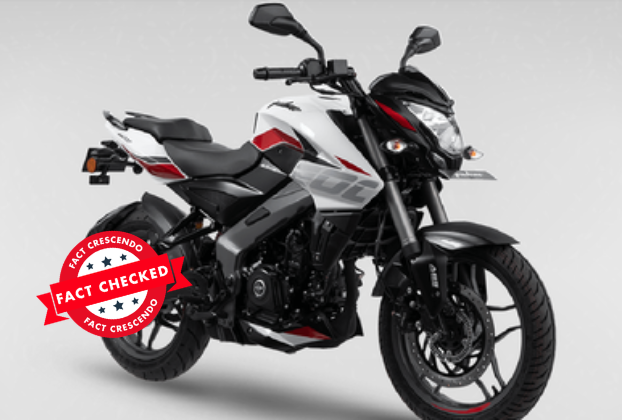
The much-discussed NS 200 (Bajaj Pulsar NS 200) has an engine capacity of 199.5cc, which is below the prohibited limit. There is therefore no ban on riding it in Sri Lanka. However, motorcycles of any capacity that are illegally imported in parts and assembled locally, or that carry forged chassis numbers or fraudulent registration documents, are completely prohibited. More details can be found here and here.
Even if a motorcycle is legally registered, the Sri Lanka Police may prohibit its use and seize it if any of the following modifications have been made:
- Excessively loud silencers — motorcycles fitted with silencers that produce excessive noise, disturbing the environment and the public.
- Unauthorised lighting systems — motorcycles fitted with flashing multi-coloured lights or unauthorised LED bulbs.
Join us to learn more about our fact-check investigations.
Facebook | Twitter | Instagram | Google News | TikTok | YouTube
Conclusion
Our fact-check confirms that claims the NS 200 motorcycle will be banned in Sri Lanka are false. This was verified by the Sri Lanka Police and by the Ministry of Transport and Highways.
Under Sri Lankan law, certain motorcycle categories are barred from public-road use, including high-capacity motorcycles above 450cc. Since the NS 200 has an engine capacity of 199.5cc, it does not exceed the restricted limit. There is therefore no ban on riding this motorcycle in Sri Lanka.
Title: No, the NS 200 Has Not Been Banned in Sri Lanka ; Here’s What the Law Actually Says!
Fact Check By: BP Hansani
Result: False