

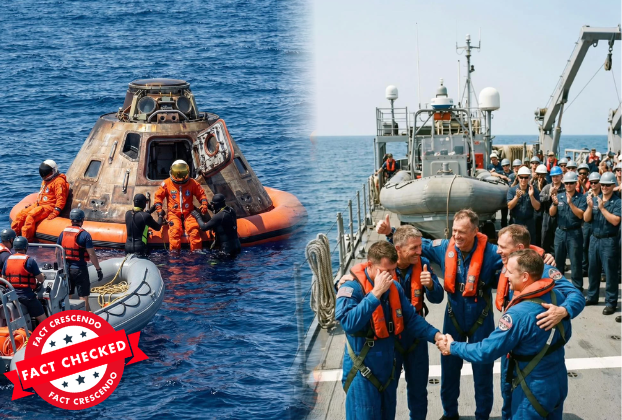
NASA’s Artemis II mission successfully concluded in April 2026 with a splashdown in the Pacific Ocean. Social media posts share a set of images claiming to show the return of NASA’s Artemis II mission to Earth, highlighting details such as high-speed reentry and splashdown recovery. However, the accompanying images appear highly stylized and cinematic, raising questions about their authenticity. We found that the viral images used in the post are AI-generated and do not represent real mission footage.
Social Media Posts
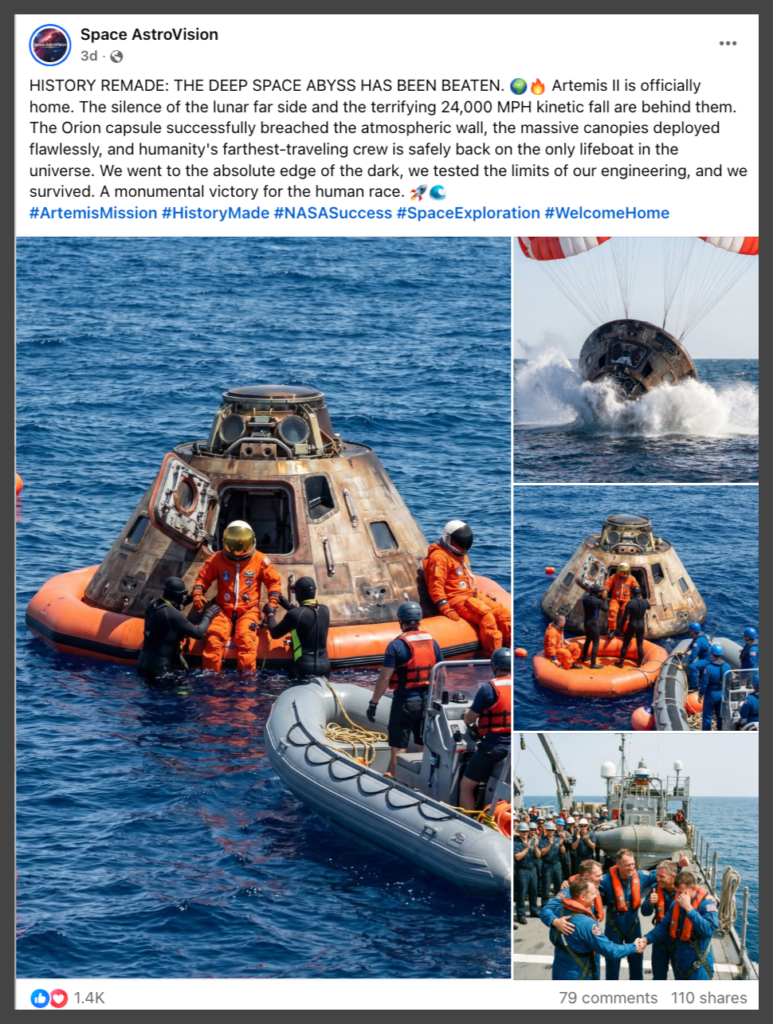
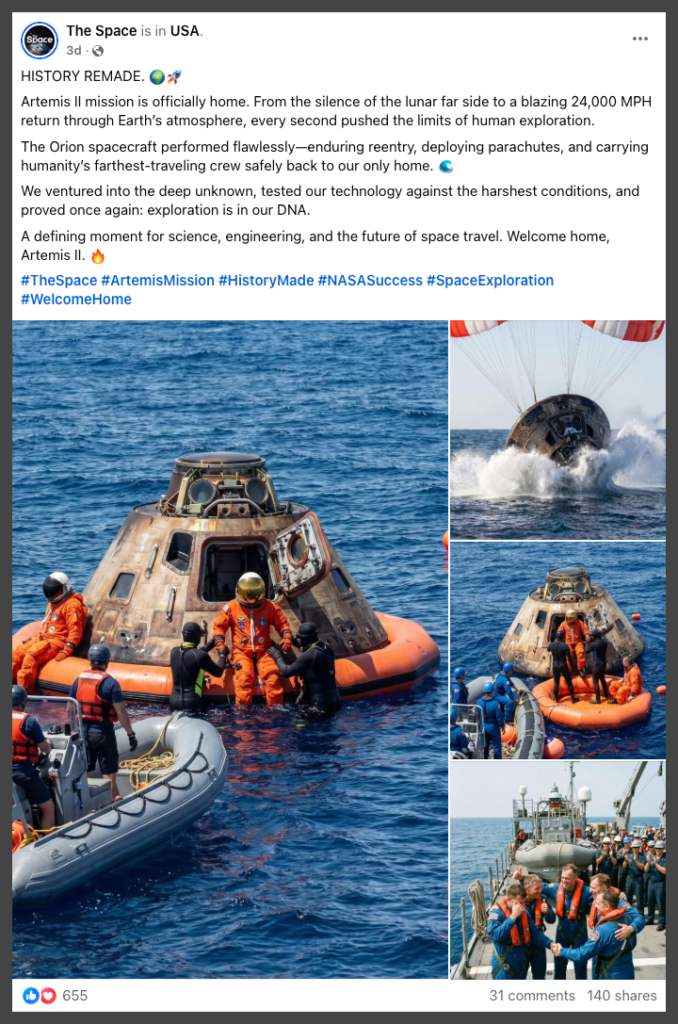
The post includes multiple images showing a capsule splashing down in the ocean, astronauts in orange suits exiting the spacecraft, and recovery teams assisting in open water, as well as a celebratory scene on a naval vessel. These images are gaining wide traction.
Fact Check
What Actually Happened During Artemis II Recovery
According to official NASA documentation , the Orion spacecraft from the Artemis II mission splashed down in the Pacific Ocean after reentering Earth’s atmosphere at speeds of around 25,000 mph. After splashdown, recovery operations followed a highly controlled and pre-planned sequence. U.S. Navy divers were the first to approach the capsule using small inflatable boats to stabilize it and attach recovery hardware.
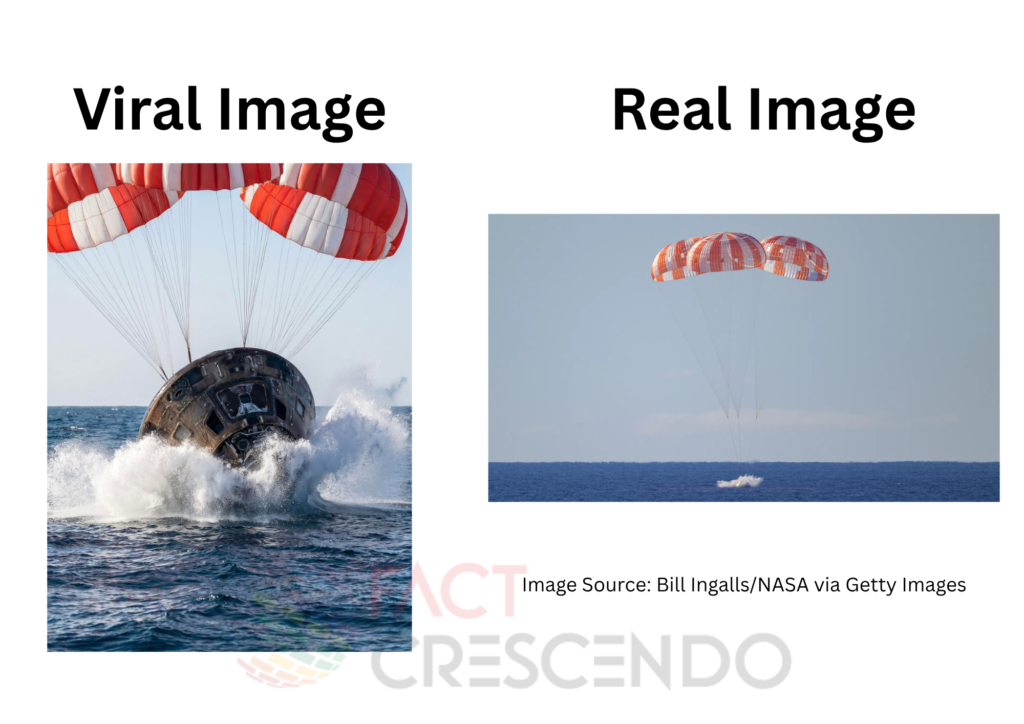
Official NASA imagery and recovery documentation describe a structured, safety-controlled process: after splashdown, astronauts remain inside the capsule while recovery teams secure it and attach an inflatable platform (“front porch”). The crew then exits onto the raft for transfer and extraction without entering the ocean. Verified mission coverage from Axios confirms that U.S. Navy teams recovered the astronauts and transported them by helicopter to a recovery ship after splashdown, rather than leaving them in the water.
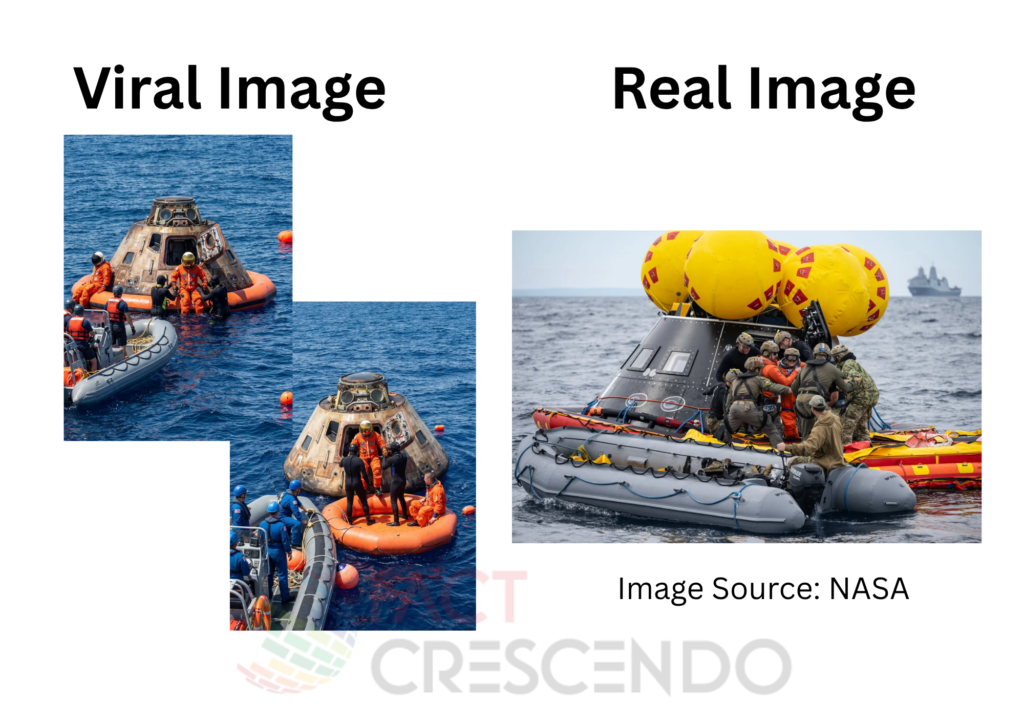
Verified footage shows that astronauts are first assisted out of the Orion capsule onto a stabilized inflatable raft (“front porch”), where recovery personnel help secure them before extraction. They are then hoisted individually into a helicopter for transport to a recovery ship (see here). At no point are astronauts seen standing or being handled freely in open water, as depicted in the viral images.
Source: CNN
Why Astronauts Are Not Recovered in Open Water
NASA does not recover astronauts directly in open water because it is unsafe right after landing. After a spaceflight, many astronauts experience short-term effects from microgravity, including weaker muscles and worse coordination and balance. NASA notes that spaceflight can “realign your sense of balance” and affect multiple body systems, so it takes time to readjust after returning to Earth (Source). Research also shows that microgravity disrupts the vestibular system, which helps control balance and spatial orientation. When gravity returns, astronauts can feel disoriented, dizzy, or unsteady.
NASA research also found that balance control is often significantly reduced immediately after spaceflight, making it harder to stand or walk safely.
Because open water is an unstable environment, recovery teams use a controlled sequence instead: astronauts move onto a secured inflatable raft and are then lifted by helicopter for quick medical checks and safe transport.
Crew Composition
The Artemis II mission includes a four-member crew: Reid Wiseman, Victor Glover, Christina Koch, and Jeremy Hansen. Notably, Christina Koch is a female astronaut and a prominent member of the mission, marking an important milestone for NASA’s Artemis program. (Source)
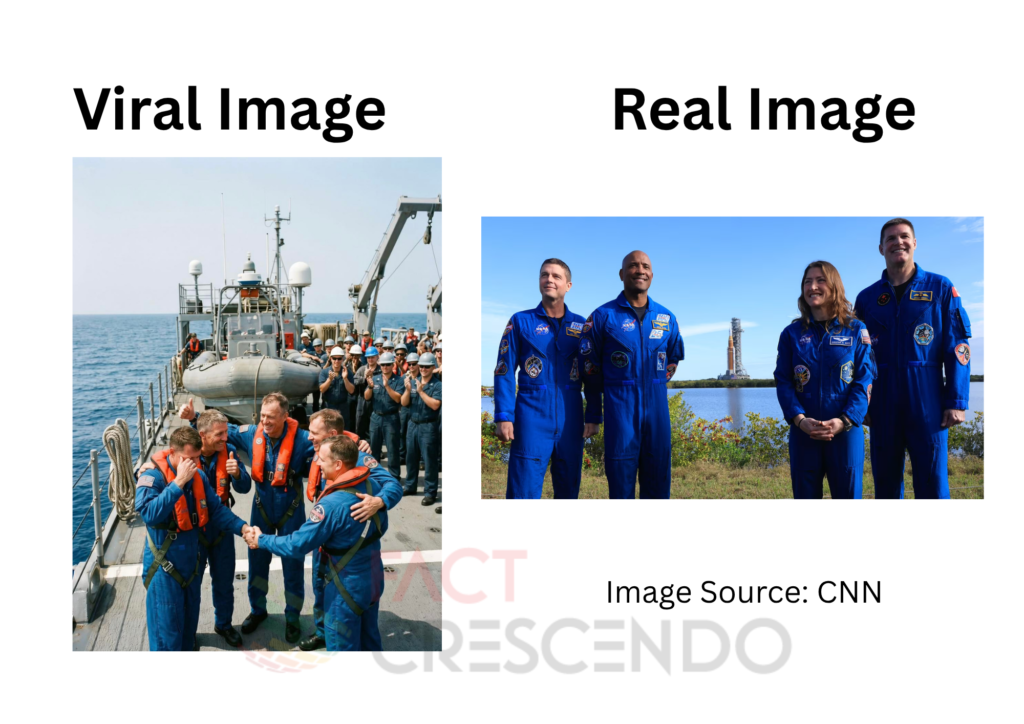
This detail provides a clear reference point when verifying visual content. In the viral images, the astronauts shown either appear to be all male or do not clearly match the known Artemis II crew. The absence of a recognizable female crew member further indicates that these visuals are not authentic representations of the mission.
Viral Image Analysis
We also used Hive Moderation, an AI image detector, to assess whether these images were AI-generated. The results indicate that each image has a greater than 99% likelihood of being AI-generated.
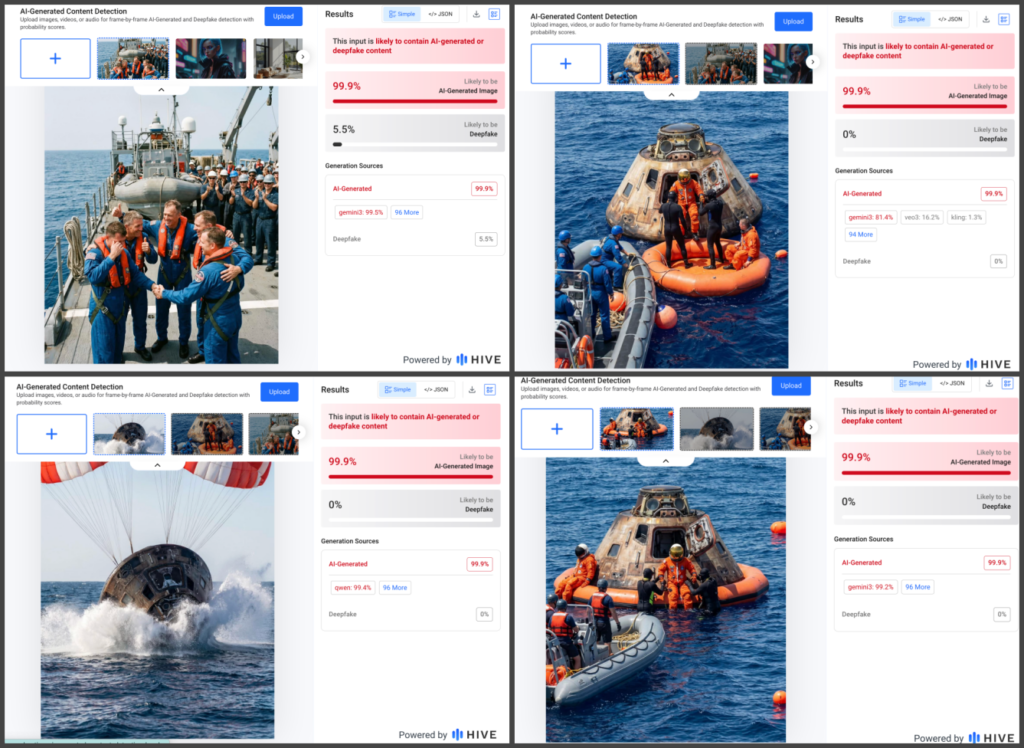
Moreover, the images themselves display characteristics commonly associated with AI-generated visuals. These include overly cinematic lighting, unusually clean spacecraft surfaces despite extreme reentry conditions, and subtle distortions in equipment and human proportions.
Conclusion
The viral images are misleading and highly likely to be AI-generated. While they are presented as documentation of NASA’s Artemis II recovery, they do not match verified footage or official recovery procedures. In reality, astronauts are transferred onto a stabilized raft and airlifted by helicopter without entering open water, and the mission crew includes a female astronaut. The visuals therefore create a false and inaccurate representation of the event.

Title: Viral “Artemis II splashdown” images are AI-generated, not real NASA photos
Fact Check By: Pranpreeya
Result: Misleading