
දිනපතා සත්ය කරුණු දැන ගැනීමට අපගේ WhatsApp චැනලයටමෙතනින් එකතුවන්න.
A road currently under development in the Eheliyagoda area has recently become the subject of public debate. Viral social media posts claim that the road’s drainage system had been constructed at a higher level than the road itself. However, Fact Crescendo conducted a fact-finding investigation into the matter. Let’s look at the viral posts first.
Social Media Posts:
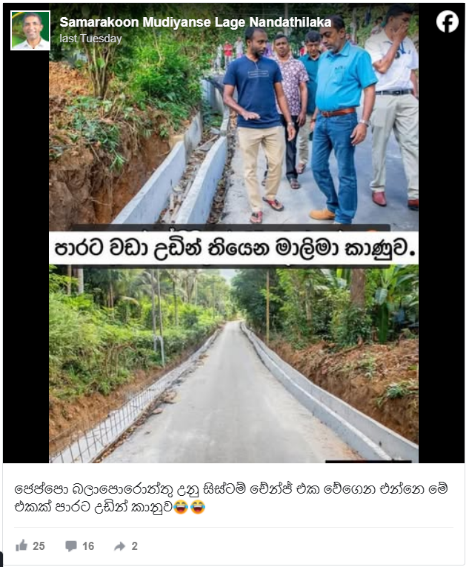
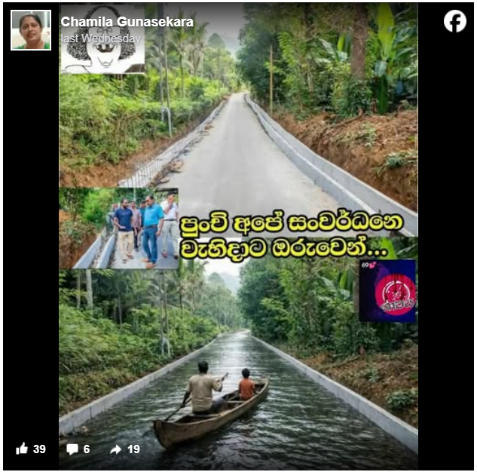
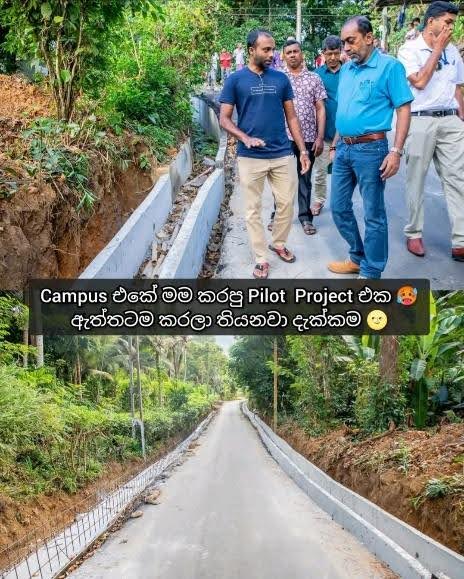
Viral Facebook posts based on a photograph shared on the official Facebook page of the Minister of Buddhasasana, Religious and Cultural Affairs, Dr Hiniduma Sunil Senevi, claimed that, “This is something that has never been done in Sri Lanka; it is like how Japan raises goldfish in drainage beside the road.”
Through this, the posts attempt to imply that the drainage system being constructed on both sides of the road is higher than the road itself.
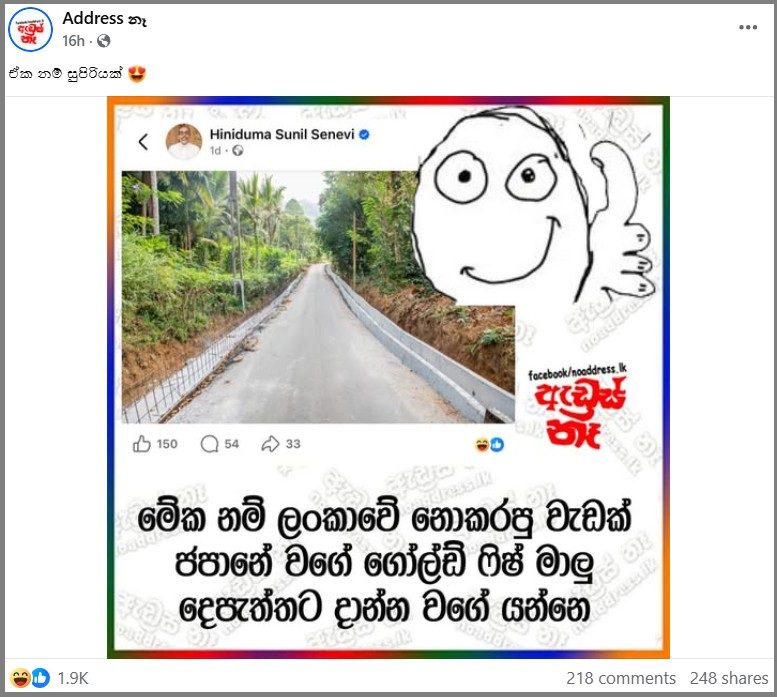
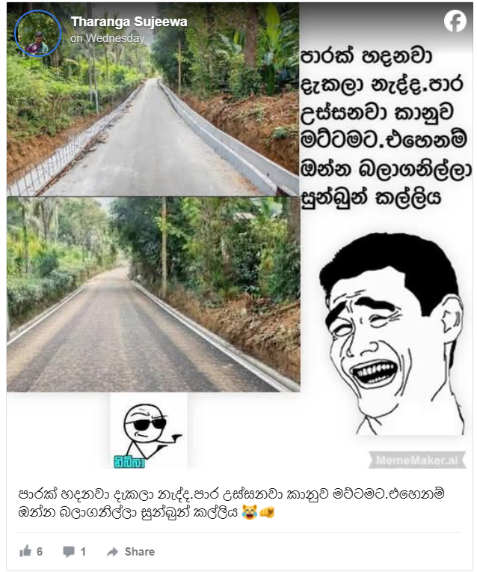
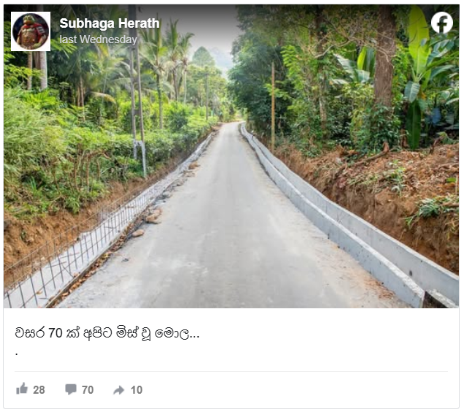
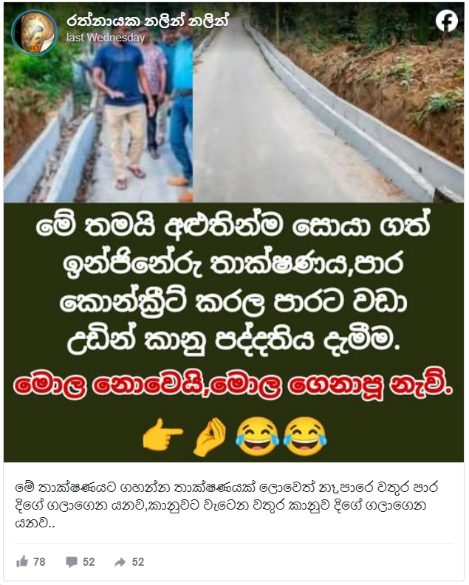
These claims were widely shared across Facebook, with many users believing them to be true, while some mocked the NPP government for constructing such roads.
Claim 2:
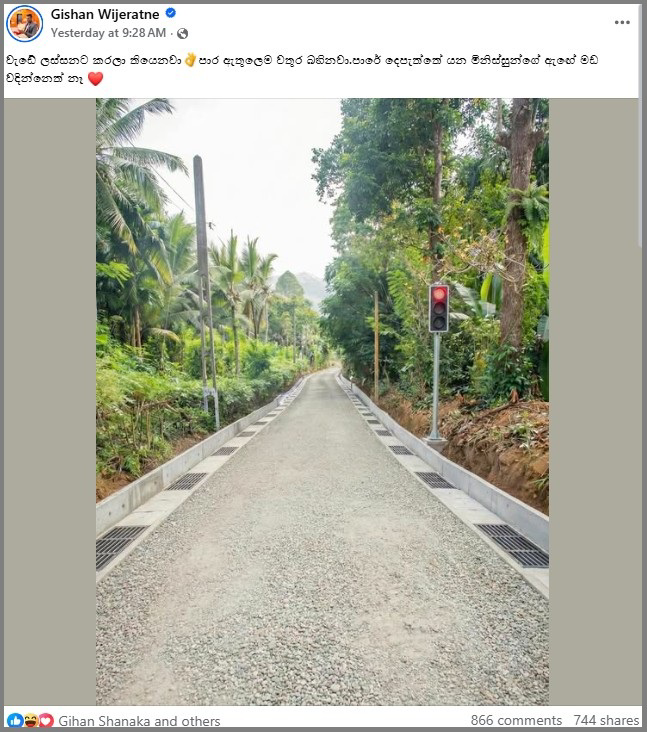
Another series of posts implied that the work had been completed on the road, alongside an image, indicating that the road level had been raised during construction to the drainage level.
Therefore, we carried out a fact-checking investigation to determine the actual status of the road, which has become a topic of public discussion.
Fact Check:
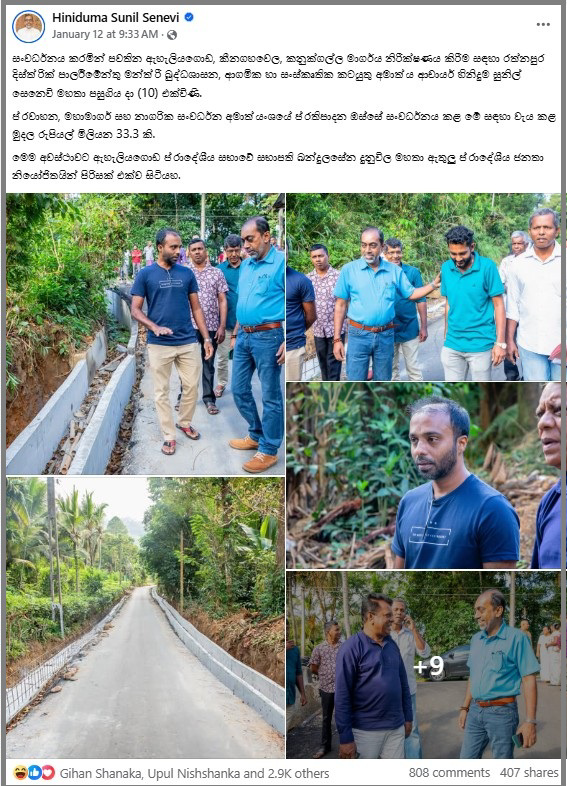
As it was clear that the photograph circulating on Facebook had been taken from the official Facebook page of Minister Hiniduma Sunil Senevi, we first reviewed the minister’s official account. Accordingly, we observed a post published on January 12, along with several photographs, showing the progress of development work on the relevant road.
The post stated as follows: “Ratnapura District Member of Parliament and Minister of Buddhasasana, Religious and Cultural Affairs, Dr Hiniduma Sunil Senevi, recently visited the Eheliyagoda, Keenagahawela, Kanukgalla road, which is currently under development, for an inspection on January 10.” Facebook | Archived
However, a review of the post’s edit history showed that the initial caption had been edited, and the original caption had stated that it was a completed road, which had added to the confusion.
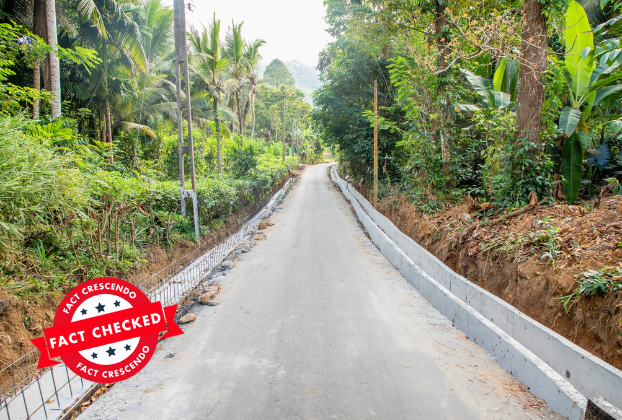
One of the photographs, in particular, appeared to show the drainage system at a higher level than the road surface. As a result, many sarcastic comments were shared on social media, claiming that instead of draining water away, the drainage system was allowing water to flow back onto the road.
However, a closer examination of the relevant photographs shows that the road development has not yet been completed, and that construction work is still ongoing.
Shown below is how the Minister’s Facebook post, which was later updated, clearly shows photographs of a road currently under development.
As road and drainage systems are designed and constructed according to engineering plans by the Road Development Authority, we first closely examined and enlarged the relevant photographs to determine whether there was any actual fault in the road design, or whether the viral social media posts had been shared due to a misunderstanding.
Closer examination of the viral photograph
Upon closer inspection, it was seen that near the bend, the drainage system had been built at the same level as/slightly below the level of the road.
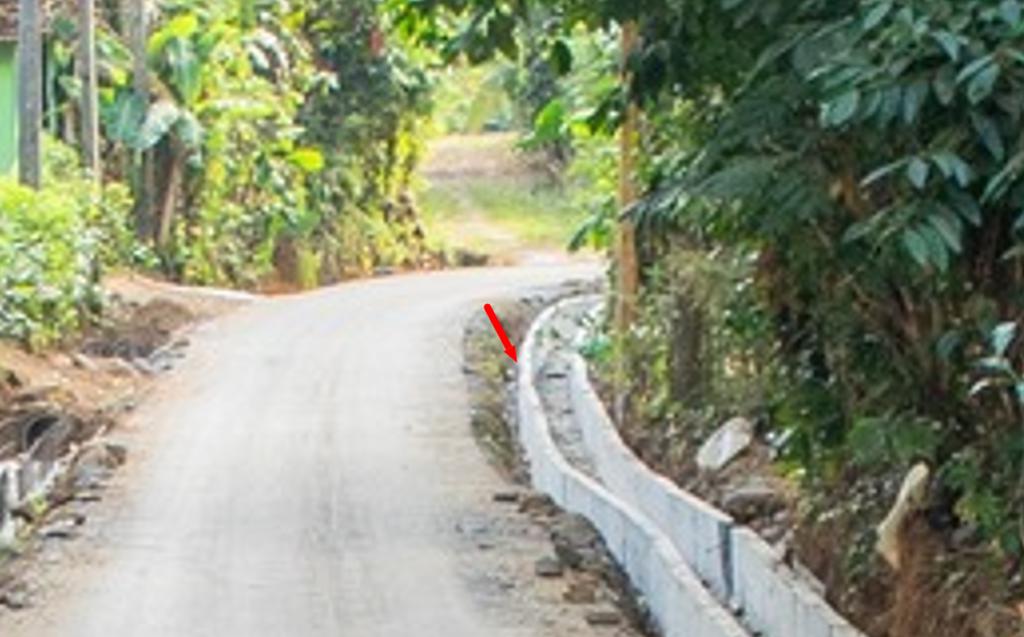
Further zooming in on the photograph shows that the road and the drainage system are almost at the same level. Below is a section of the viral photograph enlarged by 300%
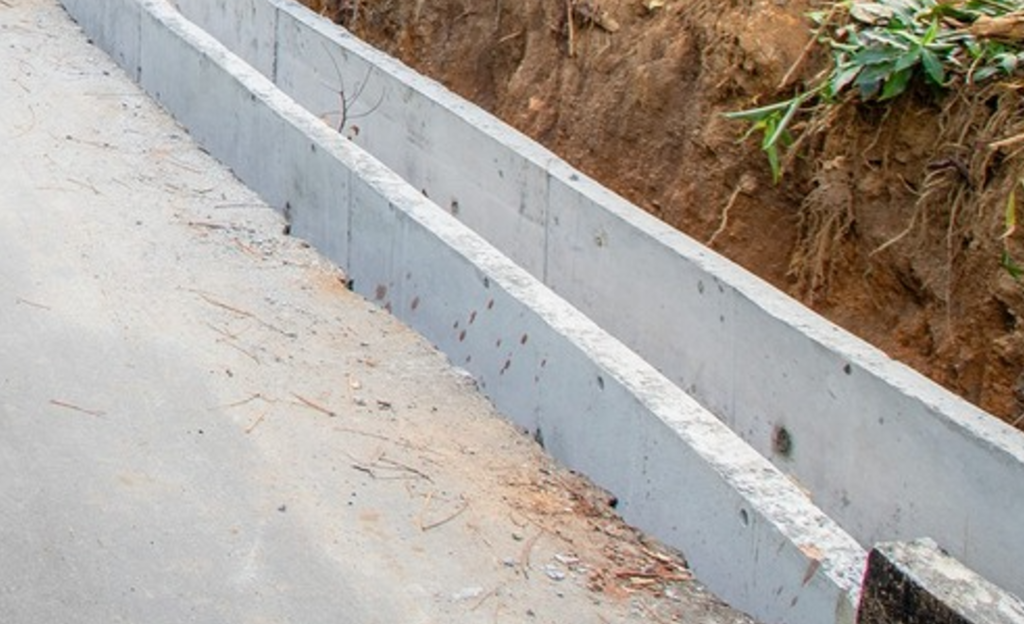
But here, the gap between the road’s edge and the starting edge of the drain is obvious. Given the unfinished state of the road, we made the decision to conduct a thorough investigation.
Eheliyagoda, Keenagahawela Regional Reporter.
To check the actual condition of the Eheliyagoda, Keenagahawela, Kanukgalla road, we contacted a regional journalist on January 16 to record video footage.
It was observed that the drainage system on both sides of the road is still under development, and soil has been filled between the completed part of the road and the drain. Once the soil is in place, the road level and the drainage channel appear to be mostly at the same height.
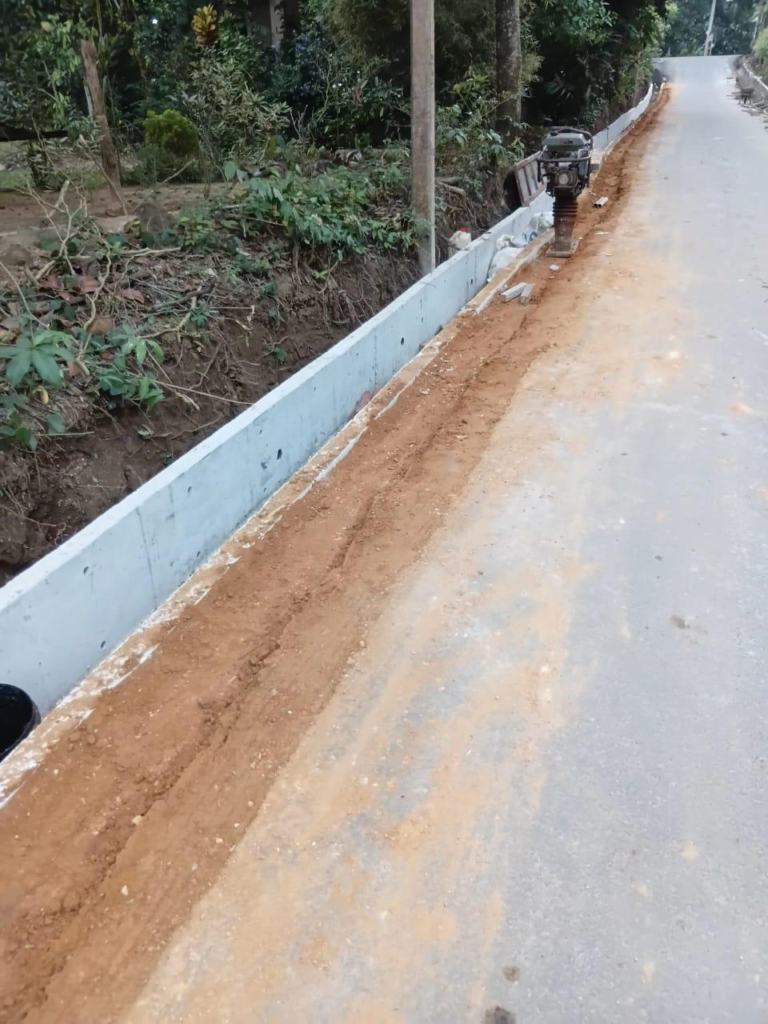
We compared the frame shown in the viral social media photograph with our own observations. By January 16, the gap between the road and the drainage channel shown in the photo had been filled with soil and levelled.
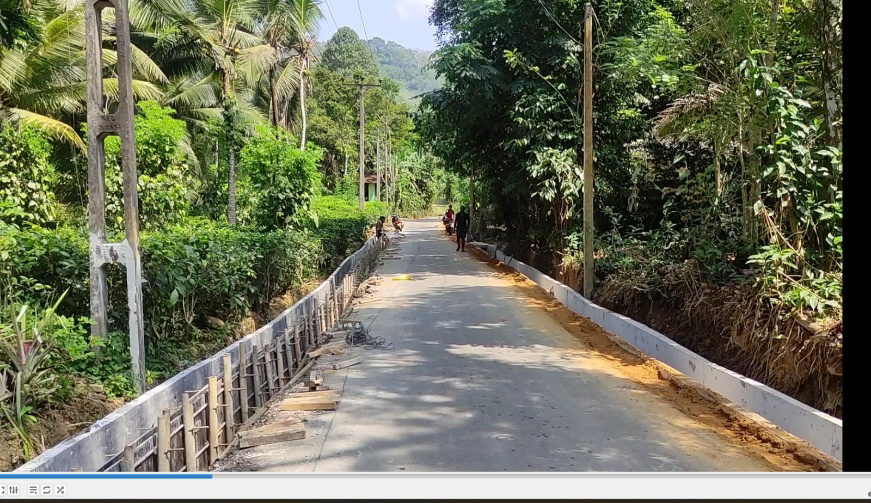
A Local resident’s perspective
We also spoke with some residents, who said that although the drainage system appeared higher than the road in the photos shared on social media, in reality, the drainage on both sides of the road is below road level.
They added that the road has now been levelled, and when the minister visited, the road work had been completed, while the drainage construction was still ongoing.
The video is shown below.
Engineer – Road Development Authority (RDA), Ratnapura
The RDA engineer clarified that the viral social media photo’s angle makes the drainage look higher than the road and that, in reality, the drainage system has been constructed below the road level.
The RDA engineer explained that all work is carried out under the supervision of engineers and other officials from the Road Development Authority.
She added that the road is designed so that rainwater flows quickly off the surface, as is the case with any road, and that the low angle of the viral photo has caused a misunderstanding on social media.
She further clarified that normally, when constructing a road and drainage system, the drainage is built first, followed by the road. Although the original plan did not include a drainage system, it was built to minimise the risk of damage during heavy rainfall.
The engineer added that before the recent cyclone Ditwah, the Keenagahawela-Kanukgalla road had already been completed. When the storm brought heavy rains, a large volume of water flowed onto the road. To protect the road, it was proposed to build a drainage system, making use of a portion of the budget set aside for road development.
She noted that within about two weeks, the road and the drainage system can be fully completed, further highlighting that the roadway is an important access road in the area.
Due to the misunderstandings spread on social media, the authorities decided to provide clarification about the road and drainage system.
The clarification also shows that filling and levelling the soil between the road and the drainage system’s shoulders would have prevented this misunderstanding.
The starting point of the road can be seen here on Google Maps.
The engineer also provided us with several photographs showing the condition of the road before the development work began.
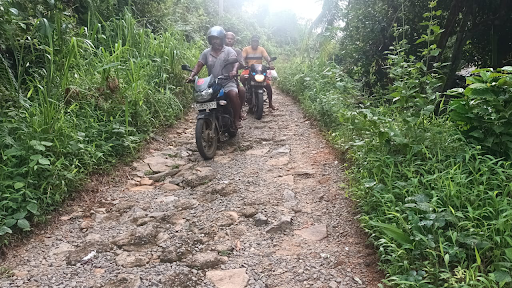
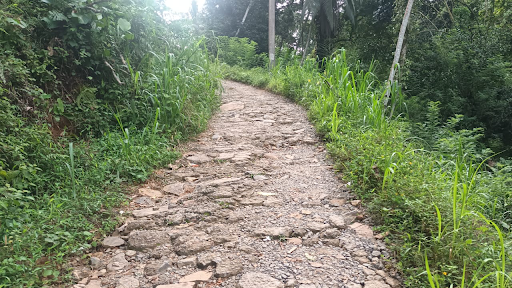
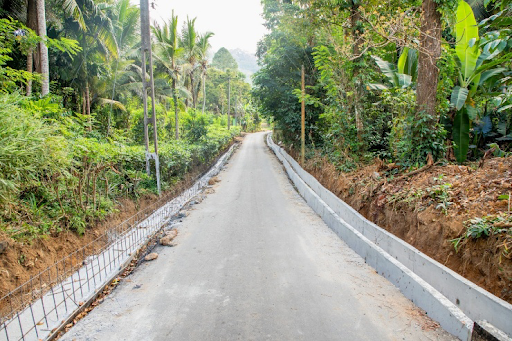
The photographs depict the appearance of a road with drainage prior to its completion.
The engineer also shared a photograph taken from a similar road under construction elsewhere in Sri Lanka. Similar to the viral image, which created confusion on social media, the photograph below also shows that the angle makes the drainage appear higher than the road, as the soil filling between the road and the drainage had not yet been carried out.
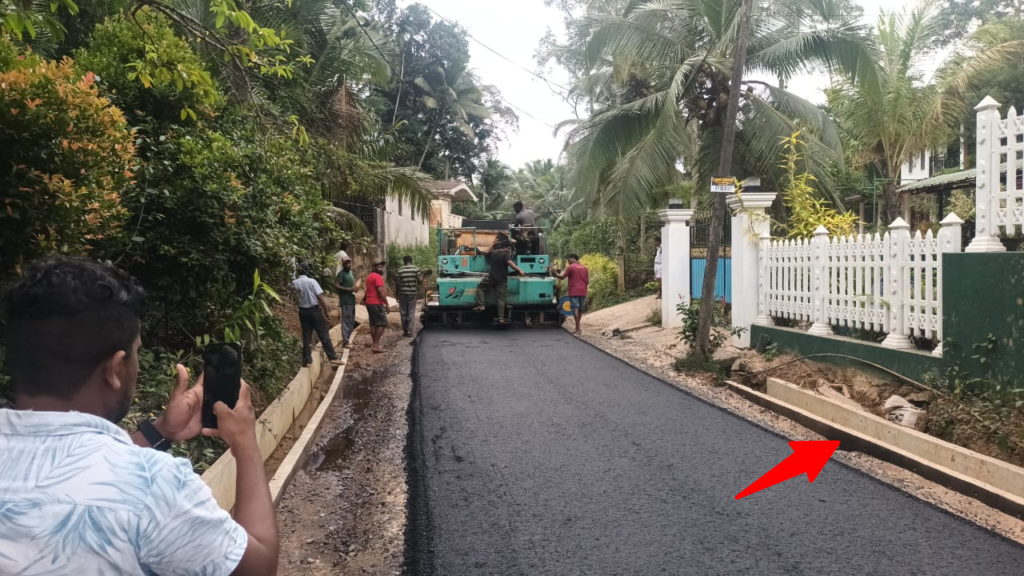
Eheliyagoda Pradeshiya Sabha Chairman
The Chairman of the Eheliyagoda Pradeshiya Sabha, Bandusena Dunuwila, clarified the situation regarding the Keenagahawela road, which has sparked discussion on social media.
He clarified that previous halts in construction had left this project unfinished. A large rock that needed to be removed for the road work required voluntary assistance from residents, resulting in approximately Rs. 5 million of the allocated budget remaining unused. 5 million of the allocated budgets remained unused.
Accordingly, part of this remaining budget was proposed by the contractor to be used to construct a drainage system, and its construction is now underway, he said.
The chairman stated that the drainage system sits approximately an inch beneath the road surface. He also noted that after approximately a week, once construction is complete, the placement of the road and drainage system will be clearly visible.
Ruwansiri Wimalarathna – Member of Eheliyagoda Pradeshiya Sabha
During our visit to inspect the road, Ruwansiri Wimalarathna, the local councillor, shared his views on the ongoing construction. He said that the claims suggesting the drainage system is higher than the road level are false, and the drainage is being built properly below the road level, under the supervision of RDA engineers and technical officers.
Fact Check 2:
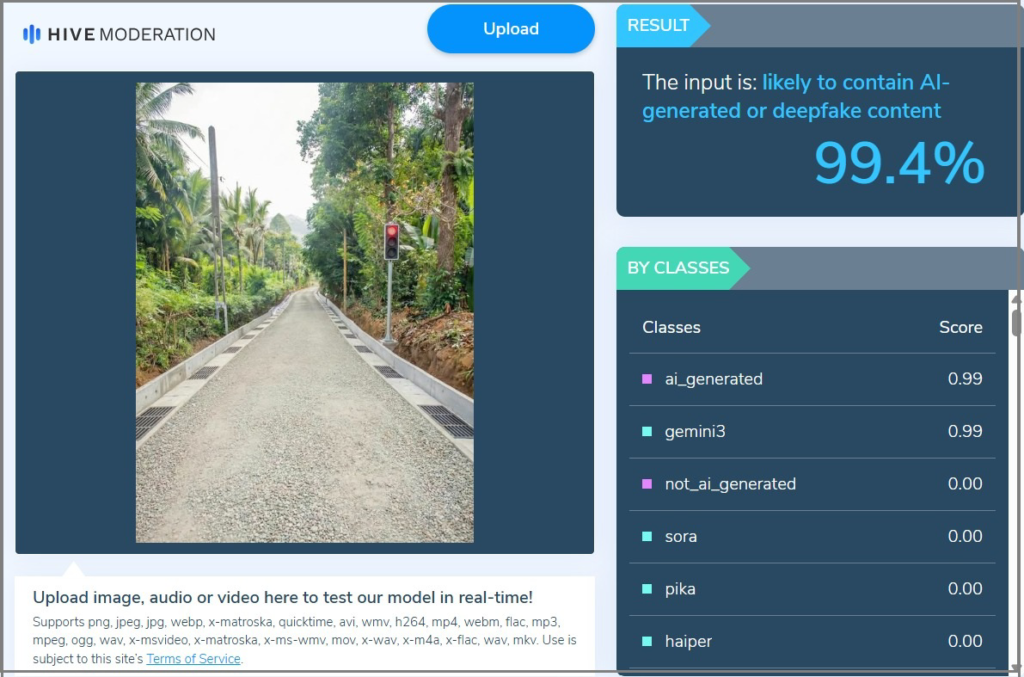
Meanwhile, several other photographs claiming to show the road as fully completed have been circulating on social media. Inspection revealed that artificial intelligence, specifically Gemini AI, was used in creating these images.
Join us to learn about fact-checking investigations.
Facebook | Twitter | Instagram | Google News | TikTok | YouTube
Conclusion:
Our investigation shows that the photograph circulating on social media, taken from Minister Sunil Senevi’s official Facebook account, actually depicts the road before it was completed. The camera angle in the photo makes it appear as if the drainage is higher than the road level, which has confused social media users.
Close-up photographs and video footage of the road and drainage, along with clarifications from the engineer in charge, confirm that the drainage system is actually below the road level. Similar observations can be made when examining other roads under construction, where the soil filling between the road and drainage has not been completed.

Title:A Road Built Below the Level of the Drainage System? The Truth Behind the Viral Photo from Eheliyagoda Road!
Fact Check By: Fact Crescendo TeamResult: Misleading