
Subscribe to our WhatsApp Channel
This is an investigation we conducted regarding a social media post stating that electricity consumers are already facing difficult situations due to the National Electricity Policy.
Social Media Posts :
A social media post was shared with the following message.
“It is reported that a major crisis has been created due to the inability to repay loans taken to build solar power plants and small hydropower plants due to the Electricity Board not purchasing electricity on weekends and public holidays, and the reduction in the price of purchasing an electricity unit.
Internal bank sources report that this situation could put the country’s banking system at serious risk in the future”.
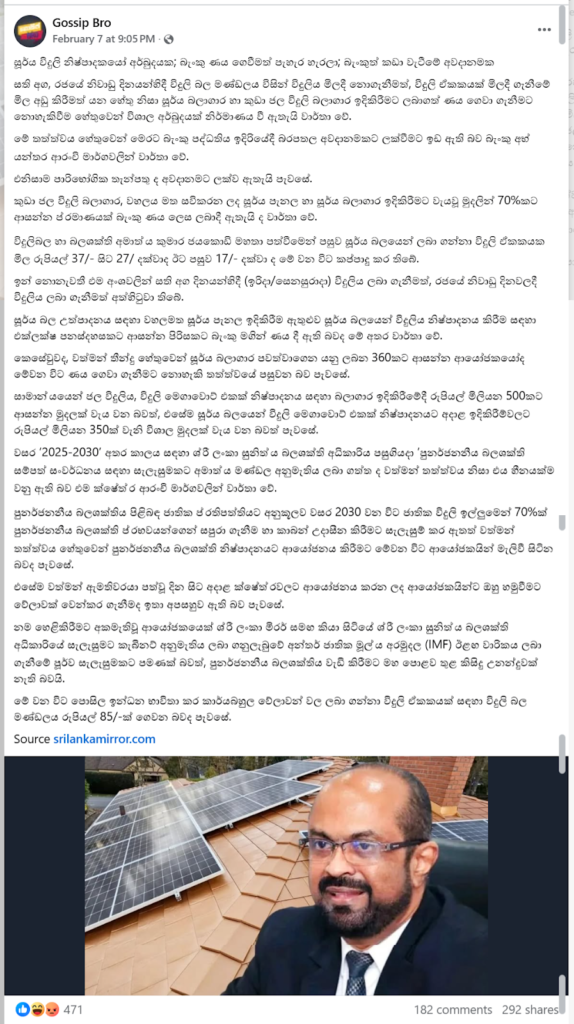
The social media posts stated that the basis for these claims was an article published on the Sri Lanka Mirror website.
Accordingly, we took steps to check whether solar electricity customers are experiencing a crisis as indicated in the posts.
Explainer :
We checked whether the mainstream media reported on this issue faced by consumers. However, we were unable to find any official news report.
Similarly, we did not notice any objections raised by consumers using solar panels in their homes. Therefore, to investigate, we monitored the media conference held by the Electricity Consumers’ Association (ECA) on January 1.
At this media briefing, Sanjeewa Dhammika, National Secretary of the Electricity Consumers’ Association, stated that homes and institutions generating electricity from solar energy may face injustice in the future. He pointed out that since the Sri Lanka National Electricity Policy is set to be implemented from next June, it has been proposed to introduce a time-based (Time of Use) tariff system in accordance with the National Electricity Policy.
It is alleged that the current unit charge of Rs. 45.80 will be increased to Rs. 67 per unit between 6:30 pm and 10:30 pm and Rs. 21 per unit between 10:30 pm and dawn, and that if this is implemented, the Electricity Board has proposed to make payments only for solar power units generated during the day, so the electricity generated by solar panels will have to be provided to the Electricity Board free of charge without charging any money.
Accordingly, they stated that the reduction in the amount of money provided by the Electricity Board to the relevant consumers who have installed solar panels through bank loans will leave them unable to pay it back, potentially placing the national banking system at serious risk.
However, what they explain during this conference is only a speculation about what will happen to consumers and producers through this policy implementation, and the concomitant collapse of the banking system.
Sri Lanka National Electricity Policy
We examined how the National Electricity Policy of Sri Lanka for the year 2025/2026, prepared by the Ministry of Energy and submitted for Cabinet approval, addresses this issue. (Pages 15, 16)
This policy clarifies the move away from the use of “block tariffs” for solar power consumer-prosumers.
All solar consumer-producers currently generating solar electricity will be transitioned to the time-of-use (TOU) tariff system. This process is scheduled to be completed before June 2026, and once transitioned, block tariffs will not apply to them.
Solar power consumer-producers who sign a Net Metering or Net Accounting agreement after January 1, 2026, will be directly subject to the TOU tariff system.
For these new agreements, the reconciliation between electricity exported to the grid and electricity imported from the grid will be done separately for each specific time period (e.g., peak, off-peak, day). It will not be calculated on a single fixed rate.
Also, this policy links TOU time frames to Battery Energy Storage Systems (BESS) and rooftop solar systems.
There is a special feed-in tariff for solar power consumer-producers who use rooftop solar systems as their main energy source and charge batteries.
The resale of electricity from the grid or a combination of grid and solar power to charge batteries during peak hours is limited. However, this limit may be reviewed when fixed and energy tariffs for all customers fully match the “cost of supply” in TOU time periods.
A detailed implementation plan to transition all low-voltage customers (including residential solar users) to the TOU tariff system is scheduled to be published by June 2026.
The regulator will conduct a study to examine specific time intervals used for TOU tariffs and consider distributed generation and demand management trends. This study is scheduled to be implemented by January 2027.
According to this new policy, those who have or plan to install a solar power system in Sri Lanka will be transferred to the TOU (Time-of-Use) tariff system by 2026. Then, the value of the electricity a consumer buys and sells changes depending on the time the consumer uses or produces electricity. However, this does not apply to solar power consumer-producers who have already signed contracts for 20 years.
However, social media posts have indicated that the new policy decision is already being implemented, and that, as a result, solar power consumer-producers are unable to repay loans obtained from banks to install solar panels, and that, as a result, the entire banking system has become unstable.
Ministry of Energy
We inquired about this with the Media Secretary of the Ministry of Energy, and he indicated that these social media posts are spreading false information.
Furthermore, he explained that the Cabinet approval has not yet been obtained for the matters mentioned by the Sri Lanka National Electricity Policy, and that this will be implemented for new consumers who will be signing the contracts to install solar panels at home in 2026.
However, he stated that there is a plan to convert to a time-based system, but this policy will ensure that electricity generated on weekends and holidays is not purchased.
It was also stated that this is a step taken to minimize the government’s need to incur high costs and to make payments based on the units consumed by customers for a fair calculation.
Nevertheless, he emphasized that this new policy still requires cabinet approval and has not yet been implemented.
Ceylon Electricity Board
The Ceylon Electricity Board states that customers who signed contracts before January 2026 will continue to be charged the same unit rates as when they signed their contracts. However, as approval has not yet been received to implement this policy, it is stated that the rumors circulating on social media are false.
Rooftop solar installation company – Hayleys Solar
Hayleys state that customers who have already installed solar panels will also be disadvantaged under this time-based system, as they will be charged Rs. 60 for units that use electricity through the grid at night, which is about three times more than the current amount.
The company points out that this will affect not only those who will sign contracts in January 2026, but also existing customers.
They also explained that the price paid per unit has been cut, as stated in the social media posts.
Join us to learn more about our investigative fact findings.
Facebook | Twitter | Instagram | Google News | TikTok | Youtube

Title:An explanation regarding social media posts published regarding the New Policy of Solar Panels.
Fact Check By: Fact Crescendo TeamResult: Insight