


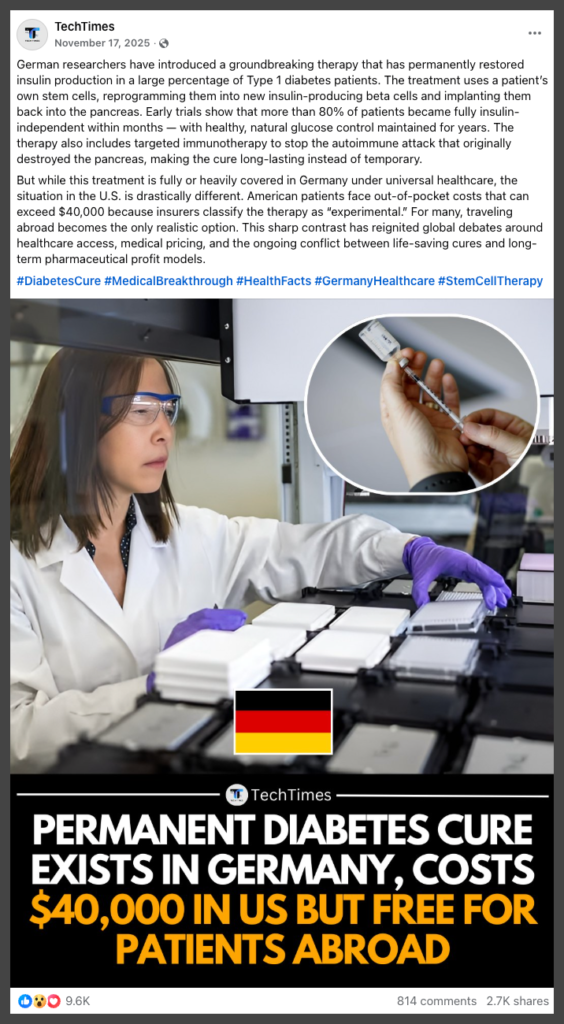
A viral claim circulating on social media platforms alleges that Germany is providing a lasting cure for diabetes that reportedly costs around $40,000 in the United States, but is offered free of charge to international patients. However, after reviewing official German health authorities, peer-reviewed research, and regulatory records, we found that this claim is false.
Social Media Posts
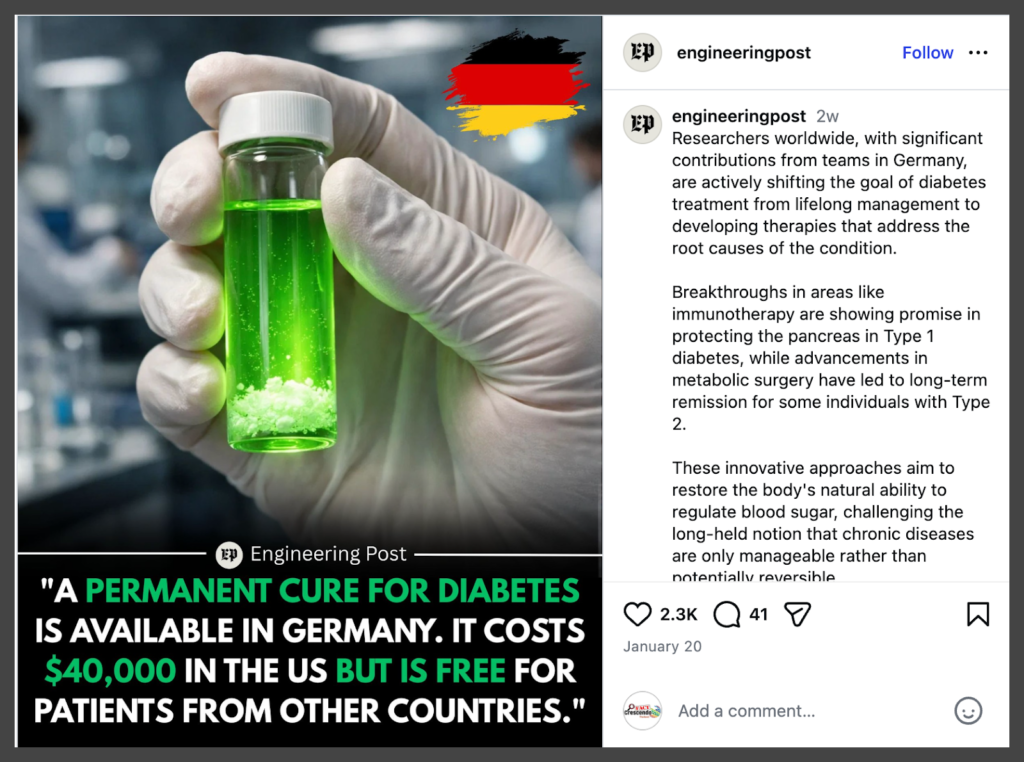
Posts spreading this narrative often assert that German researchers found a lasting cure for diabetes that costs $40,000 in the United States but is free for international patients.
The claim also went viral on Instagram.
Fact Check
What German Research Is Actually Studying
Germany is a leading participant in diabetes research, especially for Type 1 diabetes. One notable example is Helmholtz Munich, which is working with LMU Munich to create insulin-producing cells from stem cells. These cells are designed with protective features to prevent immune rejection. The project receives international support, including funding from JDRF (a major diabetes research foundation), and seeks to develop islet cell replacement as a potential alternative to daily insulin injections. It’s important to note that Helmholtz Munich describes this research as still in the early experimental stages, it is not yet a treatment available to patients, and it is not a cure.
German centers also participate in international clinical trials, such as Vertex Pharmaceuticals’ VX-880 (zimislecel), a stem cell–derived islet therapy. Early trial results show that some participants were able to reduce or temporarily stop insulin use, but these outcomes occurred in small cohorts, required lifelong immunosuppression, and lack long-term durability data.
Even in the most optimistic trials, stem cell–derived islet therapies do not eliminate the underlying autoimmune process in Type 1 diabetes. Many recipients must take immunosuppressive drugs indefinitely to prevent rejection or renewed immune attack on beta cells. Reviews published in peer-reviewed journals emphasize that insulin independence lasting months to a year represents partial disease reversal, not proof of a lifelong cure
No Approved or Lasting Cure for Diabetes Exists
According to the World Health Organization (WHO) and Diabetes UK, there is currently no approved permanent cure for either Type 1 or Type 2 diabetes anywhere in the world. Diabetes remains a chronic condition managed through medication, monitoring, and lifestyle interventions, even as research explores disease-modifying approaches. WHO’s overview of diabetes management emphasizes prevention, early detection, and long-term care rather than eradication of the disease
German research institutions echo this position. The German Center for Diabetes Research (DZD) describes stem cell therapies, immune modulation, and islet replacement as promising future approaches, but explicitly states that these strategies are still under investigation and not curative at present
Private Clinics and Experimental Treatments in Germany
Some private German clinics, such as the ANOVA Institute for Regenerative Medicine, offer experimental stem cell or secretome therapies for diabetes. These programs are delivered under Germany’s regulatory framework for innovative or experimental medicine and are described as non-curative and not standard of care. ANOVA and similar clinics note that patients must continue conventional diabetes management and that results vary widely.
These treatments are not free. BookingHealth lists diabetes-related stem cell programs in Germany costing between approximately €20,000 and €35,000, paid out of pocket by patients. Free access for international patients has not been documented.
Germany’s statutory health insurance system (GKV) covers routine diabetes care, such as insulin, glucose monitoring, and physician visits, only for residents and insured individuals. Experimental therapies, including stem cell interventions, are excluded from coverage even for German citizens. Non-EU or non-resident patients must pay entirely out of pocket or through private insurance. There is no national program that provides free experimental diabetes treatments to foreigners. (Source)
Comparison With the United States
The United States follows a similar approach. Investigational cell-based or regenerative diabetes therapies are classified as experimental and are not covered by standard health insurance. Patients who choose to pursue these treatments typically pay out of pocket, with costs often reaching tens of thousands of dollars depending on the specific procedure, clinical facility, and length of treatment. The frequently mentioned $40,000 figure does not refer to the cost of an approved diabetes medication. Instead, it represents the estimated total expense for experimental treatments, which includes laboratory work, specialized medical services, and hospital care.
The cost difference emphasized in viral social media posts does not stem from differences in drug pricing or government subsidies between countries. Rather, it reflects the way both Germany and the United States regulate and fund experimental medical procedures. In both nations, these treatments are investigational, not covered by standard insurance, and patients must pay substantial amounts themselves.
(Source: DVC Stem, Cal Matters,Feather Insurance)
Experimental Therapies: Duodenal Mucosal Resurfacing and Similar Interventions
One of the procedures most often mentioned in viral posts is duodenal mucosal resurfacing (DMR), sold under the name Revita by Fractyl Health. Revita DMR is a CE-marked medical device available in Germany for certain Type 2 diabetes patients. Clinical studies indicate that it can improve blood sugar control and reduce the need for insulin for 12 to 24 months. However, it does not claim to cure diabetes and does not eliminate the disease permanently. The treatment is designed as a tool to help manage diabetes, not as a lasting solution.
Regulatory Context in Germany and the EU
Germany’s medical regulator, BfArM, operates under European Medicines Agency (EMA) frameworks that prohibit marketing unproven treatments as “cures.” As of 2026, no stem cell, regenerative, or metabolic therapy has received EMA authorization as a curative treatment for diabetes. EMA approvals for diabetes continue to focus on glucose-lowering drugs and management technologies, not eradication of the disease.
Conclusion
The claim that Germany offers a free, lasting cure for diabetes that costs $40,000 in the United States is false. While Germany is actively involved in cutting-edge diabetes research, including stem cell therapies and metabolic interventions, no approved or permanent cure for diabetes exists anywhere in the world. Experimental treatments in Germany are neither free for international patients nor considered curative by medical authorities.

Title:Fact Check: Is Germany Offering a Free, Lasting Cure for Diabetes That Costs $40,000 in the United States?
Fact Check By: PranpreeyaResult: False