
Images circulating on social media have sparked debate among football fans during the 2026 FIFA World Cup.
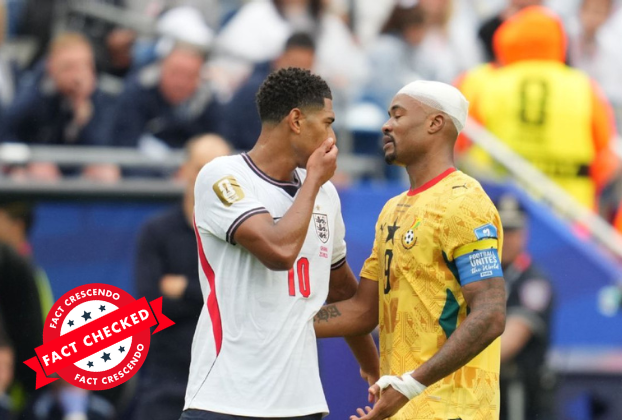
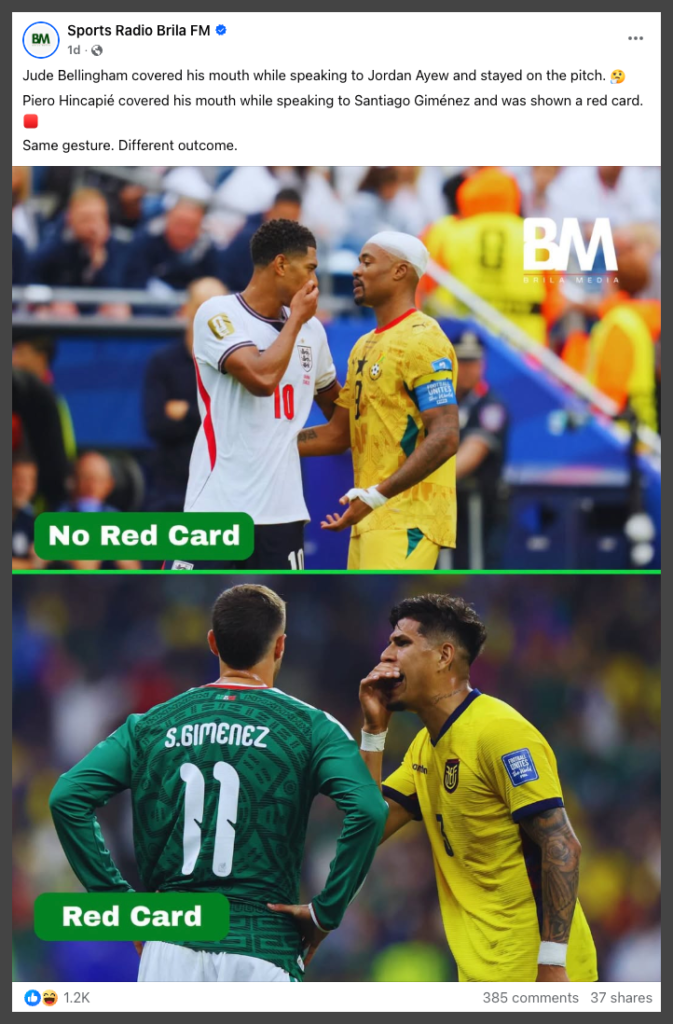
England midfielder Jude Bellingham was seen covering his mouth while speaking to Ghana captain Jordan Ayew during England’s group-stage match and was not punished. Days later, Ecuador defender Piero Hincapié covered his mouth while speaking to Mexico striker Santiago Giménez and was eventually shown a red card following a VAR review.
The clips quickly spread online alongside claims that FIFA’s new mouth-covering rule is being applied inconsistently.
However, the apparent contradiction comes down to one important detail that many viral posts leave out: under FIFA’s new rule, referees are not judging the gesture alone, but the context surrounding it.
Social Media Posts
Posts circulating claim that FIFA is applying its new mouth-covering rule inconsistently, pointing to the starkly different outcomes for Jude Bellingham and Piero Hincapié. These viral comparisons suggest that while Bellingham was permitted to continue playing after covering his mouth during a conversation with an opponent, Hincapié was unfairly penalized with a red card for what appeared to be the same gesture.
Source | Archive
Fact Check
A New World Cup Rule Targets Concealed Abuse
Ahead of the 2026 FIFA World Cup, the International Football Association Board (IFAB) approved a new disciplinary measure allowing referees to dismiss players who cover their mouths while speaking to opponents during confrontational situations. FIFA adopted the rule for this year’s tournament as part of wider efforts to tackle discriminatory, abusive and inflammatory language on the pitch.
The official wording is narrower than many social media posts suggest. According to IFAB, players may be sanctioned if they cover their mouths “in a confrontational situation with an opponent”, with implementation left to the discretion of competition organisers. In other words, the rule is not a blanket ban on covering one’s mouth during a match.
FIFA officials have repeatedly stressed that ordinary conversations, tactical discussions and friendly exchanges are not intended to trigger punishment under the law. The target is concealed abuse, not private conversation. (Source)
Why Was Piero Hincapié Sent Off?
The controversy intensified during Ecuador’s Round of 32 defeat to Mexico when defender Piero Hincapié approached Mexico striker Santiago Giménez late in the match while covering his mouth.
According to reports, officials considered the interaction confrontational and referred the incident for review. After consulting VAR footage, the referee issued a straight red card, making Hincapié only the second player at the tournament to be dismissed under the new mouth-covering rule.
The decision mirrored an earlier dismissal involving Paraguay’s Miguel Almirón, who was also sent off after covering his mouth during a heated exchange with an opponent.
(Source: LEADERSHIP Newspapers, AP News)
Why Was Jude Bellingham Not Sent Off?
Bellingham’s incident against Ghana looked remarkably similar on television. The England midfielder briefly covered his mouth while speaking with Jordan Ayew, leading many viewers to assume that a red card was inevitable under the new law.
However, match officials reached a different conclusion. Multiple reports indicated that referees did not view the exchange as confrontational, provocative or abusive. Instead, it appeared to be an ordinary discussion between two players rather than an argument or verbal altercation. Because the confrontation element was absent, officials determined that the threshold for a red card had not been met.
FIFA’s guidance surrounding the rule states that ordinary conversations are not intended to be punished under the law. The rule applies only when mouth-covering occurs during aggressive or inflammatory interactions with opponents. Casual conversations remain permitted. (Source: Goal, FourFourTwo)
The Difference Was the Situation, Not the Gesture
The viral comparison between Bellingham and Hincapié creates the impression that FIFA is enforcing two different standards for the same behaviour.
But according to the wording of the rule, the visible gesture itself is only one part of the decision.
Hincapié’s exchange with Santiago Giménez was judged to be confrontational and therefore punishable under the World Cup directive. Bellingham’s conversation with Jordan Ayew was judged to be non-confrontational and therefore fell outside the scope of the sanction. (Source)
Conclusion
The claim that FIFA is applying the rule inconsistently because “Bellingham covered his mouth and stayed on the pitch while Hincapié covered his mouth and received a red card” is missing important context.
Under FIFA’s new World Cup rule, covering the mouth is not automatically a sending-off offence. The key question for referees is whether the gesture occurred during a confrontational exchange with an opponent.
According to match officials, Hincapié’s interaction met that threshold. Bellingham’s did not.

Title: Same Gesture, Different Outcome? Why Jude Bellingham Stayed on the Pitch While Piero Hincapié Saw Red
Fact Check By: Pranpreeya
Result: Missing Context