

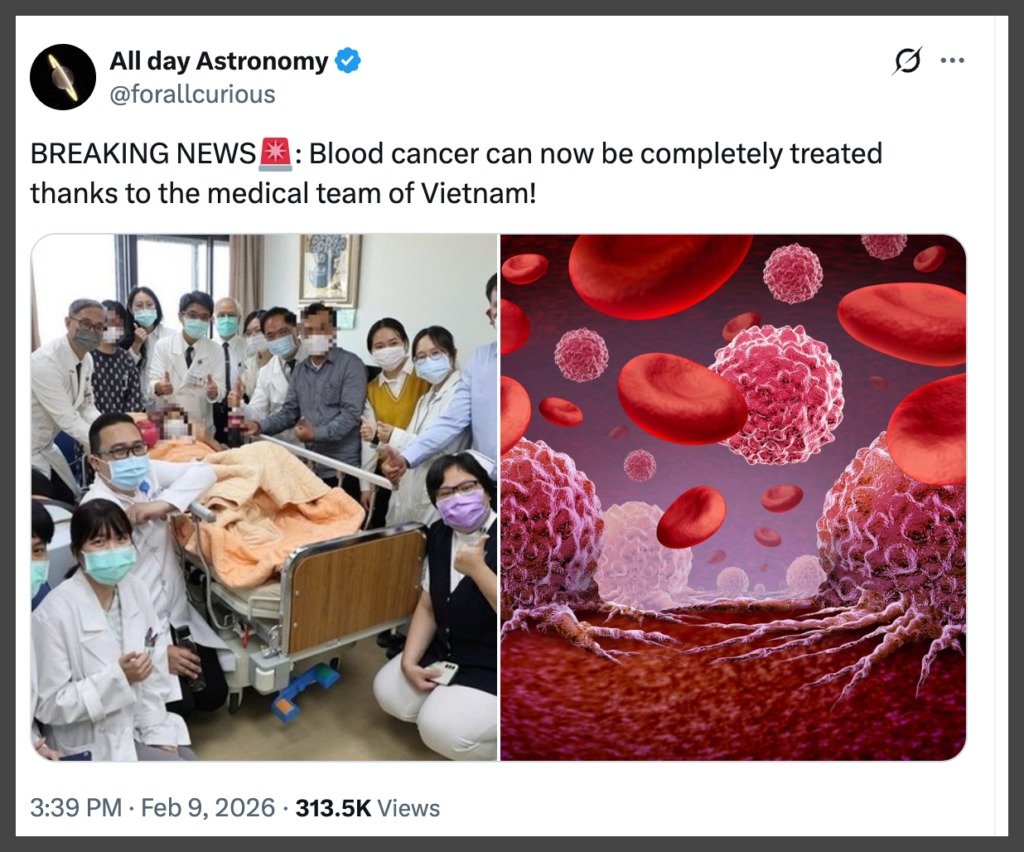
A claim circulating on social media states that blood cancer can now be completely treated, thanks to a Vietnamese medical team. However, our review found that while Vietnam has achieved important milestones in CAR-T therapy, there is no evidence that blood cancer has been completely cured.
Social Media Posts
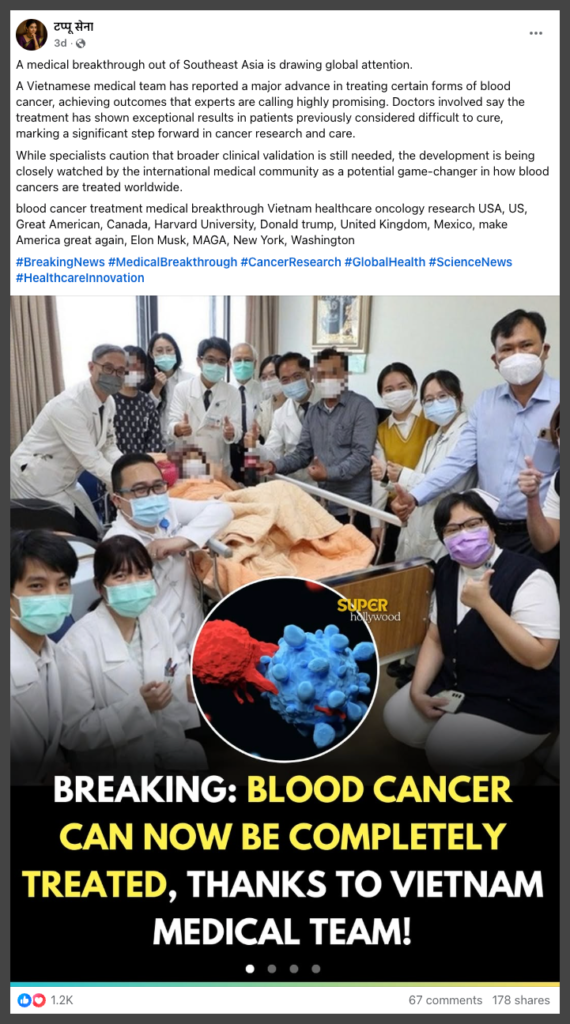
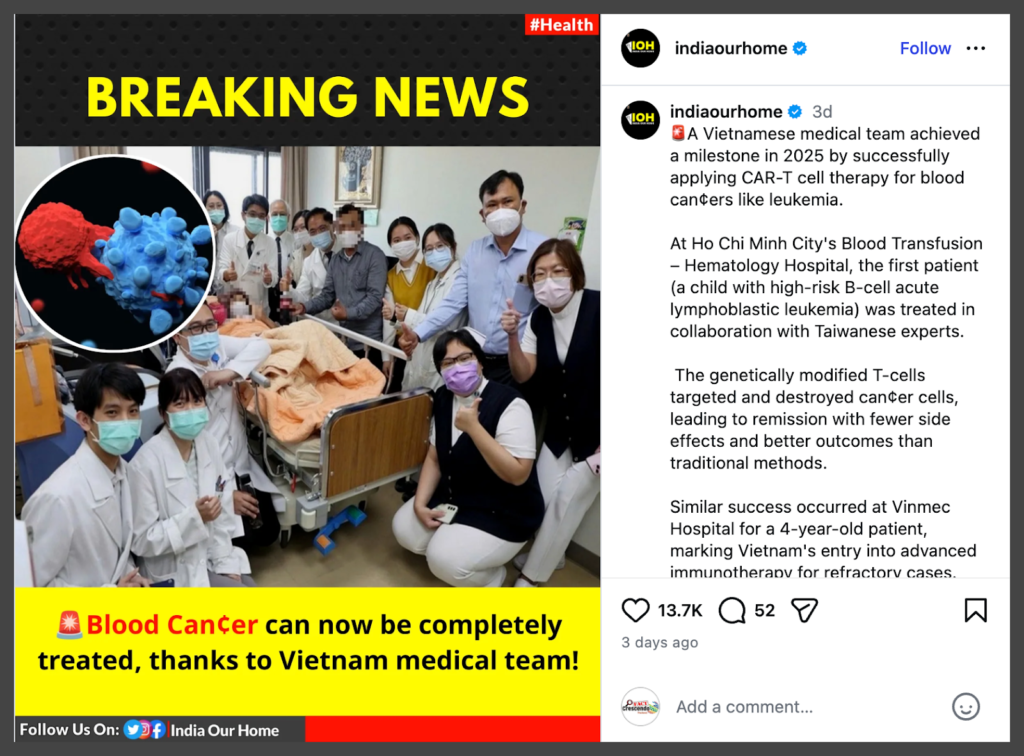
The viral claim typically reads along the lines of: “Blood cancer can now be completely treated thanks to a Vietnam medical team” or “Vietnam officially finds cure for blood cancer – Leukemia.”
The claim spreads widely on Facebook, Instagram and X.
Fact Check
What Actually Happened in Vietnam?
In 2025, Vietnamese media reported the country’s first successful uses of CAR-T cell therapy for acute lymphoblastic leukemia (ALL). According to Vinmec International Hospital, a four-year-old patient with relapsed ALL achieved “no cancer cells” detected in blood and bone marrow after CAR-T treatment, meeting criteria for complete remission. The hospital described this as part of a clinical trial approved by Vietnam’s Ministry of Health.
Similarly, SGGP News reported that a 12-year-old with high-risk B-cell ALL was treated using CAR-T therapy in collaboration with Taiwanese specialists and remained in good health more than one year later. The report emphasized this was the first case in Vietnam treated with CAR-T therapy.
These reports describe individual clinical successes. They do not state that blood cancer has been cured in general.
VnExpress International also reported that Vietnam is developing domestic capacity to manufacture CAR-T cells, reducing reliance on overseas production.
In all cases, the language used by hospitals and news outlets refers to “successful treatment” or “complete remission,” not eradication of all blood cancers.
What Is CAR-T Cell Therapy?
CAR-T (Chimeric Antigen Receptor T-cell) therapy is an advanced form of immunotherapy that works by modifying a patient’s own immune cells to fight cancer. According to the U.S. National Cancer Institute (NCI), doctors first collect T cells (a type of immune cell) from the patient’s blood. These cells are then genetically modified in a laboratory to produce special receptors on their surface that can recognize and attach to specific proteins found on cancer cells. After the modified cells are grown in large numbers, they are infused back into the patient, where they can identify and destroy cancer cells.
CAR-T therapy was first approved in the United States in 2017 for treating certain blood cancers that have either come back after initial treatment (relapsed) or haven’t responded to standard therapies (refractory). These include some types of childhood leukemia and certain lymphomas. The NCI reports that CAR-T therapy can produce long-lasting remission in some patients, and in certain cases may even cure the disease. However, it doesn’t work for everyone. The treatment also carries serious risks, including cytokine release syndrome (a dangerous immune reaction that can cause high fever and organ damage) and neurological side effects (such as confusion, difficulty speaking, or seizures).
A 2023 review in Nature Reviews Clinical Oncology found that CAR-T therapy targeting the CD19 protein may be “probably curative for a subset of patients” with B-cell blood cancers. However, the review emphasizes that some patients still experience cancer relapse, and researchers continue to study long-term outcomes to better understand which patients benefit most.
It’s important to note that CAR-T therapy doesn’t work for all types of blood cancer. The therapy is designed to target specific markers (proteins) on the surface of cancer cells, such as CD19 or BCMA. These markers are only present in certain subtypes of leukemia, lymphoma, and multiple myeloma. Blood cancers without these markers cannot be treated with current CAR-T therapies.
Remission Is Not the Same as Cure
It’s important to distinguish between “complete remission” and “complete cure.” In oncology, remission refers to a state in which signs and symptoms of cancer are reduced or undetectable. Remission does not necessarily mean that cancer will never return.
According to the National Cancer Institute (NCI), clinical trials of CAR-T therapy have reported high initial remission rates, often between 70-90% in pediatric ALL. However, a proportion of patients experience relapse within months or years.
The Vietnamese cases described in media reports show short-term remission outcomes, typically measured in months or one year. Determining whether these cases represent permanent cures would require long-term follow-up over many years. Vietnam’s Ministry of Health has not issued an official announcement declaring blood cancer cured.
Additionally, Vinmec describes its CAR-T program as a Phase I clinical trial, which primarily evaluates safety and preliminary effectiveness. Early-phase trials are not considered definitive proof of cure.
International Recognition and Current Standards
No major international health organization, including the World Health Organization (WHO), the U.S. National Cancer Institute, or leading oncology journals, has declared that blood cancer can be completely cured.
Blood cancer is not a single disease. It includes many different conditions such as leukemias, lymphomas, and multiple myeloma. Each type requires different treatment approaches depending on factors like the cancer’s subtype, genetic characteristics, the patient’s age, and how advanced the disease is.
CAR-T therapy is an important breakthrough in cancer treatment worldwide. Vietnam’s successful use of this therapy shows real progress in delivering advanced cancer care. However, this achievement represents the adoption and application of an existing treatment developed internationally, rather than the discovery of a new cure that works for all blood cancers.
Cost and Accessibility
CAR-T therapy is resource-intensive and expensive. According to Vinmec, treatment in the United States can cost approximately USD 1 million or more, while Singapore charges several hundred thousand dollars. Vinmec estimates its domestic version costs around 2.5–3 billion VND (approximately USD 100,000-120,000).
Even in developed healthcare systems, CAR-T therapy is typically reserved for patients whose cancer has not responded to standard treatments. It is not considered a universal first-line cure. This further demonstrates that CAR-T remains a specialized and limited therapy rather than a universally accessible cure.
Conclusion
The claim that blood cancer has been “completely treated” or “cured” in Vietnam is misleading. While Vietnamese medical teams have achieved significant milestones by successfully applying CAR-T cell therapy to treat individual patients with certain types of leukemia, these cases represent successful remissions, not a universal cure for all blood cancers.
Vietnam’s implementation of this advanced treatment domestically marks a significant development in the country’s healthcare infrastructure. Individual case successes, however, do not indicate that all forms of blood cancer have been cured.