
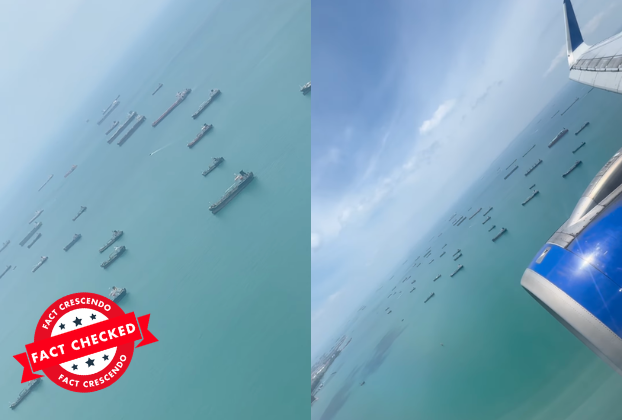
A viral video circulating on platforms claims to show the Strait of Hormuz “now open”, with aerial footage of multiple ships allegedly waiting near a port. The claim is often framed as breaking geopolitical news amid the ongoing 2026 crisis in the region. However, after examining the original source of the footage, maritime data, and credible reporting, we found this claim to be misleading.
Social Media Posts
The viral content features aerial footage showing a dense concentration of ships near a coastline, presented as evidence that maritime traffic has resumed in the Strait of Hormuz. The video has been spreading via Instagram, Facebook, and X.
Fact Check
The Video Shows Singapore, Not the Strait of Hormuz
Upon our investigation, we found that the footage does not show the Strait of Hormuz. Instead, it captures the Singapore Strait, one of the busiest shipping lanes in the world, filmed during landing at Singapore Changi Airport.
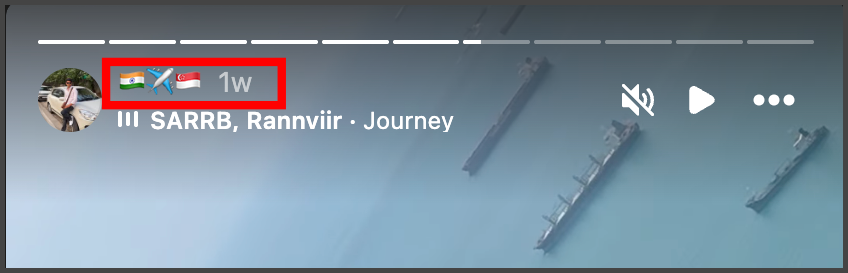
The original footage was posted on March 17 as part of a travel video and did not make any claims about the Strait of Hormuz. The original source can be found here (Archived).
Closer inspection of the uploader’s profile shows that the clip is part of a travel series documenting a journey from India to Singapore. The same footage appears in the account’s “highlights,” indicating it was filmed during a commercial flight landing in Singapore, not in the Middle East.
A live view of Singapore’s port traffic shows a similar of dense ship congestion:
Additionally, maritime monitoring organization TankerTrackers.com publicly responded to the viral claim, clarifying that the footage is from Singapore, not Hormuz.
This directly contradicts the central claim that the video reflects current conditions in the Gulf.
Current Situation in the Strait of Hormuz
Independent reporting and official data indicate that the Strait of Hormuz remains severely disrupted and effectively closed for normal commercial traffic, despite some political claims suggesting otherwise.
According to Reuters, shipments through the Strait have been effectively halted since late February 2026 due to escalating conflict and security threats.
The crisis began after military escalation involving Iran, the United States, and Israel, leading to warnings that ships would be attacked if they attempted passage. Maritime traffic subsequently dropped sharply, with many vessels anchoring outside the Strait or rerouting entirely.
The United Nations’ shipping agency (IMO) has even called for the creation of a safe corridor to evacuate vessels, highlighting the severity of the disruption. (Source)
Recent news reports also describe the Strait as effectively shut or highly constrained, with only limited and controlled movements under significant risk.
Actual Shipping Conditions
Iranian officials have publicly stated that the Strait is “not closed” and that “non-hostile” vessels may pass under certain conditions. However, in practice, this does not reflect normal operations.
Reuters reports that passage is conditional and requires coordination with Iranian authorities, excluding certain countries and increasing uncertainty for global shipping.
At the same time, global shipping companies and insurers remain reluctant to operate in the area due to risks of attacks, mines, and high insurance costs. Reports indicate that traffic levels have dropped dramatically, and only a small number of vessels are able to transit under tightly controlled conditions.
Even when individual ships pass, these cases are exceptions rather than evidence of a fully reopened route.
Conclusion
Based on available evidence, the viral video does not show ships waiting to pass through the Strait of Hormuz. It is footage of heavy vessel traffic in/near Singapore, filmed from a commercial flight approaching Singapore’s Changi Airport.
Separately, multiple credible reports indicate that shipping through the Strait of Hormuz has been severely disrupted since late February 2026, with movement limited, risky, and in some cases contingent on coordination with Iranian authorities, conditions that do not align with the claim that the Strait is simply “now open.”

Title: Viral “Hormuz Now Open” Video Actually Shows Singapore Ship Traffic
Fact Check By: Pranpreeya
Result: Misleading