

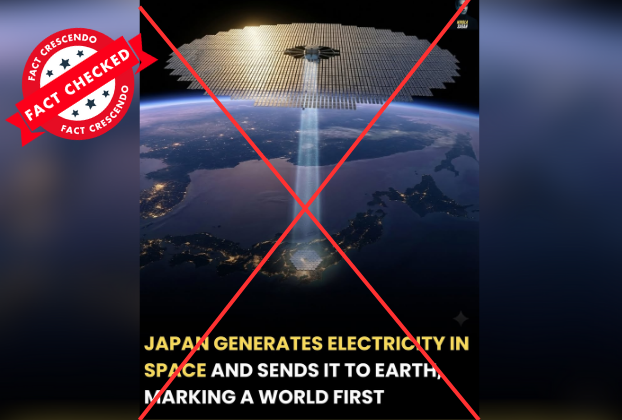
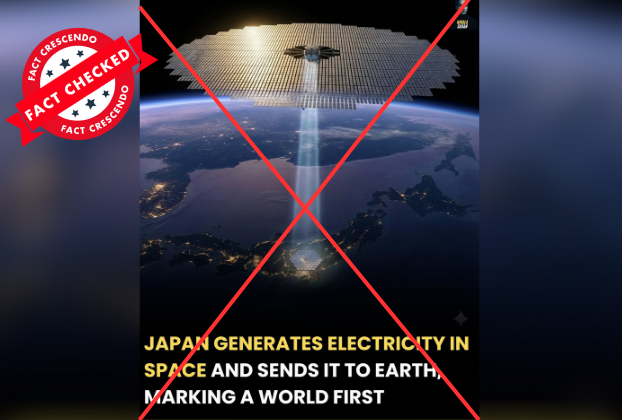
A claim circulating widely on social media states that Japan achieved a historic breakthrough, framing the event as the launch or operation of a fully functioning orbital solar power plant. The claim has appeared in viral graphics and posts shared on platforms, often accompanied by futuristic artwork suggesting a massive orbital solar power station already delivering clean energy to the ground. However, we found that the claim misrepresents the current status of Japan’s program and exaggerates its significance, making it misleading.
Social Media Posts
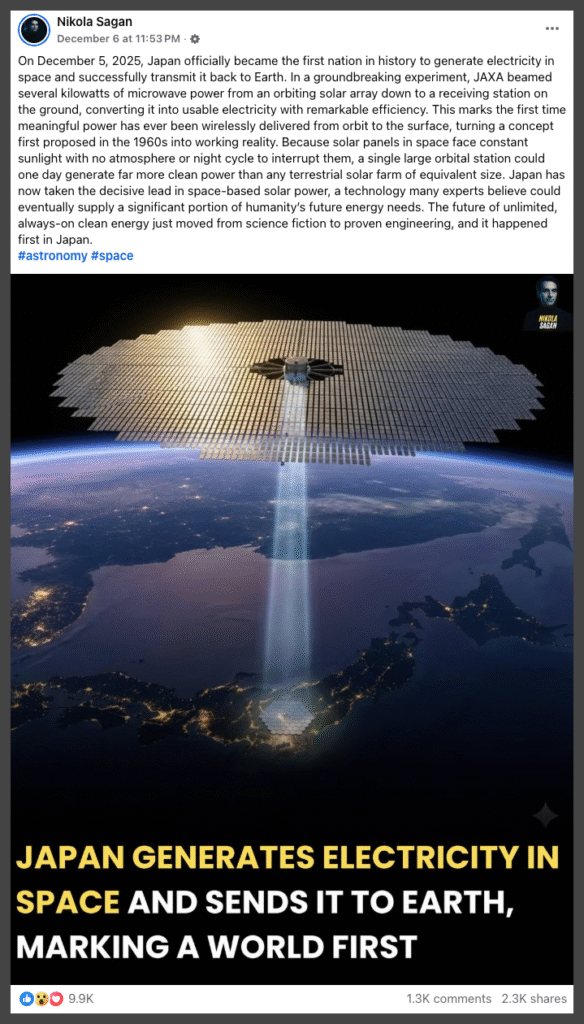
The viral posts assert that Japan has officially become the first nation in history to generate electricity in space and successfully transmit it back to Earth. The claim was widely spread on multiple platforms.

Fact Check
What Japan has actually achieved so far
Japan is indeed one of the world’s most active countries in researching space-based solar power (SBSP). Universities and research bodies, including Kyoto University and Japan Space Systems, have spent years developing technologies to collect sunlight in space, convert it into microwaves or lasers, and transmit it wirelessly to receivers on Earth. According to an official Japanese government feature published in 2023, this work is part of a long-term national research effort, not a completed commercial system.
Crucially, Japan’s demonstrated successes to date have occurred on Earth or from airborne platforms, not from orbit to ground. Experiments have shown that microwave wireless power transmission can work over tens of meters on the ground and over several kilometers from aircraft or airships. These tests validate components of the system, but they do not amount to generating electricity in orbit and delivering it to Earth in a sustained way. (Source)
The planned in-orbit demonstration
Japan’s most significant planned step is the OHISAMA project, a small satellite test scheduled for the mid-2020s. According to Space.com, this experimental satellite will weigh about 180 kilograms and generate roughly 1 kilowatt of power in low Earth orbit. The satellite will convert this power into microwaves and beam it to a ground receiver for a few minutes per orbit. This is designed purely as a proof-of-concept, a technical demonstration to show the system can work, not to provide usable electricity at scale.
Even if successful, this test would be experimental and limited in scale. It is not designed to provide continuous electricity, power homes, or operate as an orbital power plant. Industry analyses emphasize that such demonstrations are steps toward understanding feasibility, not evidence of commercial deployment. (Source)
No evidence for the claimed December 2025 “historic event”
Some viral posts claim that Japan has already completed a space-to-Earth power transmission on a specific date. A search of available sources does not reveal any announcement from JAXA, peer-reviewed publication, or reporting from major international science or energy outlets confirming such an event. Metro India’s report describes Japan’s project as planned or experimental rather than completed.
Additionally, it should be noted that Japan may not be the first nation to transmit power from space to Earth. In 2023, the California Institute of Technology’s Space Solar Power Demonstrator mission conducted an experiment using its MAPLE array, transmitting a detectable amount of power from orbit toward Earth. Although the received power was extremely small, Caltech and Space.com described it as the first orbital demonstration of space solar power transmission.
Claims about “unlimited clean energy”
In theory, space-based solar power could eventually surpass ground-based solar farms because satellites would collect sunlight 24/7, without weather or nighttime interruptions. However, space agencies make clear that this is still a long-term goal, not a reality demonstrated by today’s experiments. A 2024 NASA report points out that current demonstrations around the world, including Japan’s, are limited in scale and must still overcome significant hurdles, including high costs, energy conversion losses, the difficulty of launching massive structures into orbit, and ensuring safe power transmission.
Conclusion
The claim that Japan has launched the world’s first operational orbital solar power plant does not align with available evidence. Japan is advancing space-based solar power research and has conducted successful ground-based wireless power transmission tests, but there is no confirmation that a functioning orbital power plant is currently generating and transmitting electricity from space to Earth.

Title:Japan Has Not Yet Launched a Fully Operational Space-Based Solar Power System
Fact Check By: Pranpreeya PResult: Misleading