

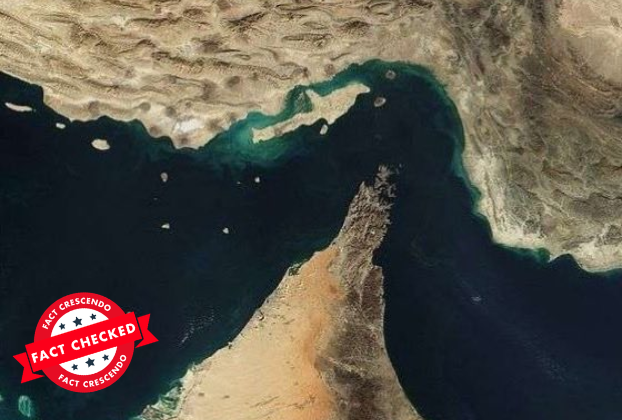
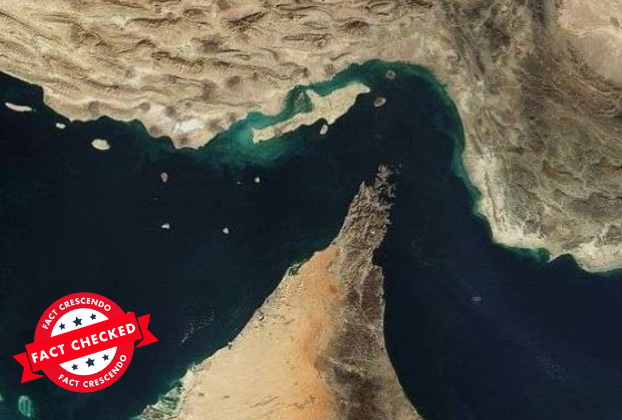
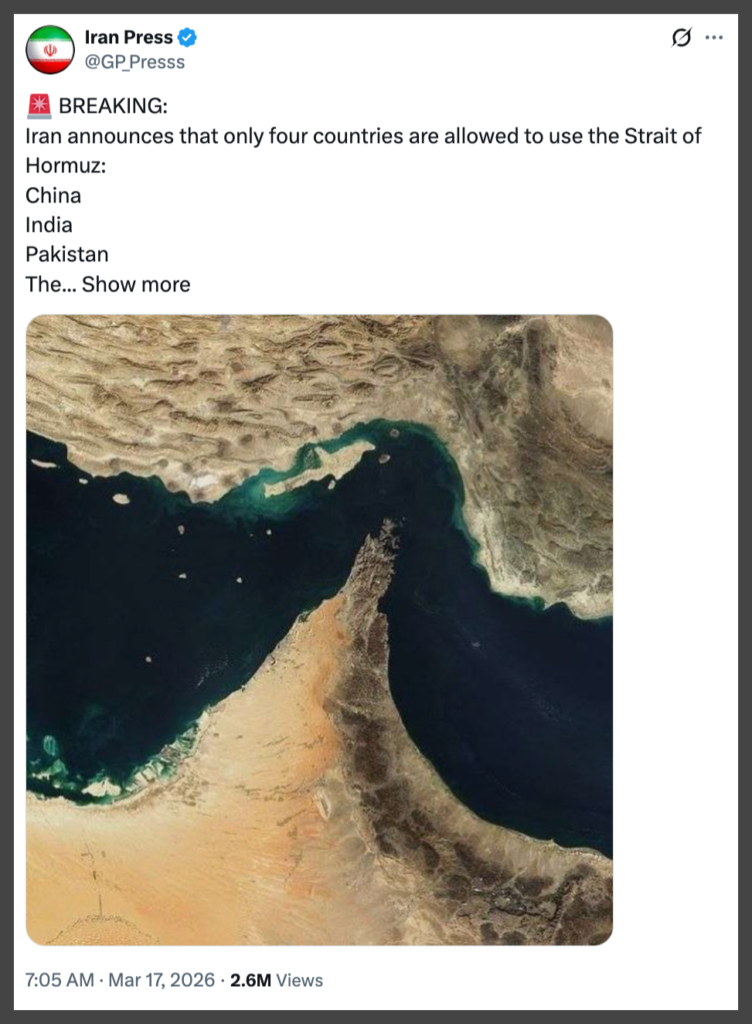
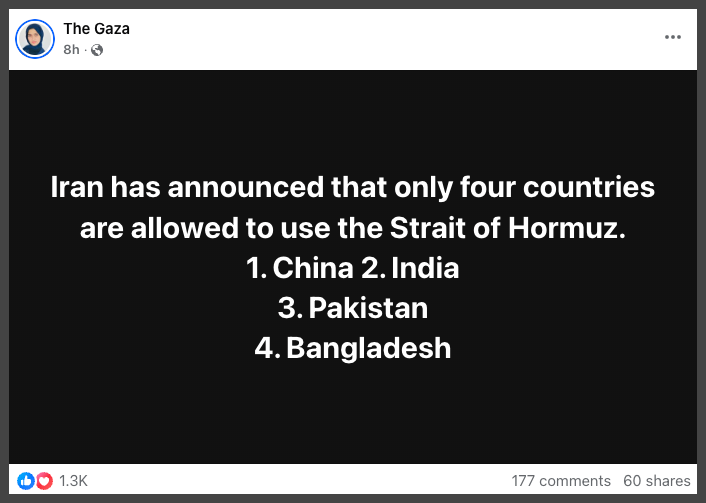
A viral claim circulating across platforms in March 2026 alleges that Iran has officially restricted access to the Strait of Hormuz to only four countries, typically named as China, India, Pakistan, and a fourth country that varies depending on the post. The claim is often framed as urgent “BREAKING” news, implying a formal geopolitical decision with major global consequences.
Given that the Strait of Hormuz is one of the world’s most critical energy chokepoints, carrying roughly one-fifth of global oil supply, such a restriction would represent a significant escalation in international trade disruption. However, after reviewing official statements, verified reporting, and the broader conflict context, this claim is misleading.
Social Media Posts
The claim appears in multiple versions, often with identical wording but inconsistent details. Most posts state that Iran has “announced” a list of four countries allowed to use the strait, but the fourth country varies between Russia, Turkey, or Bangladesh.
Fact-Check
No evidence of a “four-country” restriction
There is no official statement from Iran confirming that only four countries are allowed to pass through the Strait of Hormuz. Verified reporting shows that Iran’s position is fundamentally different from what the viral posts claim.
Statements from Iranian officials indicate that the strait has not been formally restricted to a fixed list of countries. Instead, Iran has repeatedly framed its policy in political and security terms, not numerical limits. For example, Iranian authorities have stated that the strait remains open in principle but is closed to vessels linked to the United States, Israel, and certain allies considered hostile.
What is actually happening: selective and conditional access
While there is no fixed “allowed list,” evidence shows that Iran is controlling passage through the strait on a case-by-case basis during the ongoing conflict. Ships from certain countries have been able to transit, but typically under specific conditions or after coordination.
For instance, reports confirm that vessels linked to countries such as China, India, Turkey, and others have been allowed to pass at different times, often after signaling their ownership or receiving approval from Iranian authorities.
In some cases, countries have actively negotiated or requested safe passage. China has held discussions with Iran to secure transit for oil shipments, while Bangladesh reportedly obtained assurances that its vessels could pass if they notified Iranian authorities in advance. (Source)
There are also indications that ships must coordinate with Iran’s navy before entering the strait, reinforcing that access is conditional rather than universally open or restricted to a fixed group. (Source)
Crisis context: what is actually happening in the Strait of Hormuz
The situation in the Strait of Hormuz must be understood within the context of the ongoing 2026 conflict, which has severely disrupted global shipping and energy flows. Multiple credible reports from Reuters and other major outlets confirm that maritime traffic through the strait has dropped dramatically since the escalation began in late February.
According to Reuters, shipping activity in the strait has been significantly reduced, with tanker traffic at times collapsing by as much as 97% compared to normal levels, reflecting the severity of the disruption.
This decline is driven by direct security risks. Attacks on commercial vessels, including tankers being struck by projectiles and drones, have made the waterway unsafe for normal operations.
As a result, many shipping companies, oil traders, and insurers have suspended operations in the area. Reuters reports that at least 150 vessels were stranded or anchored near the strait, while others avoided entering altogether due to escalating threats.
At the same time, the cost of operating in the region has surged. War-risk insurance premiums have risen sharply, in some cases by several hundred percent, significantly increasing the cost of transporting oil and goods through the Gulf.
Recent reporting from Wall Street Journal further indicates that traffic has not only declined but, in some periods, has been reduced to only a handful of ships per day, compared to the usual volume of around 100 daily crossings.
Together, these military risks, insurance constraints, and operational uncertainties have effectively limited movement, even without a formal legal closure of the strait.
Conclusion
The viral claim that Iran has officially limited Strait of Hormuz passage to only four countries is not supported by credible evidence.
What credible reporting shows instead is a fluid and conditional situation: amid the broader 2026 conflict, Iran has signaled it may block or target vessels linked to adversaries, while other ships have been able to pass after coordination or assurances. At the same time, the security threat environment has sharply reduced traffic through the strait as companies pause operations and insurers raise war-risk costs.

Title: No Evidence Iran Limited Strait of Hormuz Passage to Only Four Countries
Fact Check By: Pranpreeya
Result: Misleading