
Subscribe to our WhatsApp Channel
These days, many parts of the country are experiencing high daytime temperatures. In this situation, unverified and speculative posts about possible future developments are being shared on social media. Here is a fact-check we conducted on one such post.
Social Media Posts :
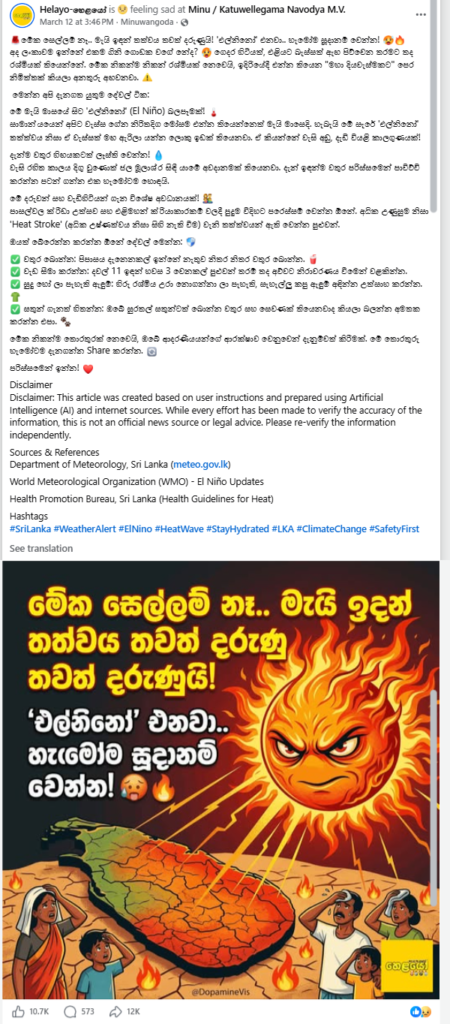
The post, shared with the claim “The situation will worsen from May, El Nino is coming, everyone be prepared,” refers to the current hot weather conditions and suggests that this is a sign of heavy rainfall in the coming period.
The post further claims that El Nino conditions will begin in May and that this could cause the southwest monsoon to weaken, leading to dry weather conditions. It also warns that water sources may dry up due to this situation and urges people to prepare in advance. In addition, the post includes advice on how to reduce the impact of high temperatures on the human body.
The post claims that El Nino conditions will definitely occur in May, and that the current heat is a sign of heavy rainfall.
We took steps to verify the accuracy of the claims mentioned in the social media post.
Fact Check :
We then took steps to verify, through forecasts and meteorologists at the Department of Meteorology Sri Lanka, whether the current hot weather will definitely lead to El Nino conditions and whether the heat is a sign of heavy rainfall.
Response from the Department of Meteorology
The Department of Meteorology Sri Lanka has issued a heat advisory for several districts in the island. The notice says that in parts of the Western, Sabaragamuwa, North Central, Southern and North Western provinces, as well as Monaragala, Mannar and Vavuniya, the heat may reach levels that need public attention. The department has also advised people to take necessary precautions and stay cautious during this period in this manner.
Meanwhile, the Director General of the Department of Meteorology Sri Lanka, Athula Karunanayake, also held a media briefing on March 12 to explain the current weather conditions to the public.
The Director General said that although some areas may receive rain, overall the country is experiencing dry weather conditions. He also advised the public to be careful during heavy physical activity in hot weather, and especially urged attention for elderly people, young children, and school students engaged in sports.
However, he said that after the current inter-monsoon period, the southwest monsoon will begin in May, along with signs of the El Nino phenomenon developing in the Pacific Ocean. He also explained that if El Nino strengthens in the coming months, it could affect Sri Lanka by reducing rainfall during the southwest monsoon. The Director General further said that El Nino conditions appear to be gradually developing, and that the second inter-monsoon period (October, November, December) usually sees increased rainfall during El Nino periods.
He continued to mention that by mid-April, rains from the Bakmaha Akunu period may slightly reduce the heat. However, a clear drop in high temperatures is expected only from late May, when the southwest monsoon begins. He also noted that similar hot weather conditions have been seen in previous years.
Meanwhile, to further clarify the claims circulating on social media, we also spoke to Scientist Kasun Pasquel from the Department of Meteorology Sri Lanka. He said that El Nino and La Nina conditions are not unusual and are part of normal climate variability. He also explained that these patterns are identified based on long-term data, rather than short-term weather changes.
He also said that it is not possible to predict heavy rains or floods in May based only on the current hot weather. He added that floods and droughts are not caused by a single factor. He further explained that even if El Nino conditions occur, they alone do not lead to severe disasters. Accordingly, the Department of Meteorology Sri Lanka does not confirm that heavy flooding will happen in May.
Daily Mirror Report on El Nino
According to a Daily Mirror report on March 27, Sri Lanka may experience El Nino conditions by May, which could extend the current heat by weakening the southwest monsoon. However, the Daily Mirror report also mentions that some thunderstorms and rainfall are expected by mid-April. It further mentions that the island is unlikely to experience very heavy rainfall until around October this year. The report can be found here.
Accordingly, neither the Daily Mirror report nor the Department of Meteorology has confirmed any upcoming heavy flooding. However, there is information regarding an upcoming El Nino condition that may develop around May.
What is El Nino ? What do experts say about 2026?
El Nino is a climate pattern in the Pacific Ocean where sea surface temperatures near the equator become warmer than usual. This can influence global weather patterns and lead to changes in rainfall and temperature. El Nino can affect monsoon rainfall patterns, but it is not the only factor that influences them.
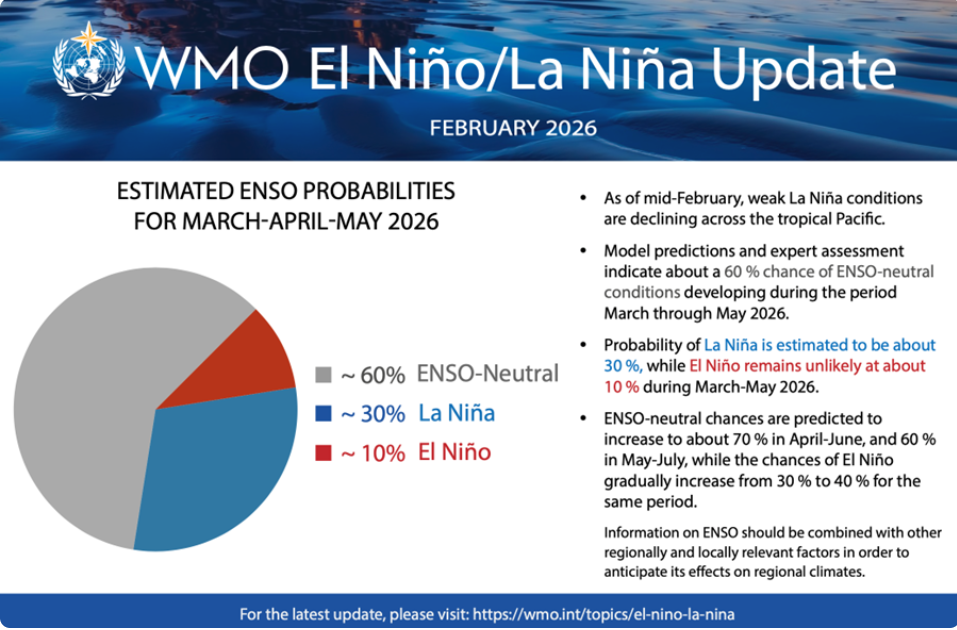
According to updates issued by the World Meteorological Organization (WMO) in February 2026, the chance of El Nino conditions developing between March and May is around 10%. The report also notes that La Nina conditions are weakening, and while the risk of El Nino may gradually increase in the coming months, it is still not confirmed.
La Nina is a climate pattern where the central and eastern Pacific Ocean becomes cooler than usual. It is the cold phase of the El Nino Southern Oscillation (ENSO) cycle.
Meteorologists have not predicted a definite El Nino condition in May. They expect generally normal conditions in the first half of 2026, and while El Nino could develop later, it is not confirmed that it will occur in May.
This shows that La Nina conditions are weakening, and that generally normal conditions are expected in the first half of the year. While El Nino may develop later, it is still not confirmed. Details here, here, and here.
Is the hot weather a special condition for this year?
March to April is naturally a hot period in Sri Lanka and is usually a dry season with little rainfall. According to weather data, daytime temperatures in April are around 30°C in many areas, so high daytime heat during this period is not an unusual condition. Studies have also shown that urban areas can be slightly warmer than rural areas due to factors such as construction and development.
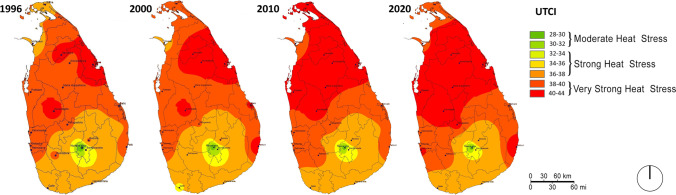
Meanwhile, temperatures in Sri Lanka have been gradually increasing over several decades. Analysis of the 1991–2020 period shows that by April, more than two thirds of the country experiences high heat conditions.
It has also been observed that even during cooler months, some days in densely populated areas record higher temperatures. In Colombo and nearby industrial areas, the heat index has increased significantly since 1997. April and May are now identified as periods with the highest heat impact.
Details here, here, here and here.
How does El Nino affect rainfall in Sri Lanka?
If El Nino conditions develop in 2026, it could lead to reduced rainfall during the southwest monsoon period. However, there are several other important factors that also need to be considered.
Historical analyses of rainfall in the Mahaweli and Kelani River basins show that southwest monsoon rainfall tends to be lower during El Nino years.
The impact of El Nino can vary depending on the Indian Ocean Dipole (IOD). When El Nino occurs together with a positive IOD, dry conditions may become more intense. However, when both are in a negative phase, there can also be an increase in rainfall, according to scientists. Details here.
Is the current hot weather a sign of heavy rain?
Heat and heavy rain are both part of changing weather patterns, but higher temperatures alone do not mean that heavy rain or floods will happen in the coming months. This cannot be predicted just from the current heat.
If El Nino develops, it may reduce southwest monsoon rains and lower water levels in reservoirs. However, other factors like the Indian Ocean Dipole (IOD) and normal weather patterns can also bring heavy rain. So, heavy rain cannot be expected solely based on the hot weather in March.
Both the World Meteorological Organization (WMO) and the Department of Meteorology Sri Lanka are closely monitoring the current hot weather and monsoon patterns. However, no flood warnings have been issued based on the present heat conditions.
Why is temperature increasing even without El Nino ?
Researchers say that even when El Nino conditions are not present, temperatures in Sri Lanka have been gradually increasing. Data over the past few decades shows a clear rise in heat levels, with more than two thirds of the country experiencing high heat conditions by April 2020. Even during cooler months like January, urban areas still show noticeable warmth. These changes are linked to global warming, increased greenhouse gas emissions, and rising urban temperatures.
A study conducted in Colombo in 2025 shows that the heat index has been increasing since 1977. It also indicates that April and May are now the hottest months of the year.
Afforestation and better urban planning can help reduce temperatures to some extent, but they are not enough to fully reverse global warming. The Intergovernmental Panel on Climate Change (IPCC) and the World Meteorological Organization (WMO) state that natural climate cycles like El Nino only cause small variations in an already warming system.
In practical terms, even when ENSO conditions are normal, climate change and urbanization mean that temperatures today feel higher than in the 1980s or 1990s. More details here, here, and here.
Join us to learn more about our fact-checking investigations.
Facebook | Twitter | Instagram | Google News | TikTok
Conclusion :
Our fact-check shows that while the current weather is hotter than usual, it is not a warning of a specific disaster in the near future. This is a natural weather pattern, but heat levels have increased further due to urbanization and long-term temperature rise. Climate systems are complex, and while patterns like El Nino can influence rainfall, they are not the only factor. There are indications that Sri Lanka may experience El Nino conditions in early May. However, social media claims stating that Sri Lanka will definitely face heavy flooding in May are misleading.

Title: Will El Nino Arrive in May? Does Today’s Heat Signal Heavy Rains Ahead?
Fact Check By: Fact Crescendo Team
Result: Misleading