

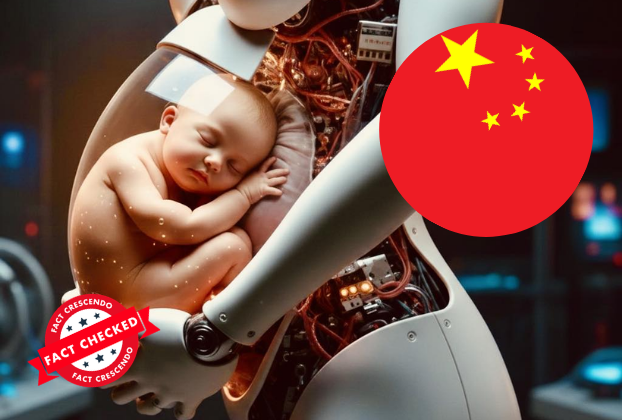

A viral claim circulating on social media alleges that China will launch the world’s first “pregnancy robot” in 2026, capable of carrying a human fetus and giving birth to a live baby. However, our investigation found that the story is false.
Social Media Posts
The viral posts typically claim that a “China will launch world’s 1st ‘pregnancy robot’ in 2026 capable of giving birth to a live baby.” The posts are often accompanied by futuristic images resembling AI-generated artwork or mannequin-style promotional renders rather than photographs of real laboratories or medical devices.
These claims were shared on Facebook and X platforms.


Fact Check
No Verified Scientific Announcement
We found no announcement from any Chinese university, hospital, biotechnology company, or government authority confirming the development of a humanoid “pregnancy robot” capable of full human gestation.
A medical breakthrough that would allow complete human pregnancy outside the body would represent one of the most significant developments in reproductive medicine in modern history. Such an innovation would typically be accompanied by peer-reviewed scientific publications, clinical trial registration, regulatory filings, or Coverage by leading medical journals such as Nature, Science, or The Lancet. None of these exist in relation to the 2026 “pregnancy robot” claim.
Media Investigations Found No Evidence
Multiple science and technology outlets have investigated similar versions of this story and found no supporting evidence.
Live Science reported that the viral “pregnancy robot” claim is fake and noted that a device capable of sustaining a full human pregnancy remains far beyond current scientific capabilities. Experts cited significant biological, engineering, infection-control, and developmental challenges that have not been solved .
Futurism similarly reported that the alleged original source of the story could not be verified and that the narrative spread through circular citations among secondary websites rather than a credible primary scientific source.
The viral “pregnancy robot” narrative resembles earlier CGI-based concepts such as “EctoLife,” a computer-generated video that depicted large-scale artificial womb facilities. That project’s creator acknowledged it was a conceptual visualization, not a real medical facility. (Source)
The 2026 “pregnancy robot” claim appears to follow a similar pattern, using speculative imagery and unverified interviews to create the impression of an imminent breakthrough.
Comparison With Real Artificial Womb Research
While the viral story is false, there is legitimate research into artificial womb technology, formally known as partial ectogenesis.
One of the most cited examples is the “Biobag” system developed by researchers at Children’s Hospital of Philadelphia. In 2017, researchers successfully supported extremely premature lambs in a fluid-filled extra-uterine environment for several weeks, allowing continued lung and brain development.
Peer-reviewed reviews indicate that artificial womb platforms remain in preclinical stages and are limited to animal models. No country currently permits full human gestation in an artificial womb from conception to birth.
Furthermore, Bioethics analyses emphasize that complete ectogenesis, meaning full pregnancy outside the human body, does not yet exist and remains speculative.
Existing systems are designed to support extremely premature infants for a limited period as a bridge to neonatal care. They do not initiate pregnancy from conception, replicate all maternal biological functions, or sustain a full nine-month gestation period.
Current Status of Artificial Womb Technology
Artificial womb technology worldwide remains experimental and focused primarily on supporting extremely premature infants at the edge of viability. Researchers are exploring systems that could serve as a “bridge” between early delivery and neonatal intensive care.
Discussions about potential first-in-human trials center on narrow medical use cases involving life-threatening prematurity. These trials would require extensive safety validation, ethical review, and regulatory approval. No credible source suggests that complete human gestation inside a robot will be available by 2026.
Scholarly debate continues around ethical, legal, and regulatory questions, including fetal status, consent, and reproductive rights. These ongoing debates further demonstrate that the technology is far from routine clinical application.
(Source: Cambridge University Press, PubMed Central)
Conclusion
Our investigation found no credible evidence, research institution, or official announcement to support the claim that China will launch a “pregnancy robot” in 2026. While artificial womb technology is an active area of scientific research, current work remains in early experimental stages with animal models and has not achieved the capability to support full human gestation from conception to birth.

Title: Fact-Checked: Viral China’s “Pregnancy Robot” Claim Is False
Fact Check By: Pranpreeya P
Result: False