

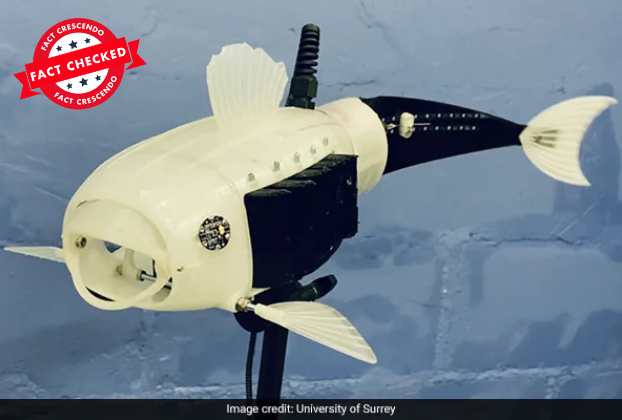
Social media posts circulating on platforms claim that researchers in the United Kingdom have developed a bio-inspired robotic fish capable of swimming through the ocean and “eating” microplastics that are difficult to remove using conventional cleanup methods. However, available evidence shows that it is an experimental prototype rather than a proven ocean-cleanup solution, and it does not literally “eat” or digest plastic as many posts imply. Therefore, we found the claim to be misleading.
Social Media Posts
Multiple social media posts share images of a robotic fish, with captions claiming that UK researchers have created a fish that can “eat plastic.”
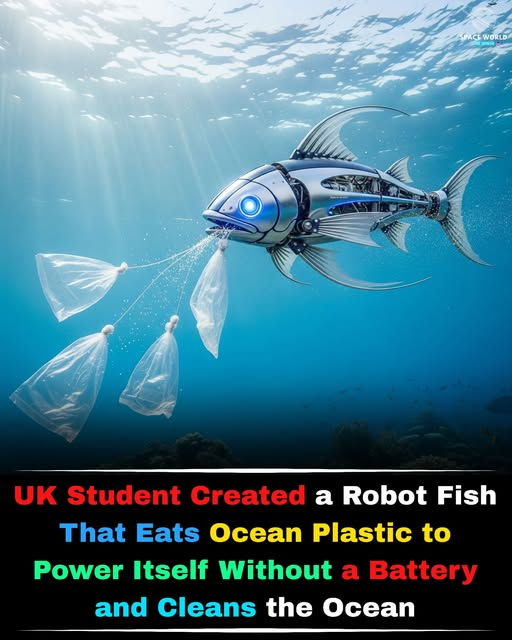
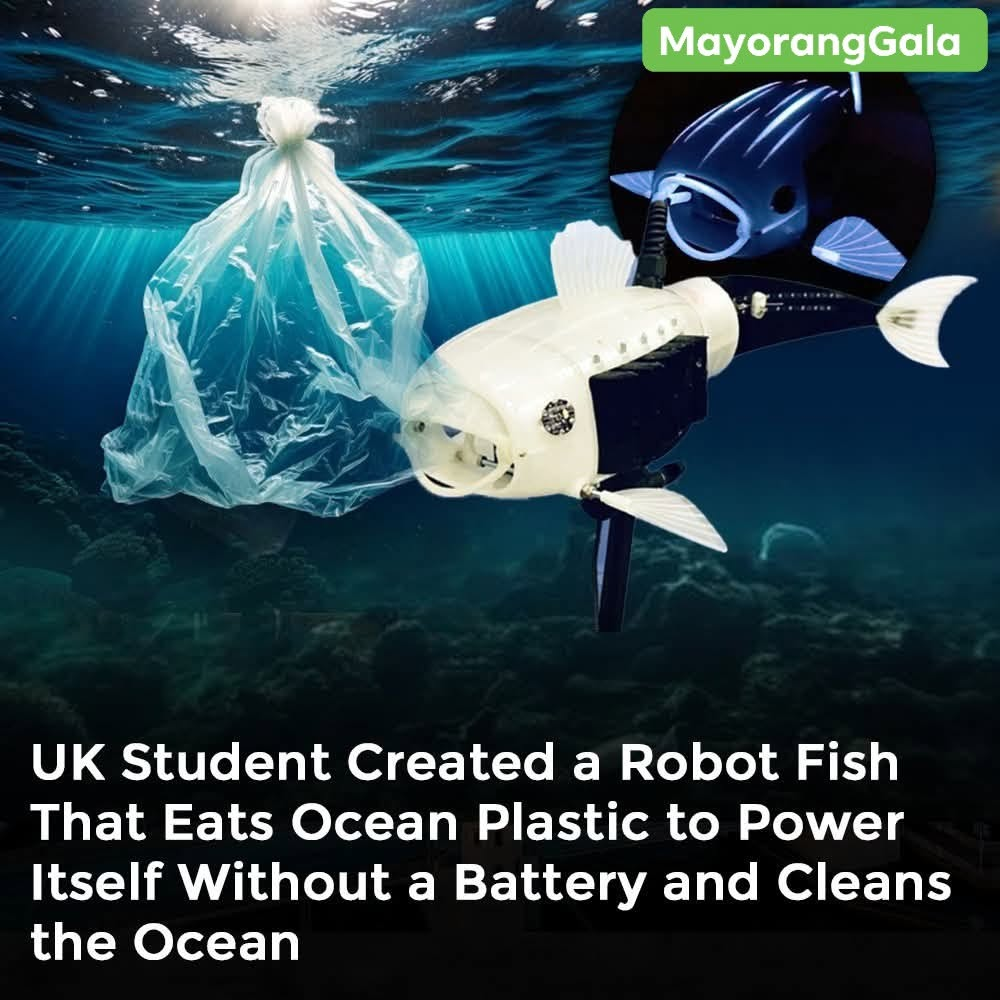
Source | Archive Source | Archive
Fact Check
The Robot Fish Is Real
The viral claim originates from a genuine project developed at the University of Surrey in the United Kingdom. According to the University of Surrey, the concept emerged from its Natural Robotics Contest, a public competition inviting participants to design nature-inspired robots that could address environmental challenges. The winning design was submitted by undergraduate student Eleanor Mackintosh, who proposed a fish-shaped robot capable of filtering microplastics from waterways.
Researchers subsequently transformed the concept into a working prototype named Gillbert. The project was documented by the University of Surrey and later described in an academic paper titled The Natural Robotics Contest: Crowdsourced Biomimetic Design, which explains that the robot uses specially designed gill structures to filter microplastics from water while swimming. The paper describes Gillbert as an open-source robotic fish built around a novel 3D-printed gill filtration system rather than a fully deployed cleanup machine.
Reports about the prototype state that the robot can collect microplastic particles measuring approximately 2 millimetres or larger by passing water through mesh-like gill filters while retaining plastic particles. The collected material can then be removed for analysis or disposal.
(Source: Robotics and Automation, Weather.com)
The Robot Does Not Actually “Eat” Plastic
The most misleading aspect of the viral claim is the repeated description that the robot “eats” microplastics.
The available description from the University of Surrey shows that Gillbert functions as a filtration device. Water enters the robot, passes through gill-like mesh structures, and plastic particles become trapped inside the filter. The robot does not digest plastic, convert it into energy, or process waste biologically in the way living organisms consume food.
While some media coverage refers to the device as a “plastic-eating robot fish”, technical descriptions define its operation as filtration and collection. Consequently, the term “eating” is used as a metaphor for the robot’s mechanical function, as the device does not biologically consume or process plastic.
It Remains a Prototype, Not a Proven Ocean-Cleanup Solution
The viral posts also create the impression that Gillbert is already a practical technology capable of cleaning oceans on a large scale. However, available evidence suggests that the project remains a proof-of-concept prototype.
According to reporting on the project, early versions of Gillbert operated under remote control. Researchers have discussed developing future generations that could become more autonomous and capable of covering greater distances, but those capabilities have not yet been demonstrated in large-scale real-world deployments.
Dr. Robert Siddall, a roboticist at the University of Surrey and one of the researchers behind the project, described the robot as an initial step toward understanding and addressing plastic pollution rather than a complete solution. He stated: “We don’t know where the vast majority of plastic dumped into our waterways ends up. We hope this robo-fish and its future descendants are the first steps in the right direction to helping us find and eventually control this plastic pollution problem” (Source). His comments indicate that the project is intended as an early-stage research tool rather than a finished technology capable of solving ocean pollution on its own.
Removing Microplastics Remains a Major Challenge
The broader challenge of microplastic removal provides additional context missing from the viral posts.
Scientific reviews note that microplastics are extremely difficult to remove because they are small, widely dispersed, and often mixed with natural materials. Current removal technologies include filtration systems, separation technologies, wastewater treatment processes, adsorption methods, and experimental biological approaches. However, researchers consistently report that no single mature technology currently exists that can efficiently remove microplastics from the open ocean at large scale.
Researchers also identify major practical obstacles for robotic cleanup systems, including underwater visibility, navigation challenges, battery limitations, maintenance requirements, and the difficulty of locating tiny plastic particles across vast marine environments. Many plastic pollutants are also found below the surface or trapped on the seafloor, making them difficult for surface-orientated collection systems to reach.
As a result, experts generally view robotic cleanup technologies as supplementary tools that may help collect or monitor pollution in specific locations rather than as standalone solutions to the global plastic crisis.
(Source: Science Direct, Pubmed Central, Royal Society of Chemistry)
Gillbert demonstrates an innovative approach to collecting microplastics and highlights how biomimetic robotics could contribute to environmental monitoring and cleanup efforts in the future.
However, the project has been presented as an experimental prototype, and researchers have discussed future improvements and potential descendants of the system. The University of Surrey and the project’s academic paper describe Gillbert as a proof-of-concept robotic fish developed from a contest-winning design rather than a deployed ocean-cleanup technology.
Conclusion
The claim is misleading. Researchers at the University of Surrey developed a bio-inspired robotic fish called Gillbert that can filter and collect microplastics from water. However, viral posts exaggerate the technology by suggesting that the robot “eats” plastic and is already capable of cleaning the oceans at scale. In reality, Gillbert is an experimental prototype that filters and traps microplastics rather than digesting them, and researchers themselves describe it as an early step toward addressing plastic pollution rather than a proven solution.

Title: Viral Posts Exaggerate Capabilities of UK ‘Plastic-Eating’ Robot Fish
Fact Check By: Pranpreeya
Result: Misleading