

Subscribe to our WhatsApp Channel
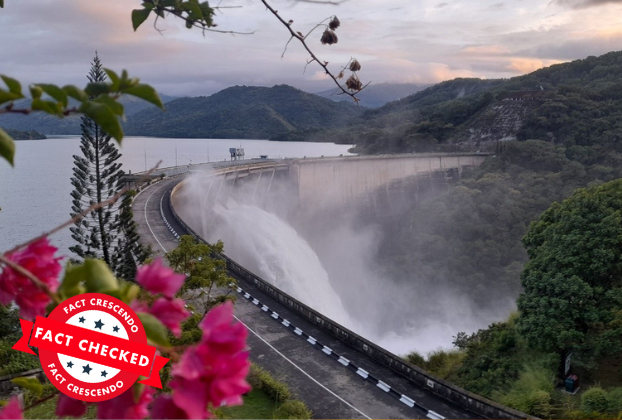
Here is a fact-finding investigation conducted by Fact Crescendo into the accuracy of social media posts that claimed that the tallest dam in Sri Lanka, Victoria Dam, was built without a single iron wire.
Social Media Posts:
We have noticed that many of the posts which are circulating on social media with claims such as “A must hear story, a strange incident, a story that no one knows”, are mostly false, misleading and fabricated.
Since such posts easily catch the reader’s attention, many people assume them to be true and share them from time to time, for many years.
Such a post was shared on social media regarding the Victoria Dam.
“Victoria Dam was built without a single piece of iron wire?
I think this information will be important for school children.
How was this Victoria Dam built without a single piece of iron wire…?
The best part is below…. Read on to know about the wonder.❤️
This dam was built at the narrowest point of the Mahaweli River.
The Victoria Dam was built a little below the place where the Hulu River joins the Mahaweli River.
The Victoria Dam was built by connecting Denigala Mountain in the Thel Deniya Divisional Secretariat Division of the Kandy District in the Central Province and Bolagala Mountain in the Haguranketha Divisional Secretariat Division of the Nuwara Eliya District in the Central Province.
The Victoria Waterfall was located 300m below this dam. The height of the waterfall is 10 meters.
This work was undertaken at a time when not even a single household in Sri Lanka had a radio. The surveys to build this dam were conducted from 1949 to 1980. That means 31 years of research have been done on this.
No matter what, the best things start after J.R. That is, after 1980.
When J.R. became President, he, along with Lalith Athulathmudalli, who introduced Mahapola, and Gamini Dissanayake, the then Minister of Power, went to England to discuss the construction of the Victoria dam.
These three people met with Queen Elizabeth and said this to her.
We are going to build a reservoir, and we request a loan for it. But even if this money is given as a loan, we will name this dam “Victoria”, which comes from the Queen’s royal lineage.
Old people used to say that Mr J.R. was so strategic and cunning that he used this chance to his advantage. Anyway, the Queen was caught by the trump card that he played.
Because the Queen has said that if the dam is named after Queen Victoria, they will give the loan as an aid.
J.R. has saved our country from a debt of crores at that time.
At that moment, the Queen asked to meet the Prime Minister of England, who was Margaret Thatcher.
She was someone who worked diligently, and she had inquired Gamini Dissanayake about why Sri Lanka is building this dam.
Why was the Victoria Dam was actually built?
📌️ To store water for agriculture
📌️ To generate hydroelectric power
📌️ To provide water for people upstream of the dam
📌️ To promote the freshwater mining industry
📌️ To control floods.
England has promised to give Rs. 8400 million to Sri Lanka for these reasons. Mr Gamini Dissanayake has apparently said that since Sri Lanka does not have people with the technical knowledge to build the dam, they also need technical training on it. In short, they have requested both the money and the building support. 🤗😃🤗
Accordingly, this work was entrusted to the Alexander Engineering Company of England.
People started coming to Sri Lanka to build the dam….
✴️✴️✴️✴️
Brief description of the dam…👇👇👇👇
This dam was built on a black rock. It has been taken as the foundation and has been grilled to make the dam. The total depth of this black rock is 237 meters.
The foundation was laid by grilling this rock to a depth of 25 meters and a width of 25 meters.
🔵 The height of the dam is 121 meters
🔵 ️Length is 520 meters
🔵 ️Victoria Dam is a double-arch concrete dam
🔵️ Four hundred and eighty thousand cubic meters of concrete have been used for this dam.
🔵 ️ The maximum water level is 438.04 meters above sea level.
🔵 ️ The total amount of water that can be stored is one million seven hundred and twenty-two cubic meters.
🔵 ️ The area covered by the reservoir at the maximum water level is 23.7 square kilometres – spread over 5 Divisional Secretariat divisions.
🔵 This dam consists of 7 floors. It is possible to move around within those 7 floors. If the dam is filled with people on top and inside, 50,000 people can stay.
🔵 When this dam is filled, the dam is pushed down by a maximum of 68 millimetres and a minimum of 30 millimetres, which means the Victoria Dam is a concrete dam that swings back and forth. It is impossible to imagine, right?
🔵 ️The other fact is that not even a single iron wire has been used for this dam. We think that the strength is added with iron wires. But, iron wire has not been used; instead, a special method has been used for this, which is that they have used ice water to mix the concrete. Also, the mixed concrete has been put into the block within 3 minutes. Otherwise, they have thrown away the concrete.
🔵 ️ Also, the water flowing through the Victoria Dam generates 210 megawatts of electricity. It is the largest hydroelectric power plant in Sri Lanka.
🔵 The water released from there goes to the Randenigala Reservoir, then to the Rantabe Reservoir, then to the Loggal Oya Reservoir, then to the Mahaweli C Zone, and then to the Maduru Oya Reservoir.
🔵️ There are 8 automatic sluices. During the flood season, only 2 sluices are opened. When these 2 sluices are opened to 74 centimetres, 300 cubic meters of water are released per second.
🔵 ️ An Englishman named Neil Martin laid the foundation stone for this in 1980.
🔵 ️ The work was completed in 1984. On April 7, 1984, the reservoir was filled with water. In 1985, it was officially handed over to Sri Lanka.
🔵 ️ 7000 workers worked day and night.
🔵 ️ The estimated number of deaths was 1200. The number of deaths was 50… 47 Sri Lankans. 3 English….
Thank you….
“To the original owner of the post”
This post was widely circulated among Facebook users as follows.
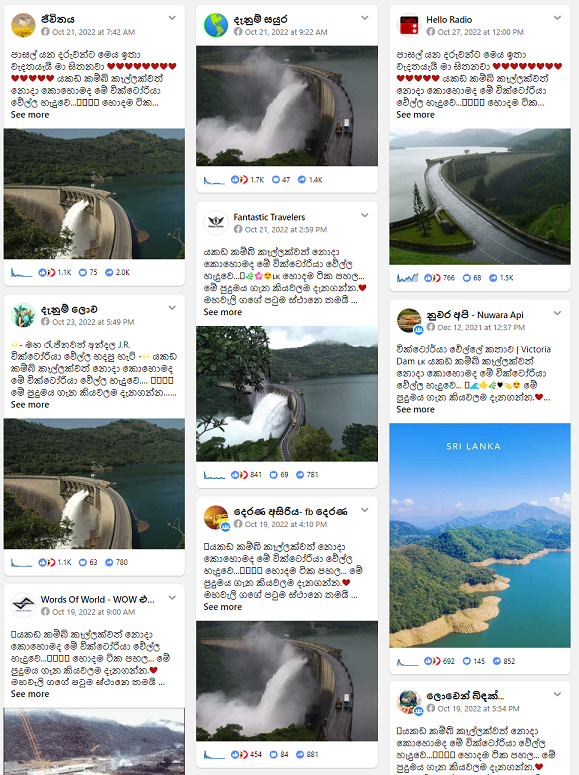
The responses to these posts also showed that many people had assumed all the facts stated in the above post to be true. Below are some such responses.

This post was shared and published by some of the websites as well. Archived Link
Based on several requests from readers to verify the accuracy of the information in this post, we took steps to verify the credibility of this information.
Fact Check :
The Victoria Reservoir, which was constructed in Sri Lanka in 1980 with a grant of 8400 million rupees from the United Kingdom by Queen Elizabeth II, was ceremonially opened on April 12, 1985, under the patronage of British Prime Minister Margaret Thatcher.
The Victoria Dam was built to take advantage of the water that falls from the Mahaweli River, Hulu River, Galmal Oya, Talawathu Oya and Ma Oya to the Victoria Falls, and find solutions to the country’s large-scale problems. These problems are storing water for the agricultural industry, generating hydroelectric power, providing water for people living upstream of the dam, developing the freshwater fisheries industry, controlling floods, etc.
The Victoria Dam, a double arch dam with a height of 122 meters, claims to be the tallest in Sri Lanka. With a water capacity of 722 million cubic meters and a catchment area of 1869 square kilometres, the Victoria Reservoir spreads over a surface area of 23.7 square kilometres. It has 8 spillways and is 12.5 meters wide and 6.5 meters long.
It is hard to believe that not a single iron wire was used to build this dam, so we inquired with the staff of the Victoria Reservoir to verify this and the accuracy of the facts stated in the above note.
Wasantha Ehalapitiya, Engineer-in-Charge and Deputy Director of the Victoria Reservoir
Mr Wasantha Ehelapitiya stated that the claim that iron wire was not used in the construction of the reservoir dam is false, especially since the spillway, particularly the upper part of the dam, where the spillways are installed, has been designed using reinforced concrete, and tons of iron have been used for that purpose.
The engineer-in-charge explained that the story that the dam was built without using any iron wire was created due to the exaggerated and misleading explanations given to school students who came to visit the Victoria Reservoir by a public relations officer at the Victoria Observation Deck, who had no special technical knowledge and that story had been used for many years to explain the reservoir and the dam.
A video clip of an instant in which it was explained was also shared through social media.
However, some of the facts in the above note are true, and it was explained that Roller Compacted Concrete (RCC) was used in the construction of many dams, both at the time of the construction of the Victoria dam and other constructed dams. The same raw materials used for ordinary concrete are often used here, but mixed in different proportions, which is suitable for low cost and quick construction, and reduces the likelihood of cracking due to the reduced thermal impact on the dam. A report on how RCC concrete is produced and its uses is here. A video is here.
Saliya Ratnayake, engineer in charge of maintenance of the Victoria Reservoir Dam
Mr Saliya Ratnayake stated that the above social media posts have been circulating for the past few years, and some of the facts stated therein are false.
Although the Victoria Dam was built with a donation of Rs. 8400 million from the British government, social media posts have stated that Mr J.R. Jayewardene had the Victoria Dam built by deceiving the Queen of England. However, he stated that there is no credibility in this statement as there is no room for such fraudulent acts in such diplomatic activities.
Furthermore, he stated that the Victoria Dam has 8 automatically operated sluice gates and 2 non-automatically controlled mud sluice gates to discharge the sludge and water that accumulated at the bottom of the dam. There are also 7 observation galleries to which people can visit. At present, many modern devices have been placed in each of these galleries to monitor the behaviour of the dam. However, he emphasized that the fact published on social media articles that about 50,000 people can stay inside the dam is also completely false and that it is very dangerous for the public to visit inside the dam, which is also a great hindrance to the normal duties of the dam.
He furthermore emphasized that the statement that “not even a single iron rod was used to build this dam” is false and that iron rods have been used to strengthen the area where the sillways of this dam are located.
Also, when the water fills, the dam moves forward and back, which is not visible to the naked eye. Here is a Facebook post he posted, along with photographs of the dam during its construction, providing further details.
Victoria Dam
The Victoria Dam is a two-arch dam located 6 km from the town of Theldeniya on the upper reaches of the Mahaweli River (209 km). It was built for the Victoria Reservoir. The main purpose of the dam was to provide irrigation and generate hydroelectric power. The Victoria Dam is the tallest in Sri Lanka.
Designed to irrigate 365,000 hectares of land and generate 600 megawatts of electricity, the Victoria Dam was first proposed in 1964 following a study conducted by Canada’s Huntings Technical Services and a team from the Food and Agriculture Organization of the United Nations Development Program.
Construction of the Victoria Dam was initiated by former President J.R. Jayawardene on 14 August 1978, and construction of its main structures was completed in 1980. It was opened on 12 April 1985.
The Victoria Dam was built under the Accelerated Mahaweli Development Programme (AMDP). The project had been in the planning stage for many years and was implemented as an accelerated programme in 1977, taking into account the economic difficulties in the country.
The dam and tunnel were built by the British joint venture Balfour Beatty & Edmond Nuttal, while the power station was built by the Costain Group. Sir Alexander Gibb and Partners served as the project’s consulting engineers.
The dam construction has resulted in the relocation of four times the estimated number of people (30,000). More information on this can be found here, here and here.
Join us to learn more about our investigative fact findings.
Facebook | Twitter | Instagram | Google News | TikTok
Conclusion :
Our investigation shows that some of the facts contained in the widely circulated post on social media, stating, “Victoria Dam built without a single iron wire,” are false and misleading.
This is due to an exaggerated and misleading explanation made by a person involved in explaining the Victoria Reservoir and the dam.
Victoria Reservoir’s Acting Engineer and Deputy Director Wasantha Ehalapitiya stated that, like many other dams, the Victoria Dam, especially the spillway area, has been designed using reinforced concrete.
Furthermore, the engineer in charge of the maintenance of the Victoria Reservoir Dam, Mr Saliya Ratnayake, emphasized that although the dam moves forward and backward when the water is filled, it is rarely visible to the naked eye. Also, the fact that about 50,000 people can stay inside the dam is also false.

Title:A misleading post stating that not even a single iron rod was used to build the Victoria Dam
Fact Check By: Fact Crescendo TeamResult: Misleading