

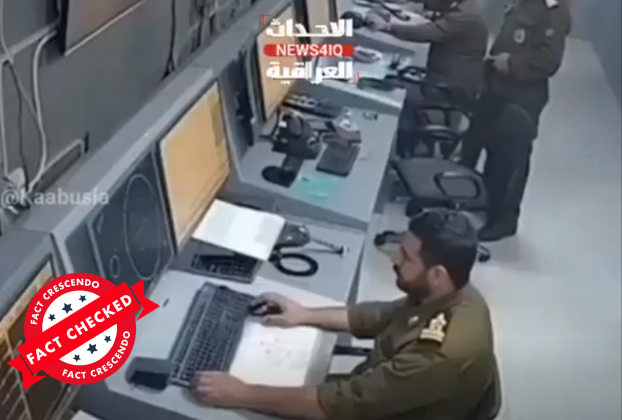
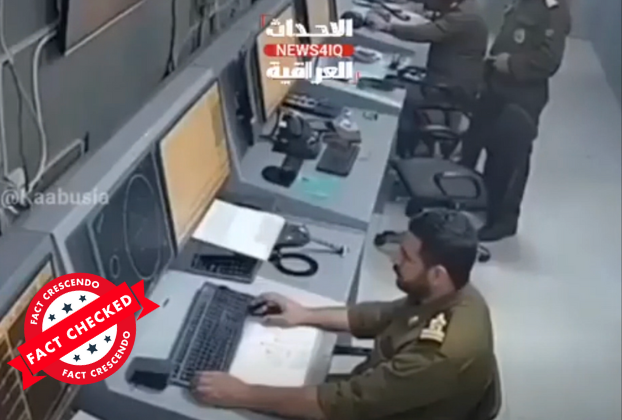
A viral montage circulating across social media platforms claims to show leaked CCTV footage from inside Iranian military and nuclear facilities during Israeli airstrikes. Many users believed it to be authentic amid renewed discussion of Iran–Israel tensions. However, our investigation finds the claim is mostly false.
Social Media Posts
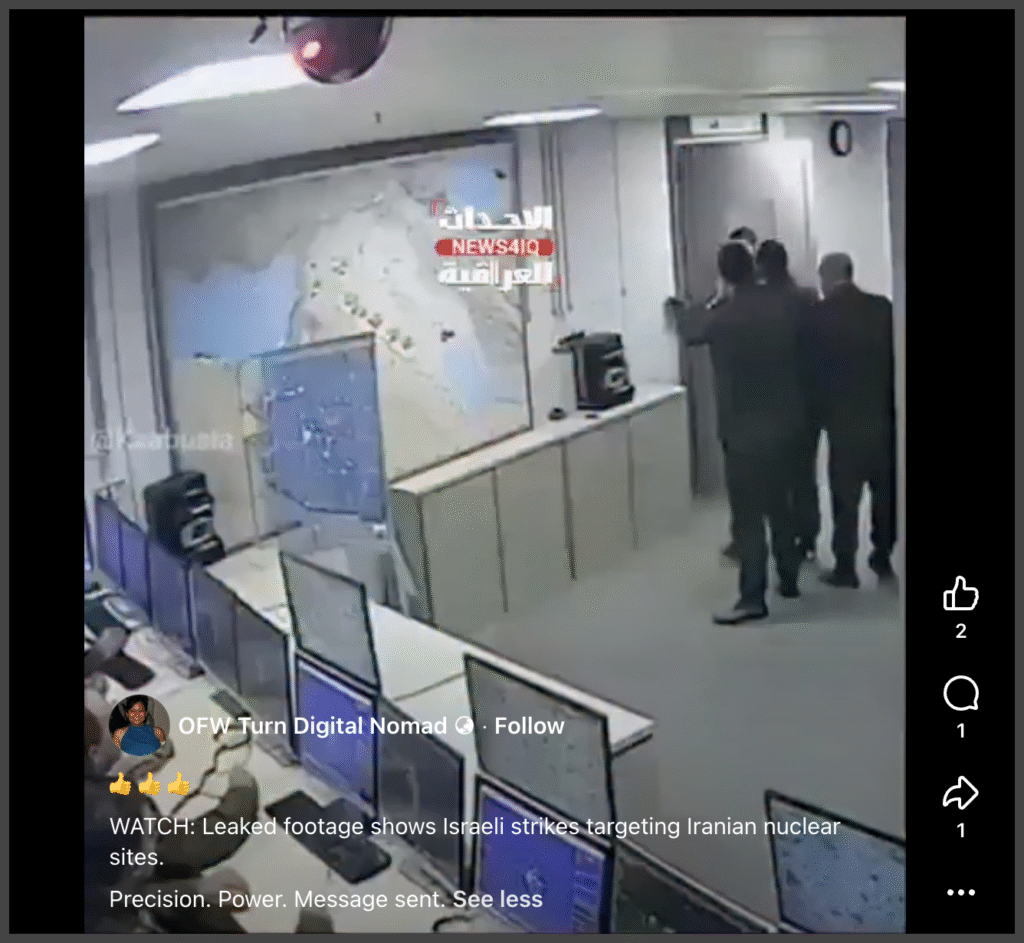
Several accounts on Facebook reshared versions of the same montage, often captioned as ‘leaked footage from Iranian nuclear sites.’
Fact Check
Three of the Four Clips Are AI-Generated
We began our investigation by using reverse image search to trace the video’s origin and found that the full four-part montage first appeared on @kaabusia, an account that frequently posts AI-generated or satirical conflict content. The account has previously spread debunked videos, including AI-fabricated scenes about child marriage and Iranian military failures.
BBC Verify journalist Shayan Sardarizadeh publicly debunked the montage, identifying visual anomalies and the account’s prior record of spreading disinformation.
According to Sardarizadeh’s review, only the third clip is real (previously shown on Iranian state TV), while the others are AI-generated fakes. The fake clips show visual flaws including incorrect military uniforms, distorted hands and desk objects, personnel working normally during explosions, and undamaged security cameras.
Our analysis identified several technical anomalies consistent with AI-generated content. In multiple frames, the lighting behavior appears inconsistent with authentic CCTV footage, explosion flashes produce uniform illumination across scenes rather than the directional light and shadow patterns typically captured by security cameras.
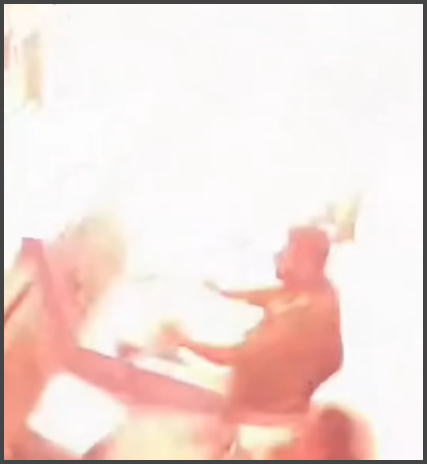
Debris movement exhibits characteristics that differ from physical expectations, appearing to float or drift without the motion blur or gravitational effects observed in real footage.
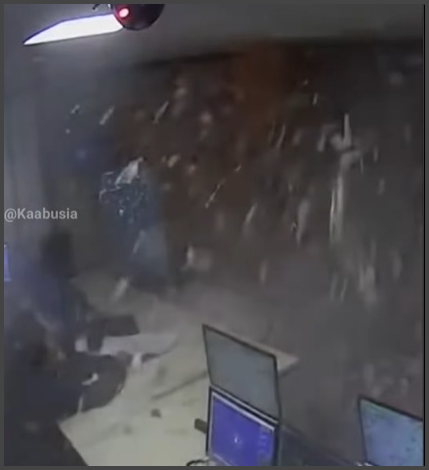
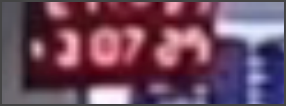
The digital clock visible in the background displays numerical forms that appear irregular and inconsistently rendered, a characteristic limitation observed in generative AI systems when reproducing precise numerical displays.
We also used Was it AI, an AI image detection tool, to assess the likelihood of AI generation. The results show that three of the four clips are highly likely to be AI-generated, further strengthening the evidence.

Only the Third Clip Is Real but Misrepresented
The third segment, featuring a briefing room reacting to a distant explosion, is authentic footage aired by Iran’s state broadcaster SSN TV on November 29, 2025. It shows damage from strikes on air defense sites near Tabriz, not nuclear facilities.
Independent confirmation by outlets such as Ynetnews shows it was released as part of post-ceasefire reporting. There is no evidence it depicts nuclear sites, and no interior CCTV from such facilities has been leaked publicly.
Context: The Real June 2025 Strikes
Israel’s Operation Rising Lion began on June 13, 2025, targeting Iran’s nuclear program, ballistic missile sites, and energy infrastructure to halt uranium enrichment.
The operation targeted several critical sites: Natanz, where the underground enrichment facility suffered extensive damage and centrifuge destruction that set Iran’s nuclear capabilities back by several years; Fordow and Isfahan, both enrichment and research facilities that were struck using U.S. B-2 bombers carrying 30,000-pound bunker-buster munitions on June 22. The attacks caused substantial losses on both sides, including several high-ranking Iranian military officials such as IRGC commander Hossein Salami, while Israeli casualties numbered approximately 28 from Iran’s retaliatory missile and drone attacks. (Source: CNN, JINSA)
Iran launched approximately 574 ballistic missiles and 1,100 drones toward Israel, with the majority intercepted by defense systems. A U.S. military base in Qatar was also targeted. A ceasefire brokered by the United States came into effect on June 24, 2025 (Source). No verified CCTV footage from nuclear facilities has been publicly released; available official footage documented external structural damage rather than interior control room operations. The IAEA reported no radiological contamination but documented significant damage to Iran’s nuclear infrastructure (Source).
The circulation of this video aligns with documented instances of AI-generated content related to the conflict. CBS News documented the spread of digitally fabricated videos during this period, including falsified footage of events such as a Tehran prison fire.
Conclusion
The viral video claiming to show leaked CCTV footage from Iranian nuclear facilities is misleading. Three of the four clips in the montage are AI-generated fabrications, while the single authentic segment shows a briefing room responding to strikes on air defense sites near Tabriz, not nuclear facilities, and has been misrepresented. Although Israel did conduct significant strikes on Iran’s nuclear infrastructure during Operation Rising Lion in June 2025, no verified interior CCTV footage from nuclear sites has been publicly released, and the viral video originated from an account known for spreading AI-generated disinformation.

Title:Viral Video Claiming ‘Leaked Footage’ of Israeli Strikes on Iranian Nuclear Sites Is Misleading
Fact Check By: Cielito WangResult: Misleading