
Subscribe to our WhatsApp Channel
A statement made by the Central Bank Governor at the Finance Committee meeting on May 13th, warning that the country’s economic outlook is uncertain, is now being widely shared across social media and mainstream media outlets.
Here is how Fact Crescendo investigated this claim.
Social Media Posts:
Posts circulated on social media claiming that Central Bank Governor Nandalal Weerasinghe had expressed concern about the current government’s actions and warned that the future is very uncertain.
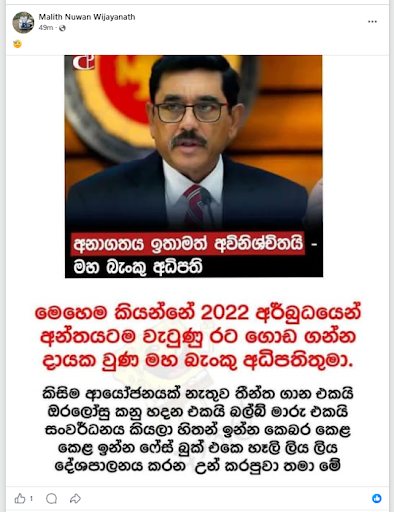
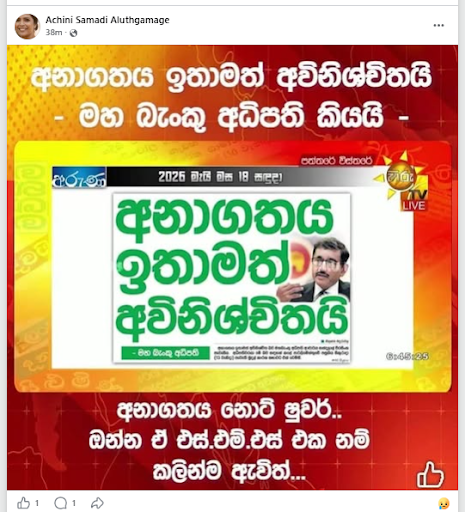

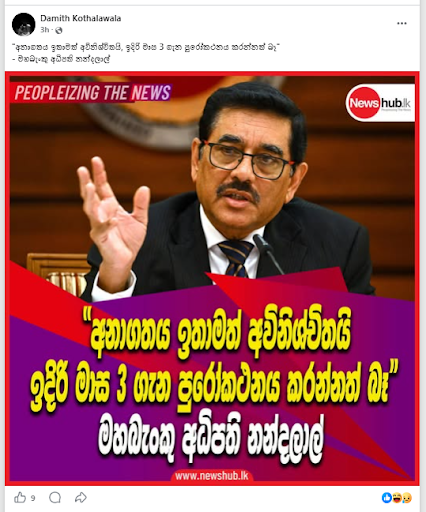
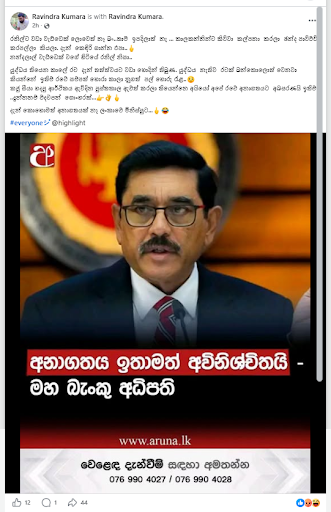
FB Post 1 | FB Post 2| FB Post 3 | FB Post 4
We investigated whether the Central Bank Governor had actually made such a statement.
Fact-Check:
In investigating the social media posts, we found they were based on a statement made by Central Bank Governor Nandalal Weerasinghe at the Finance Committee meeting on May 13th. Major media outlets reported the Governor as saying that if the global uncertainty continues, the country could be at risk and that it is difficult to predict the next three months, as reported here and here as well.
However, the social media posts omitted the fact that this prediction was driven by global uncertainty, instead presenting the Governor’s words purely as a criticism of the government’s actions.
To verify this further, we reviewed a video recording of the Finance Committee meeting.
Matters considered at the Finance Committee meeting
The main focus was the 2025 Annual Economic Review, which reported 5% GDP growth and higher per capita income despite global uncertainty. Officials also discussed inflation control, monetary policy, and strengthening the economy through record worker remittances. The discussion included challenges such as the fall of the rupee, rising oil prices due to the Middle East conflict, and a major fraud case at NDB Bank. The committee also reviewed financial stability, bank consolidation, new insolvency and bankruptcy laws, and the need for Central Bank transparency and accountability to Parliament.
Central Bank’s forecast for the future economy
Regarding the future economy, Deputy Governor of the Central Bank Chandranath Amarasekara stated that outflows were expected to exceed inflows, primarily due to the rise in global oil import prices, leading to an expected current account deficit. A significant increase in inflation was also anticipated, which officials referred to as cost-push inflation.
The timeframe discussed by Governor Nandalal is fiscal year 2026 and beyond. He stated that the Central Bank operates in three- to six-month projection cycles, particularly due to current global instability, and that the future is highly unpredictable.
He pointed out that because the situation is changing rapidly, it is difficult to make a reliable projection beyond a three-month horizon.
The Governor noted that the main reason for this uncertainty is the unpredictable nature of the ongoing Middle East conflict and its impact on global oil prices. The Central Bank’s basic economic projections were built on the assumption that the war would end within three months and global conditions would return to normal.
However, due to the rapid decline in global oil reserves and the evolving situation, the Central Bank has had to continually revise its outlook. To illustrate the severity of the energy crisis, the Governor noted that even India had announced active measures to conserve oil despite holding reserves of $700 billion.
Since February 2026, escalating conflicts in the Middle East have created significant inflationary challenges. Key concerns highlighted for 2026 include:
• Rapid inflation: Ongoing conflicts have already triggered a sharp rise in inflation, which climbed from 2.2% in March 2026 to 5.4% by April 2026.
• Cost pressures from energy prices: Rising global energy prices, driven by regional instability, have resulted in what officials term “cost-push inflation.”
• Risks to inflation targets: While the target remains at 5%, achieving this is entirely dependent on the assumption that Middle Eastern conflicts are temporary and that global economic activity will normalize quickly once they end.
• Risk of a prolonged crisis: With oil reserves declining rapidly, there are warnings of global sustainability risks if the situation persists beyond September. A prolonged conflict could cause inflation to surge well above the 5% target.
Crucially, the Governor did not attribute this uncertainty to government policy. Instead, his forecast remains tied to external factors, specifically military developments in the Middle East and their impact on oil markets.
Further clarifying this, the Governor noted at a seminar on the Annual Economic Review 2025 on May 18 that his remarks had been misrepresented. He urged media outlets to correct misleading headlines. This incident aligns with a broader trend of financial misinformation in Sri Lanka, such as the recently debunked claim regarding a People’s Bank security breach, which can be reviewed here.
Join us to learn more about our investigations
Facebook | Twitter | Instagram | Google News | TikTok | Youtube
Conclusion:
Our investigation found that a statement by Central Bank Governor Nandalal Weerasinghe is being misleadingly shared on social media as a criticism of the current government and as evidence of high future uncertainty. The Governor actually attributed the economic uncertainty and the difficulty of predicting the economy beyond three months to the global conflict and its impact on the world economy, including Sri Lanka. Crucially, he did not state that the economy became unstable due to the current government or its decisions.

Title: Central Bank Governor’s Statement on Economic Uncertainty Shared Misleadingly on Social Media
Fact Check By: Pavithra Sandamali
Result: Misleading