

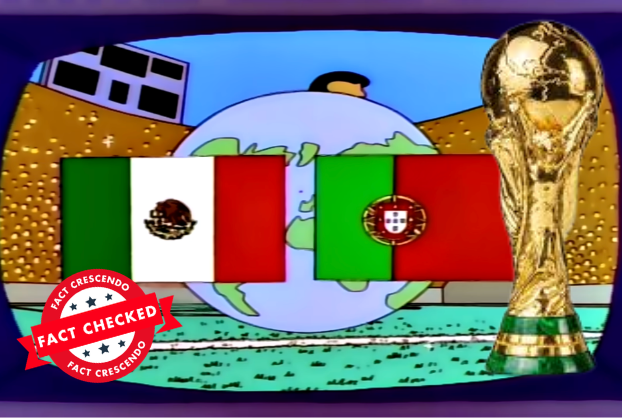
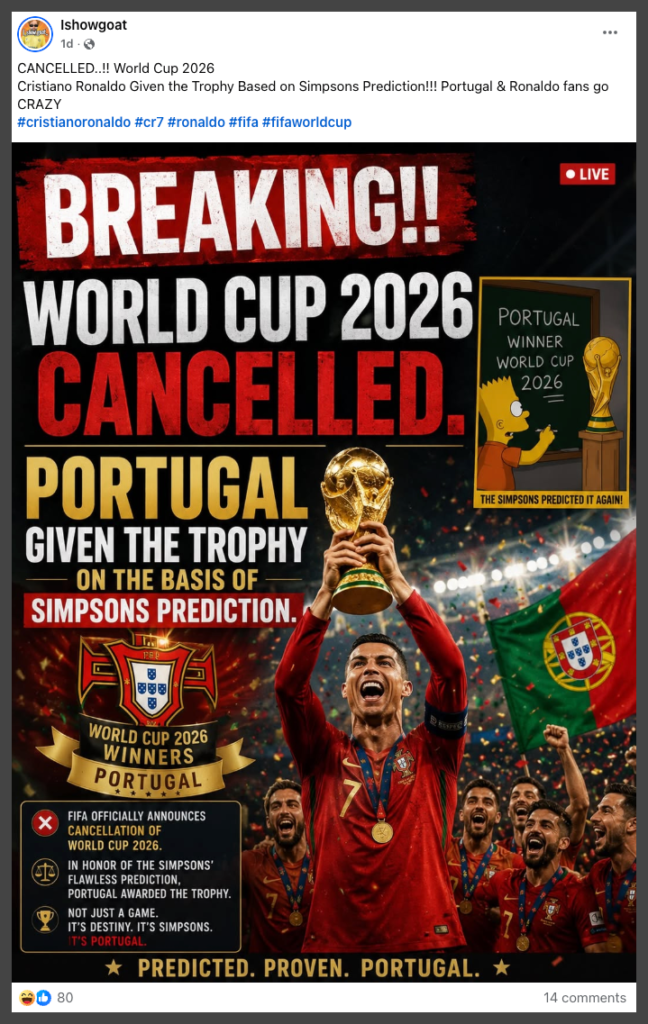
A viral claim circulating on social media platforms alleges that The Simpsons predicted the winner of the 2026 FIFA World Cup decades in advance. However, an examination of the original episode shows that the viral narrative significantly misrepresents what actually appeared in the show. We found the claim to be false.
Social Media Posts
The viral posts typically use a screenshot from The Simpsons Season 9, Episode 5, “The Cartridge Family,” which first aired on November 2, 1997, accompanied by the claim that the Simpsons already predicted the winner of the 2026 FIFA World Cup.
Fact Check
What Actually Happens in the Episode?
The viral claim is based on a real scene from “The Cartridge Family.” However, the scene has been stripped of its original context.
In the episode, Homer and his family watch a television advertisement promoting a fictional soccer match in Springfield between Mexico and Portugal. The commercial asks viewers which nation is the greatest on Earth and encourages them to attend the game.
The scene does not mention the FIFA World Cup, the year 2026, a World Cup final, a tournament bracket, Cristiano Ronaldo, or the outcome of the match.
The soccer game later takes place in Springfield Stadium, where it is portrayed as deliberately boring for comedic effect. The match is interrupted by a crowd disturbance and no winner is shown.
Neither the commercial nor any other part of the episode mentions 2026. The year was added later by internet users attempting to connect the scene to the upcoming FIFA World Cup.
Moreover, The episode never reveals who wins the Mexico-Portugal match.
The commercial merely advertises the game. Later scenes show spectators becoming bored before the match concludes. No score is provided, no champion is declared, and no trophy ceremony appears.
Similarly, there is no reference to Cristiano Ronaldo. At the time the episode aired in 1997, Ronaldo was only twelve years old and had not yet become an international football star.
The Reality Behind “Simpsons Predictions”
The belief that The Simpsons can predict the future has become a cultural phenomenon in its own right.
Some examples frequently cited as successful predictions include:
- Donald Trump’s presidency.
- Disney’s acquisition of 21st Century Fox.
- The 2015 FIFA corruption scandal.
- Smartwatch-like devices.
- Video calling technology.
Because some examples appear striking in hindsight, audiences often assume that new viral claims must also be genuine. However, the show’s creators have repeatedly rejected the idea that they possess any special predictive ability.
Producer Bill Oakley has stated: “There are very few cases where The Simpsons predicted something. It’s mainly just coincidence because the episodes are so old that history repeats itself.”
Longtime showrunner Al Jean has similarly described many apparent predictions as “educated guesses,” explaining that if writers throw enough darts, some are bound to hit the target.
The Same Pattern Appears in Other Viral “Simpsons Predictions”
The 2026 World Cup rumor is part of a broader trend of misinterpreting The Simpsons as prophetic. For instance, in 2026, social media falsely claimed a 2012 episode predicted a hantavirus outbreak on the cruise ship MV Hondius. Reuters clarified that the episode actually depicted a fictional “Pandoravirus” prank, not a real-world warning, demonstrating how internet users often retroactively force connections between old episodes and current events.
The comparison is significant because the mechanism behind both viral claims is nearly identical. In both cases, internet users retroactively connected an old episode to a contemporary event, added details that never appeared in the original broadcast, and presented the resulting narrative as evidence of a prediction.
Long-running shows like The Simpsons provide a vast library of content where viewers can retroactively find scenes vaguely resembling current events. These coincidences are often amplified through selective social media sharing and out-of-context clips, creating a false narrative of prophecy.
This persistence is driven by the illusory truth effect, where repeated exposure to a claim makes it seem more credible regardless of evidence. By sharing the same screenshots across multiple World Cup cycles, familiarity overrides facts, allowing debunked misinformation to regain traction through sheer repetition.
In the case of the Mexico-versus-Portugal screenshot, the same image has been repeatedly shared during multiple World Cup cycles. Each repetition reinforces familiarity, making the claim seem increasingly plausible despite the absence of supporting evidence.
This dynamic illustrates how viral misinformation can persist for years after it has been disproven.
Conclusion
The Simpsons did not predict the winner of the 2026 FIFA World Cup. The viral claim is based on a genuine scene from the 1997 episode “The Cartridge Family,” but the scene only depicts a fictional soccer match between Mexico and Portugal in Springfield. The episode never mentions the FIFA World Cup, never mentions the year 2026, never identifies the match as a final, and never shows Portugal winning. Claims about Cristiano Ronaldo lifting the trophy are entirely fabricated.

Title: Fact Check: No, The Simpsons Did Not Predict Portugal Winning the 2026 FIFA World Cup
Fact Check By: Cielito Wang
Result: False