
Subscribe to our WhatsApp Channel
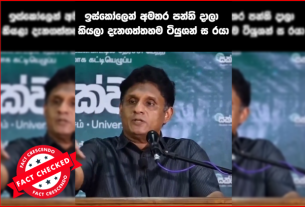
A striking line raced across Sri Lankan social media: a third of the money the country borrowed from the International Monetary Fund had been stolen, some posts went further and accused the government of pocketing it. The charge was explosive, and the figure sounded precise enough to believe. We traced it from headline to source. Here is what we found.
Social Media Posts
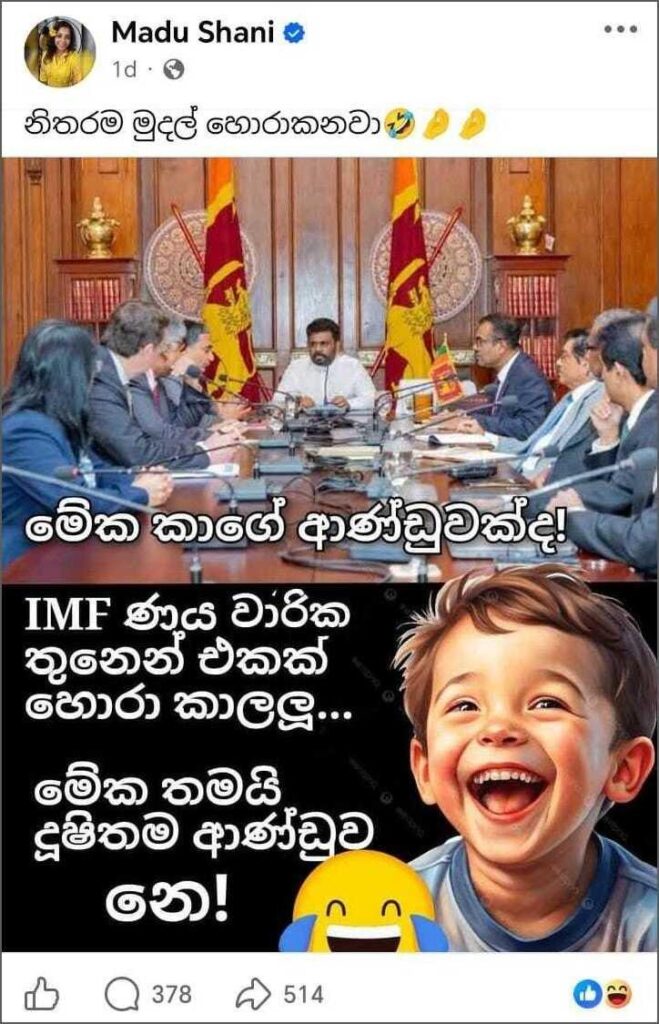
The claim spread through a set of near-identical posts, the key example of which is shown below.
Fact Check:
The idea that “a third of the IMF loan was stolen” first surfaced not on social media but in a handful of mainstream news headlines, so we went back and read the full reports behind them. That coverage can be viewed here, here and here.
In substance, those reports said the following:
- Since 2023, money has been moved abroad through banks using the international telegraphic transfer (TT) system, under the cover of fraudulent imports.
- President Anura Kumara Dissanayake told Parliament that the sum taken out of the country this way is close to US$1 billion.
- The payments were made in advance for imports, yet no corresponding goods ever arrived.
- Several suspects have already been arrested, with investigations continuing.
The underlying fraud is real, and independently corroborated. Coverage of the President’s statement appears in EconomyNext and the Daily FT. Public Security Minister Ananda Wijepala told Parliament that one investigation found a single company had funneled Rs. 12.89 billion (US$42.7 million) to 256 companies across 26 countries through 953 transactions. In response, the President, as Finance Minister, signed new Import and Export (Control) Regulations No. 06/2026 into force. So, fraud is genuine, and the government itself is investigating it.
But here is the pivot. The reports said roughly US$1 billion taken out since 2023 was equivalent to about a third of the IMF loan, not that any part of the IMF loan itself was stolen. “One-third” was a yardstick used to convey the scale of the sum, nothing more. Several headlines then dropped that crucial word “equivalent,” and the social media posts that followed distorted the claim further still.
What the President Actually Said in Parliament (June 2026)
“The next case of corruption has been discussed on our election platforms for a long time. Since 2023, advance payments of close to US$1 billion, around Rs. 300 billion have been made through TT. But the goods never came. Within this there is drug money, money earned through corruption, wealth earned through crime. Investigations have been ordered. We are now bringing in regulations to prevent it. We have identified several bank branches, and a number of people have been arrested. What has gone out of the country in dollars is wealth earned through corruption.”
The full statement is available here.
At no point did the President call this money equivalent to a third of the IMF loan or describe it as a theft of IMF funds. As he put it, this was money earned through corruption and crime and moved out through the banking system.
Ministry of Finance Response
The media secretary to Deputy Minister of Finance and Planning Anil Jayantha flatly denied the claim that a third of the IMF loan had been stolen. The Public Debt Management Office (PDMO), under the Ministry of Finance, has also confirmed that no portion of the funds received from the IMF has been stolen.
Presidential Media Division Response
The Presidential Media Division confirmed that no theft of IMF loan tranches has occurred. The nearly US$1 billion in corrupt funds the President disclosed as having been moved abroad through banks is not IMF money, and the media had used the phrase “equivalent to a third of the IMF loan” only to convey scale. That comparison, it noted, has since been twisted into misleading posts.
Central Bank of Sri Lanka Clarification
The Central Bank Governor recently set out the details of the near US$1 billion (about Rs. 300 billion) moved out under the guise of import payments. Watch the interview here.
According to him, fraud abused a legitimate advance-payment mechanism under the Import and Export Control Regulations. Under it, an importer can remit advances abroad through a commercial bank against an invoice. Some submitted fraudulent invoices, sent the money, and never imported the goods.
The funds went out under various individuals’ names and through shell companies. The Governor noted that roughly 45% of the outflow was in fact used to import genuine goods, but those imports were not properly declared to Customs. Advance payments now require Customs registration, VAT and TIN numbers before disbursement. Full discussion is available here. At no point did the Governor describe this as a theft of IMF funds.
The IMF Loan Package: The Actual Figures
The IMF’s Extended Fund Facility (EFF) was approved on March 20, 2023, for SDR 2.286 billion, about US$3 billion. After the combined fifth and sixth reviews concluded on May 27, 2026, and released a US$695 million (SDR 508 million) tranche, the total disbursed so far stands at SDR 1.778 billion, roughly US$2.4 billion. So, it is arithmetically accurate to say the US$1 billion moved abroad by fraudsters is equivalent to about a third of the IMF loan. It is simply not part of that loan.
Why “A Third of the IMF Loan” Is the Wrong Way to Put It
The error comes from conflating two entirely separate channels. The fraudulent money left through commercial banks as import advances, a different and far more loosely policed route than IMF disbursements. The key distinctions:
- Where it lands. IMF tranches are credited directly to the Central Bank of Sri Lanka’s official foreign-reserve account, not a commercial account open to political discretion (see the IMF statement and the CBSL statement).
- The SDR mechanism. IMF support arrives not as dollar notes but as Special Drawing Rights (SDR), an international accounting unit. Converting SDRs into usable funds is itself a formal, documented process, subject to the IMF’s safeguards assessment.
- Tranche-by-tranche release. The IMF does not hand over the full US$3 billion at once. Tranches are released only every few months, after confirmation that earlier ones were used properly and subject to economic review, as with the US$695 million released in May 2026 (see the IMF staff visit, June 2026).
The correct conclusion follows plainly: because the fraudulent import payments and the IMF tranches run through two separate, independently monitored channels, the claim that a third of the IMF loan was stolen is false.
The Official Bodies That Oversee the Funds
- IMF mission and Executive Board. IMF officials visit Sri Lanka regularly (for example, the June 2026 staff visit) and examine Central Bank and Treasury accounts directly.
- Auditor General’s Department. The Auditor General has constitutional authority to independently audit the government’s and Central Bank’s use of foreign aid and loans (source).
- Financial Intelligence Unit (FIU). The Central Bank’s FIU monitors suspicious transactions through dedicated technical systems (source).
- Governance Diagnostic Assessment (GDA). The IMF introduced its first Governance Diagnostic Report in Asia specifically for Sri Lanka, to strengthen its anti-corruption framework (full report).
How the Public Can Track the Money Independently
- Transparency International Sri Lanka (TISL) monitors fiscal transparency through its Government Action Plan Tracker.
- Manthri.lk lets anyone follow Sri Lanka’s progress on IMF conditions through its IMF Tracker.
Join us to learn more about our fact-check investigations.
Facebook | Twitter | Instagram | Google News | TikTok
Conclusion
The social media claim that a third of Sri Lanka’s IMF loan tranches have been stolen is false. No IMF loan funds have been stolen. What is true is that organized fraudsters have moved close to US$1 billion out of the country since 2023 through fraudulent import-advance payments, a fact confirmed by the President, the Central Bank, the Ministry of Finance and the Public Security Minister, with investigations ongoing.
Because that fraudulent sum happens to equal roughly a third of the IMF loan, the media used it as a comparison, but several headlines, by dropping the word “equivalent,” turned it into something incomplete and misleading. In short: fraud is real, the claim of IMF-fund theft is false, and the two are entirely unconnected. We rate the claim as false.

Title: One Third of Sri Lanka’s IMF Loan Was NOT Stolen : Misleading Media Headlines Led to Confusion
Fact Check By: B.P. Hansani
Result: False