
Subscribe to our WhatsApp Channel
After Cyclone Ditwah, the deadliest disaster to hit Sri Lanka since the 2004 tsunami, the government opened a donation fund called ‘Rebuilding Sri Lanka.’ As money flowed in, a newspaper line about where the donations were being held was picked up by a television review show and then by social media and quickly hardened into a blunt accusation: the government had stolen the relief money. The charge is emotive, and it lands hard when people are hurting. We followed the audit trail. Here is what it actually shows.
Social Media Posts
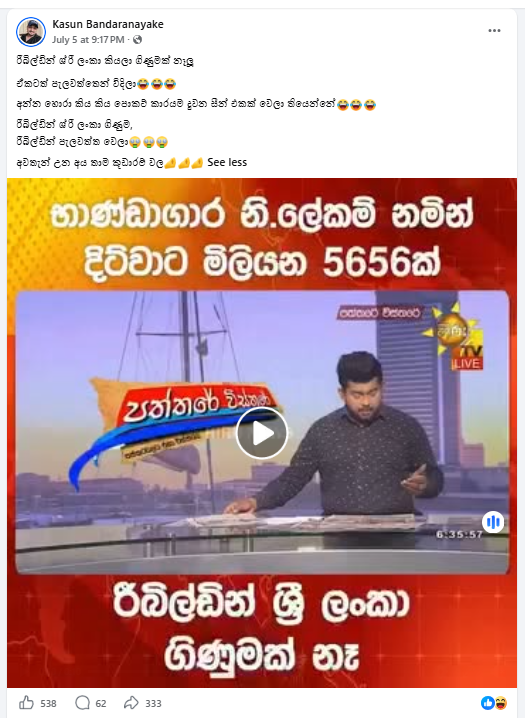
A Divaina newspaper report referenced National Audit Office findings on donor contributions for post-Ditwah rebuilding, noting the funds were held in bank accounts registered under the name of the Deputy Secretary to the Treasury.
Drawing on that article, a Hiru newspaper-review programme had its presenter imply the current government had embezzled the money, and from that video further social media posts claimed the Ditwah relief funds had been misappropriated, as seen below.
Fact-Check:
Cyclone Ditwah and the Fund’s Establishment
Cyclone Ditwah, which struck Sri Lanka between November 26 and 28, 2025, is recognized as the country’s most devastating natural disaster since the 2004 tsunami. Nearly all 25 districts were hit by flooding and landslides, claiming more than 640 lives and affecting close to 2 million people. According to the World Bank’s GRADE report, direct economic losses were estimated at US$4.1 billion, roughly 4% of GDP.
In response, the ‘Rebuilding Sri Lanka’ programme and its associated donation fund were launched under the patronage of President Anura Kumara Dissanayake, as part of a broader Rs. 500 billion recovery programmes aimed at rebuilding destroyed homes, compensating owners of partially damaged property, stabilizing landslide-prone areas, and rehabilitating agricultural land, rural roads, and irrigation infrastructure.
The Cabinet approved establishing this fund as a statutory fund under the Presidential Secretariat, with a management committee chaired by Deputy Finance Minister Anil Jayantha Fernando and a presidential task force headed by Prime Minister Harini Amarasuriya.
How the Fund Has Grown Over Time
- December 19, 2025: about Rs. 4.29 billion (including over US$6 million).
- December 31, 2025 (audited): Rs. 5,656 million.
- February 10, 2026: Rs. 6.07 billion, plus US$10.29 million.
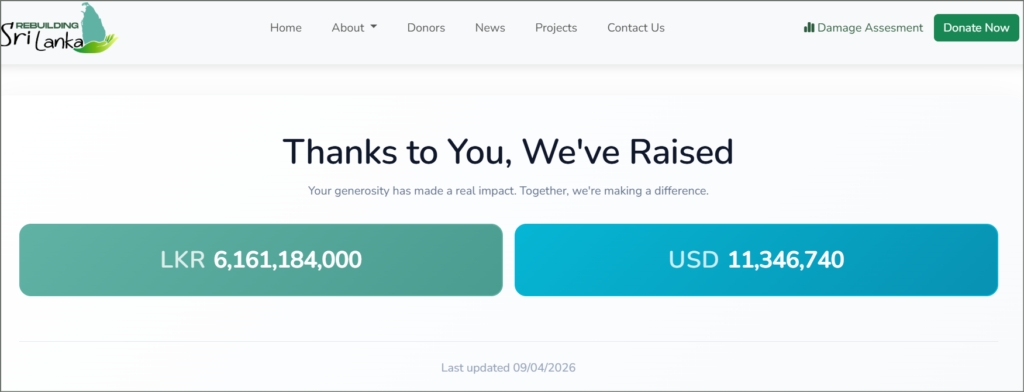
- June 2026: about Rs. 10 billion, according to the Deputy Minister.
Adding the rupee and dollar figures listed on the fund’s official website yields a total close to Rs. 10 billion.
The National Audit Office Report
According to the National Audit Office, Rs. 5,656 million in donor contributions had been received by December 31, 2025, held in bank accounts registered under the name of the Deputy Secretary to the Treasury. The audit also found that, despite Cabinet approval, the statutory ‘Rebuilding Sri Lanka’ fund had still not been formally established as of May 20, 2026.
At the June 2026 meeting of the Parliamentary Committee on Public Finance (COPF), Senior Assistant Auditor General E. M. S. Ekanayake stated that none of the funds received had yet been spent, and that the entire sum remained in a special Treasury account.
Under the Public Finance Management Act, non-statutory funds cannot be maintained; only statutory funds established through an Act of Parliament may be. So, the fund has yet to attain official legal status, and donations are being held temporarily in a special Treasury account in the meantime.
Where Is the Money, and Could Anyone Withdraw It Secretly?
Can funds held in the Deputy Secretary to the Treasury’s account be withdrawn at the discretion of a minister or official? No.
- Consolidated Fund. Under Article 149 of the Constitution, funds credited to this account legally belong to the state’s Consolidated Fund, not to any individual’s personal account.
- Parliamentary approval is mandatory. Under Article 150, not a single rupee can leave the Consolidated Fund except under a minister’s warrant for sums approved by Parliament (see the Treasury Financial Regulations, Sections 148-150).
- Required by the PFMA 2024. Under the Public Finance Management Act No. 44 of 2024, non-statutory funds cannot be maintained, and such money must go into the Consolidated Fund. The call to formalize the funds is therefore entirely legitimate.
- Is the balance traceable? There is no live balance dashboard, but the total received is published on the official website, and the independent Auditor General (Articles 153-154) audits the account and reports to Parliament and the COPF. Oversight is institutional and periodic, not concealed.
No one can personally withdraw these funds, spend them without parliamentary approval, or evade audit scrutiny. What was raised before the COPF was not missing money, but a legal-structural gap: the failure to formally establish the statutory fund.
At the COPF: Dr. Harsha de Silva
Dr. Harsha de Silva, Chairman of the COPF, stressed at the June 2026 session that, to his knowledge, no legally established fund called ‘Rebuilding Sri Lanka’ actually exists despite media references to it, raising questions about where donor contributions were held and how they were audited.
His argument was that, since the Public Finance Management Act prohibits non-statutory funds, a provision introduced after the ‘Helping Hambantota’ fund controversy, the ‘Rebuilding Sri Lanka’ fund must likewise be formally established through an Act of Parliament and run with proper transparency and audit accountability. Notably, he did not allege that any misappropriation had occurred.
Leader of the House Minister Bimal Rathnayake
Speaking in Parliament in June 2026, Leader of the House and Transport Minister Bimal Rathnayake accused certain opposition MPs of presenting baseless claims to mislead the public.
He clarified that ‘Rebuilding Sri Lanka’ is simply an alternate name for the official account held by the Deputy Secretary to the Treasury, and that because all funds credited to it flow directly into the Consolidated Fund, there is no possibility of financial fraud or misappropriation. Since parliamentary approval is mandatory for spending, he said, not a single rupee could be spent without the House’s sanction, and work on drafting legislation to formally establish the fund had already begun.
Deputy Minister Anil Jayantha Fernando
Responding to a question from Samagi Jana Balawegaya MP Mujibur Rahuman, Deputy Finance Minister Anil Jayantha Fernando said no separate external fund named ‘Rebuilding Sri Lanka’ had been created, precisely to avoid the problems that arose from external funds like the Tsunami Fund. Instead, the money is credited more securely and lawfully to an account under the Deputy Secretary to the Treasury.
He noted that Parliament had approved Rs. 500 billion for post-Ditwah reconstruction, with Rs. 248 billion already allocated and disbursed. Only about Rs. 11 billion has come from local and foreign donors so far, with the remaining Rs. 489 billion of the approved Rs. 500 billion borne by the General Treasury via the Consolidated Fund. He stressed the funds have not been used for any unlawful purpose and confirmed a clear financial statement would be presented at year’s end detailing how the full Rs. 500 billion was spent, with a breakdown of donations versus Consolidated Fund money.
Prime Minister Harini Amarasuriya
Prime Minister Harini Amarasuriya said that because establishing an independent statutory fund through an Act of Parliament takes time, a special deposit account was opened under the General Treasury so assistance could be received without delay.
She emphasized that not a single rupee of public money had gone to any private or unlawful account; all funds remain secure under the Deputy Treasury Secretary’s custody and the Auditor General’s oversight, so no question of legality arises. She added that the governing committee is drafting the legal and institutional framework to formally establish the fund and is working toward Cabinet approval soon.
The Real Issue
The real issue confirmed by the audit is not theft, but that ‘Rebuilding Sri Lanka’ has yet to be formally established as a statutory fund despite months passing since Cabinet approval. Former Finance Minister Ravi Karunanayake noted this leaves it in a state that is technically illegal and legally ambiguous under the PFMA (The Morning). So, while the claim of theft is false, a genuine question about legal structure and transparency does remain.
Join us to learn more about our fact-check investigations.
Facebook | Twitter | Instagram | Google News | TikTok
Conclusion
Our investigation finds that the social media claim the government has embezzled or misappropriated donations to the ‘Rebuilding Sri Lanka’ fund is not supported by the National Audit Office’s report. Per the audit, none of the funds received have been spent; they remain safely under the official custody of the Deputy Secretary to the Treasury. Claims that relief has been withheld are also misleading, since Rs. 248 billion has already been separately disbursed from the Treasury.
The genuine issue confirmed by the audit is that, despite months since Cabinet approval, the statutory ‘Rebuilding Sri Lanka’ fund has not yet been formally established in law. So, while the embezzlement claim is false, legitimate questions remain about the fund’s legal status and transparency. We rate the claim as misleading.

Title: Missing Millions? Unpacking Claims That the ‘Rebuilding Sri Lanka’ Fund Was Embezzled
Fact Check By: Pavithra Sandamali
Result: Misleading