

Subscribe to our WhatsApp Channel
Kasagala Green Plantations (Pvt) Ltd has become the subject of heated debate in recent weeks. The dispute intensified after the Central Bank of Sri Lanka (CBSL) issued an official statement rejecting claims its director made during a television appearance and opened a formal investigation soon after. Below is our explainer on the key event that transpired.
Social Media Posts :
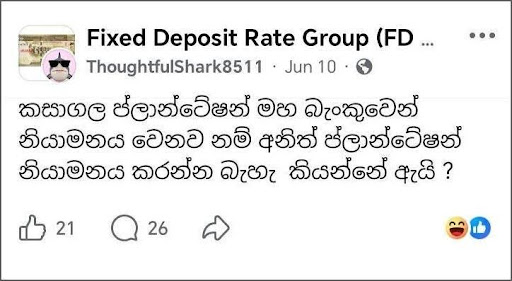
Posts questioning whether Kasagala Plantations were running a pyramid scheme circulated as follows:

Other posts, working from the assumption that Kasagala Plantations is a CBSL-regulated entity, continued to discuss the controversy in this form:
We investigated the facts available on this matter.
Explainer :
What Kind of Company Is Kasagala Green Plantations?
According to its own website, Kasagala Green Plantations (Pvt) Ltd is the main subsidiary of the Kasagala Group, a Sri Lankan business conglomerate built on agriculture, exports, and investment. The company grows and exports high-demand crops including black pepper, cinnamon, mango, bell pepper etc. To sell its own produce directly, it runs an island-wide retail chain under the brand Kasagala Green Super. The company takes public investment for these agricultural ventures, which it says are backed by fixed assets such as land and plantations. Further details are available here. Archived.
Media outlets have reported a rise in unauthorized entities using mainstream media and aggressive marketing to solicit public funds through high-yield investment schemes. Those reports are available here and here.
What was said on ITN’s “Pini Viyana” on 8 June 2026
Appearing on ITN’s Pini Viyana programme on 8 June 2026, Kasagala Green Plantations Chairman Ranjith Peiris discussed the rapid growth the Kasagala Group had achieved domestically and internationally within roughly a year and a half.
During that appearance, he stated that Kasagala Green Plantations is regulated by the Central Bank of Sri Lanka and submits financial statements every six months.
The full program is available here.
The Central Bank of Sri Lanka(CBSL) Says Kasagala Is Not a Regulated Entity
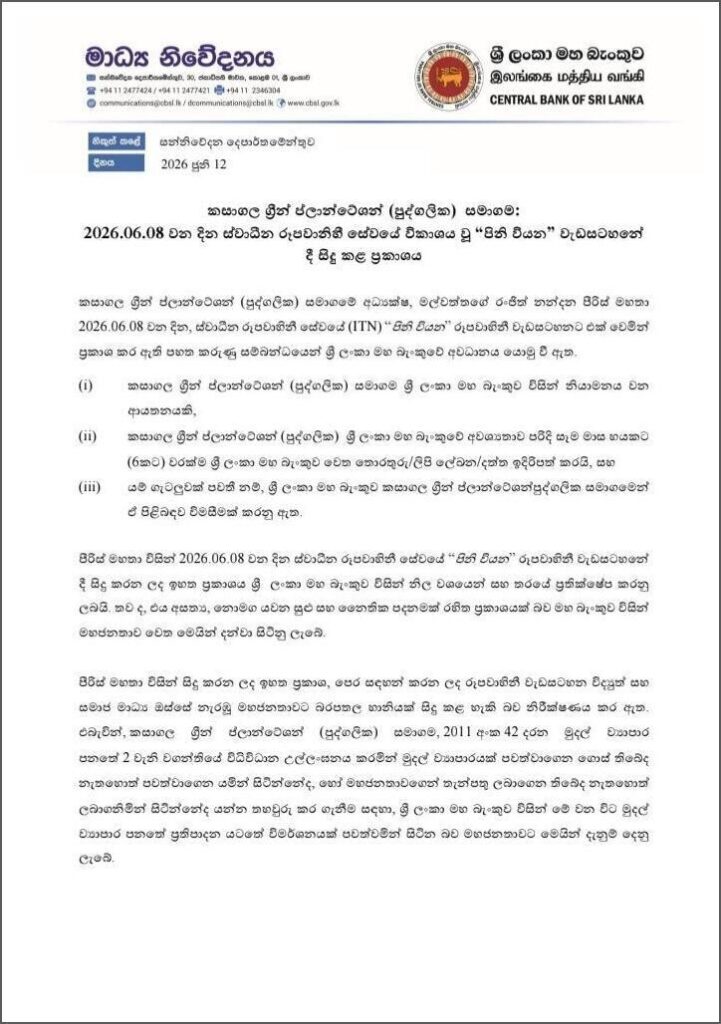
CBSL issued a formal statement noting it had been taken notice of these remarks by Mr. Peiris on Pini Viyana, specifically that Kasagala Green Plantations is regulated by the Central Bank, and that the company submits information to CBSL every six months under that supposed regulatory requirement.
The Central Bank officially and firmly denied these claims, declaring them false, misleading, and without legal basis.
CBSL also disclosed that it is investigating, under the Finance Business Act No. 42 of 2011, whether Kasagala Green Plantations has conducted or is conducting finance business, or has accepted or is accepting public deposits, in violation of Section 2 of that Act. The official notice is available here.
An Investigation Is Currently Under Way
The Central Bank is investigating whether Kasagala Green Plantations has conducted or is conducting a finance business, or has accepted or is accepting public deposits, in violation of Section 2 of the Finance Business Act. No final determination has been made yet about whether an offence occurred, but the Central Bank has clearly stated it has reasonable grounds for suspicion.
Kasagala’s Response to the Central Bank’s Notice
After the Central Bank’s statement, Kasagala Plantations held a press conference to give its own account. Company management said the Kasagala Group is a plantation business registered under the Companies Act No. 7 of 2007, and that Central Bank approval is not required to operate an agricultural or plantation business.
Management said the company does not accept public deposits in violation of the Finance Business Act, and that its operations are based on plant sales and forward crop agreements. They said the Central Bank had requested documents for its inquiry and that the company had already provided everything requested. Full press conference is available here. The company has continued posting actively on social media, including promotional content, since the dispute began.
How the Central Bank Has Handled Similar Cases Before
The Central Bank has taken legal action against entities like this and their affiliates on several previous occasions. Under Section 83C of the Banking Act No. 30 of 1988, any scheme that generates profit primarily from recruiting new members or increasing their contributions, a pyramid scheme, is illegal. Anyone who promotes, markets, invests in, or manages such a scheme can face prosecution. This framework is set out on the Central Bank’s dedicated pyramid scheme page.
How to Spot a Potentially Fraudulent Investment Scheme
The Central Bank consistently points to these warning signs:
Unrealistic returns: promising investment returns well above standard bank interest rates.
Unclear revenue source: the business cannot clearly explain where its income comes from, especially when it depends heavily on recruiting new investors.
Unverifiable regulatory claims: claiming ties to government regulators that cannot be confirmed directly with those agencies.
Manufactured credibility: heavy television and social media advertising used to build public trust artificially.
Confusing registration with regulation: mistaking a basic certificate of incorporation for a Central Bank license to conduct financial business.
(Being a company legally registered with the Registrar General does not mean the Central Bank has regulated it as a financial institution. This is a common point of confusion among investors.)
Where This Leaves Kasagala Green Plantations
It is clear that Kasagala Green Plantations is not regulated by the Central Bank. The Central Bank has not concluded that the company has committed financial fraud. That investigation remains ongoing.
Before investing in any institution, the public should:
Verify regulatory status: check whether the entity is a licensed, registered institution under the Central Bank.
Report concerns: contact the Central Bank on the 1935 hotline, by emailing fcrd@cbsl.lk, or via WhatsApp at 0765780000.
Be cautious of media exposure: television or social media presence alone is not a guarantee of legitimacy.
The Central Bank has separately warned media organisations against promoting unauthorized investment schemes. Further details are available here.
Join us to learn more about our fact-check investigations.
Facebook | Twitter | Instagram | Google News | TikTok

Title: Kasagala Green Plantations and the Central Bank: What Actually Happened, Explained
Fact Check By: B.P. Hansani
Result: Insight