



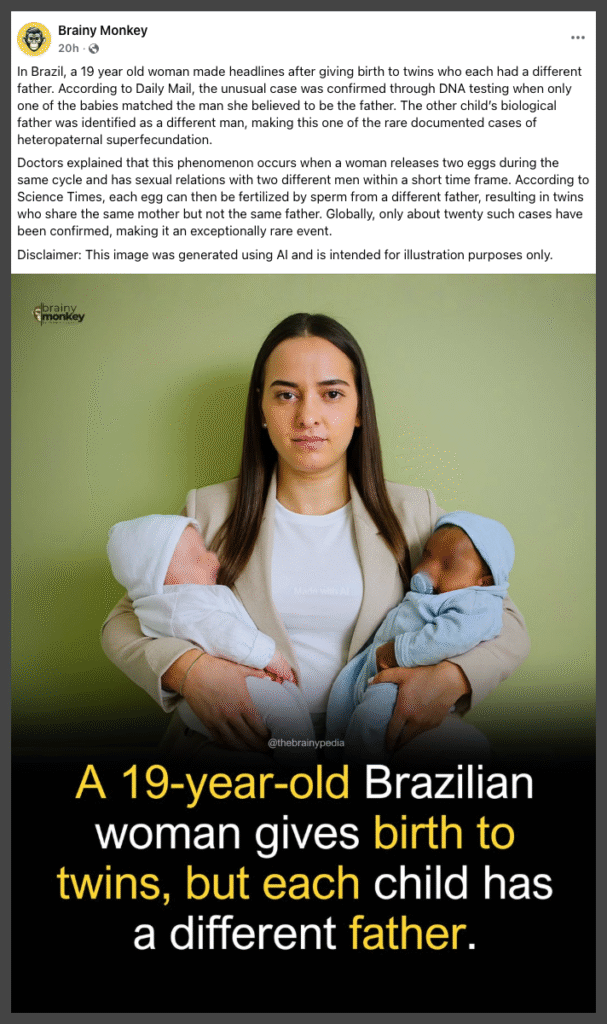
A widely shared story claims that a 19-year-old woman from Mineiros, Goiás, Brazil, gave birth to twins who have two different biological fathers. The report has been repeated by international outlets and social media posts, often framed as a “one-in-a-million” case that surprised doctors worldwide. While this claim is true, the way it spreads online often omits key scientific context.
Social Media Posts
Many social media users have shared a story about a Brazilian woman with captions such as “One Mother, Two Twins, Two Different Fathers: A One-in-a-Million Birth.” The story has spread widely across multiple platforms.

Fact Check
What do reliable reports say about the Brazil case?
Brazilian local media provide the clearest description. Reports from Metrópoles state that a 19-year-old woman from Mineiros, in the state of Goiás, became pregnant with twin boys after having sex with two partners on the same day during her fertile period. When the twins were around 8 months old, the man she believed to be the father requested a paternity test. The test showed he was the biological parent of only one of the boys. The mother then contacted the second man, who agreed to testing and was identified as the father of the other twin.
The pregnancy and follow-up were monitored by physician Dr. Túlio Franco of Faculdade Morgana Potrich (FAMP). Franco told Metrópoles that this situation is known scientifically as heteropaternal superfecundation and cited preliminary literature suggesting only around 20 such cases had been documented worldwide at the time. The mother reported a high-risk pregnancy with pre-eclampsia and differences in fetal development timing. Despite this, the twins were delivered healthy and have continued to develop normally according to local reports.
International reports, such as from The Science Times and MedIndia mirror these details and identify the case as an example of heteropaternal superfecundation.
What is heteropaternal superfecundation?
The Brazil case demonstrates a known but very rare reproductive phenomenon called heteropaternal superfecundation. Here’s how it works:
Superfecundation occurs when two or more eggs released in the same menstrual cycle are fertilised by sperm from separate acts of intercourse. When those eggs are fertilised by sperm from different men during the same cycle, it’s called heteropaternal superfecundation. The result is twins who share a mother but have different biological fathers.
From a genetic standpoint, these twins are fraternal twins who are also half-siblings, they share about 25 percent of their genes, similar to regular half-siblings from different pregnancies.
The biological mechanism is straightforward: Some women occasionally release two eggs in a single cycle (called hyperovulation) rather than the usual one. Sperm can survive in the reproductive tract for up to five days, while each ovulated egg remains viable for roughly 12 to 48 hours. If a woman has intercourse with two different partners within this narrow fertile window, it’s possible for each egg to be fertilised by sperm from a different man.
As the McGill University Office for Science and Society puts it, these are “just fraternal twins with an extra twist.” (Source)
How rare is this?
There is no exact general-population rate, but several lines of evidence show that heteropaternal superfecundation in humans is extremely uncommon. A classic forensic study by Wenk et al. (1992) reviewed 39,000 paternity test records and found only three cases of heteropaternal superfecundation. Among dizygotic twins involved in paternity suits, the estimated frequency was 2.4 percent, though the authors cautioned that this could not be safely extrapolated to the wider population.
A 202 case report from Colombia in the journal Biomédica documented twin boys with different fathers confirmed by STR-based paternity testing, labelled heteropaternal superfecundation an “extremely rare phenomenon,” and noted that more cases may surface as DNA testing becomes more common.
The McGill OSS explainer states that by 2020 only 19 cases had been reported worldwide, again emphasising that the true number is likely higher because the phenomenon is usually detected only when paternity is specifically tested.
Myths and misconceptions
Online discussions of the Brazil story often include incorrect or incomplete claims. Here are the key clarifications:
It doesn’t break biological rules: Heteropaternal superfecundation is unusual but entirely consistent with what we know about reproduction: a woman can release multiple eggs in one cycle, sperm can survive in the reproductive tract for several days, and different sperm can fertilize different eggs.
It’s not the same as superfetation: Superfetation refers to becoming pregnant again during a separate menstrual cycle while already pregnant, which is a controversial and exceptionally rare event in humans. In the Brazil case, both eggs were fertilized during the same cycle, which is superfecundation, not superfetation.
The babies aren’t “abnormal”: Medical reports show that heteropaternal twins are typically healthy. Being half-siblings rather than full siblings has genetic implications, but it’s not a medical problem. The Brazilian twins were reported as healthy and continue to be monitored by a university medical team.
It requires specific circumstances: Heteropaternal superfecundation doesn’t happen by chance with a single partner. It requires intercourse with two different men within the same fertile window, plus the release of multiple eggs in that cycle.
Legal and social implications
Heteropaternal superfecundation raises questions for family law and child support frameworks.
In Brazil, the man confirmed as father of one twin chose to recognize and support both twins, registering them and paying child support. The second biological father did not take responsibility.
In other jurisdictions, courts have had to decide how child support applies when twins have different fathers. A 2015 case in New Jersey, USA ruled that a man identified as the father of one twin was responsible for child support only for that child, not for the sibling who had a different father. This case is referenced in legal and scientific discussions of heteropaternal superfecundation.
Advances in genetic testing are bringing to light scenarios that traditional legal frameworks for parenthood did not explicitly address.
Source:
Wenk et al. – How frequent is heteropaternal superfecundation?

Title:Brazilian Woman’s Twins with Different Fathers: A Rare but Real Phenomenon
Fact Check By: Cielito WangResult: Insight