

Subscribe to our WhatsApp Channel
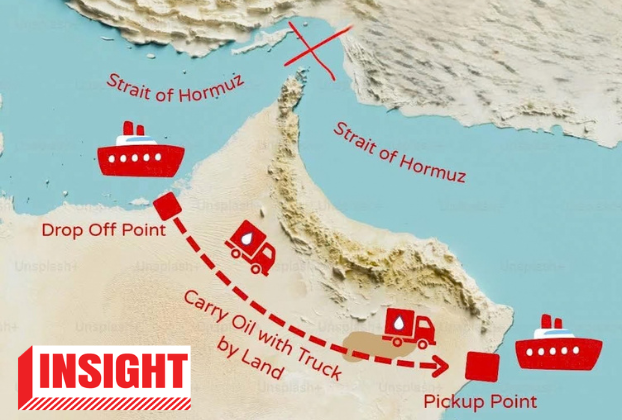
Amid ongoing conflict in the Middle East, Iran has blocked the Strait of Hormuz, which is a major shipping route for transporting oil. A social media post was published regarding this, stating that a solution has been implemented to bypass the Strait of Hormuz and transport oil via land. Here is a fact check we did regarding it.
Social Media Posts :
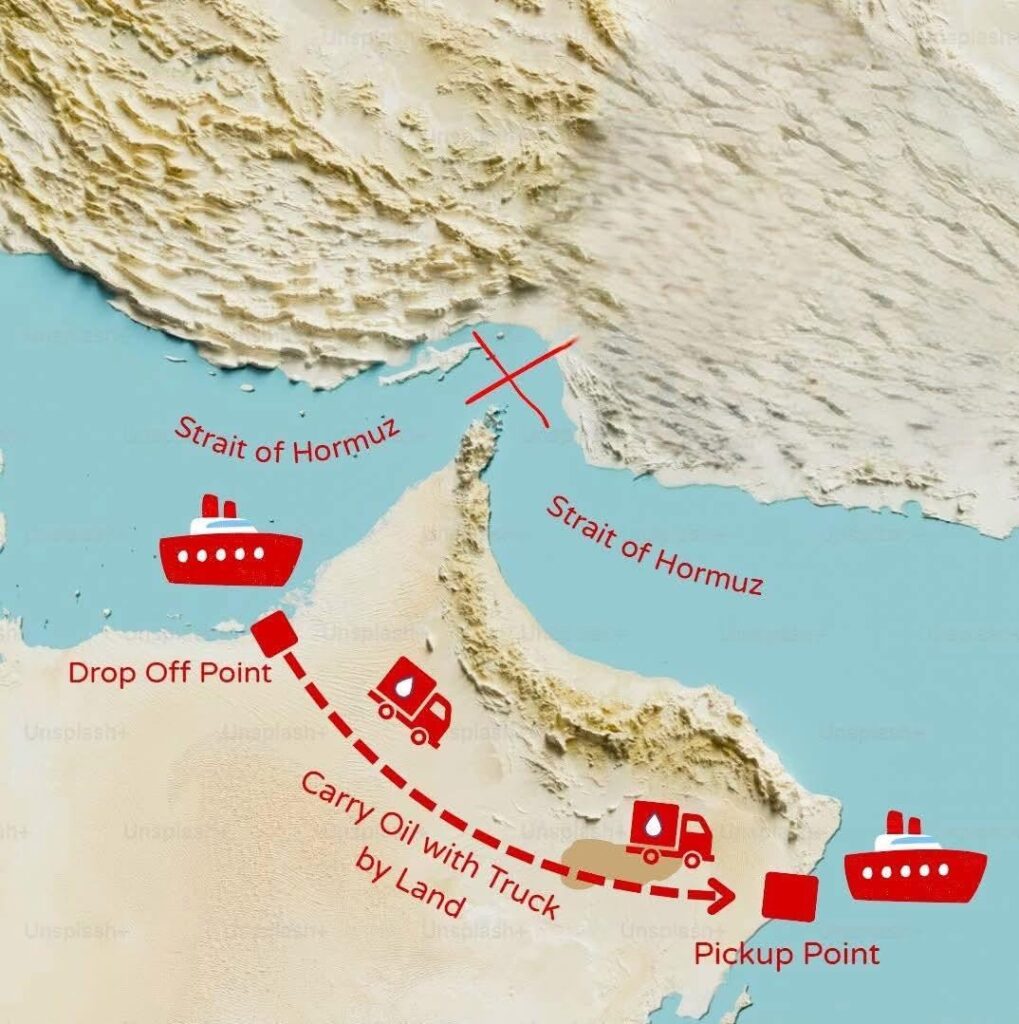
This image explains a proposal that suggests that tankers could offload crude oil at ports in the Persian Gulf region, then transport the oil overland via trucks across the United Arab Emirates and Oman. Oil would then be reloaded onto tankers on the Gulf of Oman side to bypass the Strait of Hormuz.
Explainer :
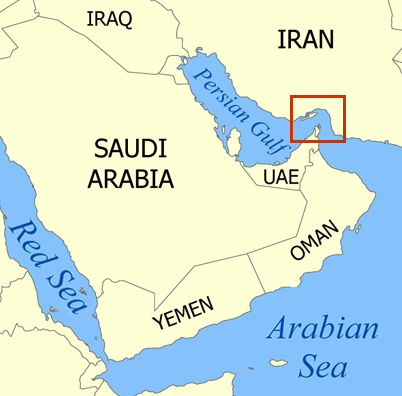
Where is the Strait of Hormuz located?
The Strait of Hormuz is the world’s most critical oil shipping route.
Located between Iran to the north and Oman and the United Arab Emirates to the south, it is 50 km (31 miles) wide at its entrance and exit, and narrows to 33 km (20 mi) at its narrowest point. It is the only maritime connection between the Gulf and the Arabian Sea.
The Strait of Hormuz is the main transportation route for major Middle Eastern oil and gas exporters to international markets, and importing countries depend on its continued operation. More information on this here.
Volume of oil transported through the Strait of Hormuz
The main reason the truck route through land is considered impractical is the enormous volume of oil passing through the Strait of Hormuz. According to the US Energy Information Administration (EIA), about 20 million barrels per day are shipped through the strait. This scale is a core obstacle to overland alternatives.
More information on this can be found here.
Approximately 80% of the oil passing through Hormuz is shipped to Asian markets, with Japan, South Korea, China and India heavily dependent on supplies transported through this strait.
In the first half of last year, the United States imported about 400,000 barrels of crude oil and petroleum products per day from Persian Gulf countries through the Strait of Hormuz.
However, shipping through the Strait of Hormuz has fallen sharply, following the February 28 US and Israeli military strikes against Iran and the Islamic Revolutionary Guards Corps (IRGC) targeting vessels transiting the strait.
According to the UK Maritime Trade Operations (UKMTO), the average number of commercial ships passing through the Strait of Hormuz daily is around 138.
Replacing such a massive amount of sea transport through land would require far more infrastructure and logistics than currently available. More information regarding this here and here.
Tank capacity and truck capacity
The difference in carrying capacity between oil tankers and trucks makes this idea impractical. A typical large oil tanker can carry about 2 million barrels of crude oil, while a standard tanker truck can typically carry only 150–200 barrels.
This means that it would take approximately 10,000 to 15,000 truck trips to transport a single large tanker. To equate this to the 20 million barrels per day that typically pass through the Strait of Hormuz would require hundreds of thousands of truck trips each day, which is unrealistic.
Existing alternative routes already use pipelines
Countries in the region have already developed alternative routes to bypass the Strait of Hormuz, but these are via pipelines, not trucks.
For example, Saudi Arabia operates the East-West (Petroleum) Pipeline, which transports crude oil from its eastern oilfields to the Red Sea port of Yanbu. Similarly, the United Arab Emirates’ Habshan–Fujairah Pipeline takes oil directly to the Gulf of Oman, allowing exports to bypass the strait.
However, even these large-scale pipelines do not cover the volume of shipping through the Strait of Hormuz, and studies show that they cover only a fraction of the oil shipped through the Strait of Hormuz, and that the majority of global oil supply still depends on this sea route. More information on this is here.
Infrastructure and cost constraints
Transporting oil by truck on a massive scale would require extensive infrastructure that does not currently exist. The road networks across Oman and the UAE are not designed to handle hundreds of thousands of heavy tanker trucks daily. In addition, ports would need major facilities to unload oil from tankers, transfer it to trucks, and reload it onto other ships.
Crude oil trucks are significantly more expensive than pipelines. Pipeline transportation typically costs only a few dollars per barrel, while truck transportation can be several times more, depending on distance and logistics, according to international media reports.
Security and operational risks
The transportation of large amounts of crude oil by truck also poses major security and logistical challenges. Coordinating hundreds of thousands of trucks every day increases the odds of highway accidents, toxic spills, and environmental disasters. Furthermore, transferring oil from tankers to trucks and back to ships would be a slow and complex process compared to continuous flow in pipelines. More information on this can be found here and here.
Join us to learn more about our investigative fact findings.
Facebook | Twitter | Instagram | Google News | TikTok | Youtube
Conclusion :
The above photo circulating on social media may point to the practical difficulties of global oil transportation. The Omani Peninsula appears to be relatively short, as the geographical distance from Musandam, UAE, to Oman is approximately around 190 – 320km. However, according to experts, the feasibility of such a route is not determined only by the distance.
The sheer scale of global oil shipments passing through the Strait of Hormuz every day means that transporting oil by truck through land would require an extremely large number of vehicles and significant infrastructure, making the idea impractical, even with a relatively short land crossing. Therefore, to think that oil shipments can bypass the Strait of Hormuz using trucks via Oman is impractical.

Title: Is it feasible to transport oil across the UAE & Oman using trucks?
Fact Check By: Fact Crescendo Team
Result: Insight