


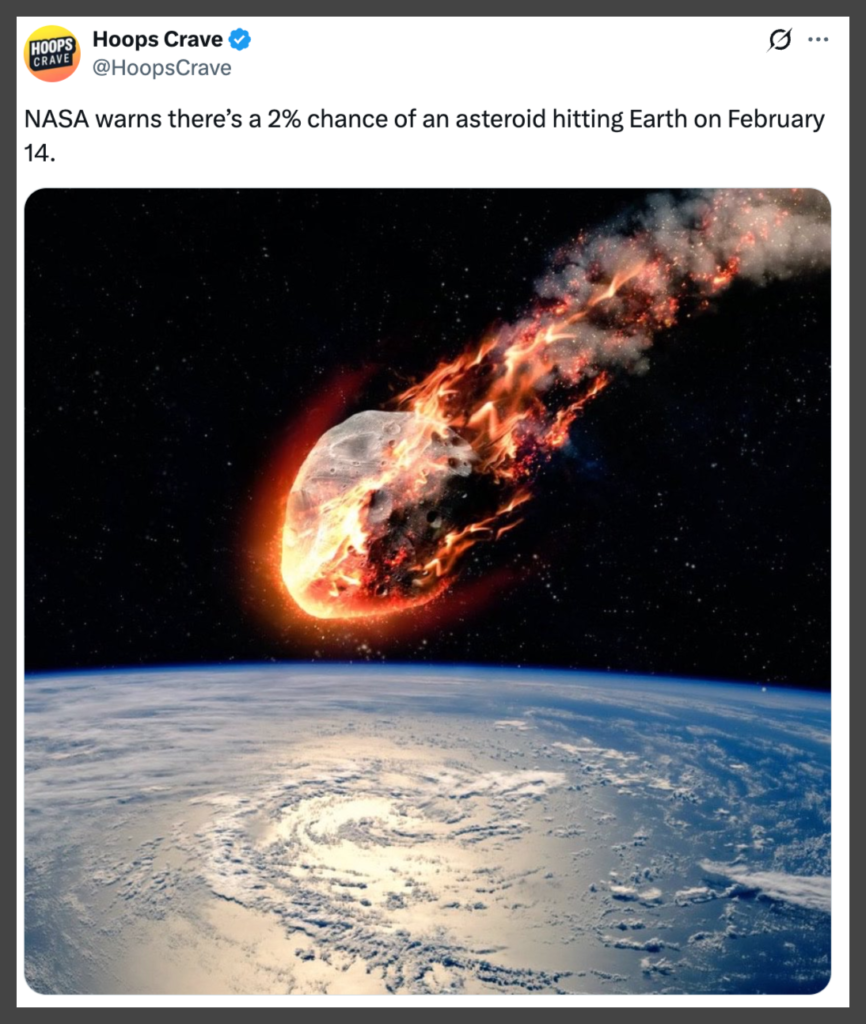
A claim circulating widely on social media platforms alleges that NASA has issued a warning about a 2% chance of an asteroid hitting Earth on February 14. The post has gained traction by combining a specific probability figure with the notable date of Valentine’s Day. However, an examination of available evidence indicates the claim is misleading.
Social Media Posts
Multiple social media users recently claimed that NASA identified a 2% risk of an asteroid hitting Earth on February 14.

Fact Check
No NASA Warning for February 14
NASA monitors potential asteroid threats through its Center for Near-Earth Object Studies (CNEOS), which maintains a publicly accessible Sentry Earth Impact Monitoring table. This database catalogs all known near-Earth objects that have any calculated chance of impacting our planet, including their potential impact dates and associated probabilities. A review of the latest data shows no asteroid with a 2% impact probability for February 14, 2026, and NASA has not released any warning that matches the viral social media claim.
Where the “2%” Figure Actually Came From
The 2% probability figure circulating online comes from early analysis of asteroid 2024 YR4, but it was never linked to February. When astronomers first spotted 2024 YR4 in late 2024, their initial calculations suggested a 2–3% chance of Earth impact on December 22, 2032. This preliminary estimate was reported in early 2025, with scientists noting that such probabilities typically change significantly as more observations are made.
As astronomers tracked the asteroid more carefully, NASA’s Sentry monitoring system progressively lowered the Earth-impact probability, first dropping it below 1%, then eventually reducing it to nearly zero. This demonstrates that the original 2% figure was based on incomplete data and was never meant to be a final assessment.(Source)
Why February 14 Keeps Appearing
The Valentine’s Day angle appears to come from confusion with a different asteroid, 2023 DW. In early 2023, NASA reported that 2023 DW had a very small chance, about 1 in 560 (≈0.18%), of impacting Earth on February 14, 2046. Even at the time, NASA and the European Space Agency stressed that these odds were expected to decline as more data became available. This case was widely reported as a “Valentine’s Day asteroid,” but it never involved a 2% probability and was tied to a date more than two decades away, not an upcoming year. (Source)
What NASA Says About 2024 YR4 Now
According to NASA’s official science page on 2024 YR4, updated with data through mid-2025, the asteroid poses no significant risk to Earth in 2032. While refined calculations indicate a remaining ~4.3% chance of a lunar impact on December 22, 2032, Earth-impact scenarios have been ruled out with current observations. These conclusions incorporate data from ground-based telescopes and the James Webb Space Telescope.
Conclusion
The claim that NASA warned of a 2% chance of an asteroid hitting Earth on February 14 is false. The 2% figure originated from early calculations for asteroid 2024 YR4’s potential impact in December 2032, not February, and has since been reduced to near zero. The February 14 date appears to stem from confusion with asteroid 2023 DW, which had a much lower probability (about 0.18%) of impacting Earth on Valentine’s Day 2046, not 2026.

Title:Did NASA Warn of 2% Asteroid Impact Risk on Valentine’s Day 2026?
Fact Check By: Cielito WangResult: False