

A claim circulating widely on platforms suggests that placing cabbage leaves on painful joints can alleviate arthritis symptoms, reduce stiffness, and even “boost mobility.” However, we found that cabbage leaf wraps have only been studied in a very narrow context (knee osteoarthritis) and that the evidence supports at best modest, short-term symptom relief. These wraps are not validated as a general arthritis treatment and should not be interpreted as an alternative to proven therapies.
Social Media Posts
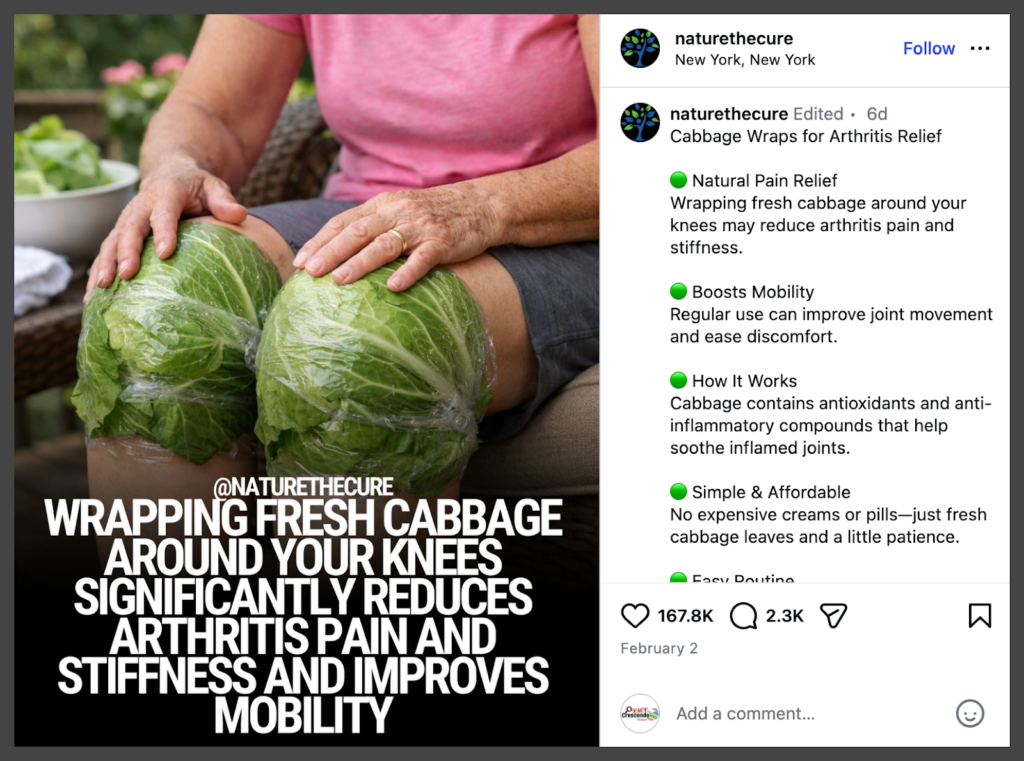
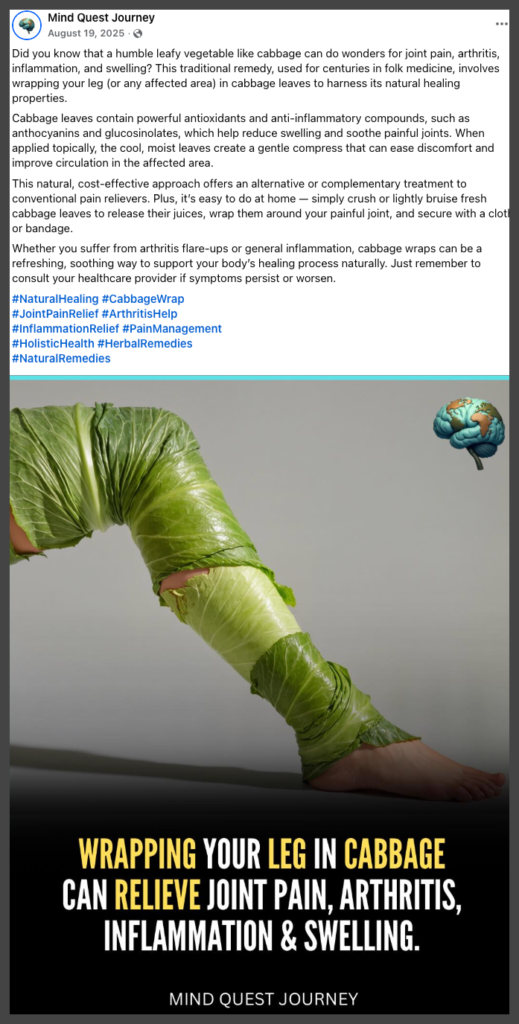
Social media posts promoting cabbage wraps make several assertions: that cabbage leaves can significantly reduce arthritis pain, improve joint movement, act through anti-inflammatory compounds, and serve as a natural alternative to medications.
Fact Check
Clinical Evidence on Cabbage Wraps
Limited Research: Knee Osteoarthritis Only: Clinical studies specifically examining cabbage leaf wraps have been conducted only in people with knee osteoarthritis (OA), which is the most common type of arthritis and involves wear and tear of joint cartilage. These studies do not address other forms of arthritis such as rheumatoid arthritis or psoriatic arthritis, nor do they apply to joints like the hands, hips, or spine.
The most frequently cited trials include:
- Randomized Controlled Trial by Lauche et al. (2016): This study tested cabbage leaf wraps against a topical anti-inflammatory gel (diclofenac) and standard care in patients with knee osteoarthritis. Participants in the cabbage wrap group applied the leaves to their knees daily for at least two hours over a four-week period. The results showed that cabbage wraps reduced pain and improved joint function more effectively than standard care alone. However, when compared directly to diclofenac gel, cabbage wraps did not perform any better at reducing pain after four weeks.
- Thai Randomized Trial (2022): A four-week open-label trial compared cabbage leaf wraps to a cooling gel pad and diclofenac gel in people with moderate-to-severe knee OA. The cabbage and cooling gel groups both showed significant improvements in pain (Numerical Rating Scale) and function (Oxford Knee Score) from baseline, and both performed better than the diclofenac group in this particular experiment. However, results were based on a relatively small group and the study was not blinded, which increases the chance of placebo effects.
- A 2023 account by Medical Dialogues, summarizing the Lauche study, concluded that cabbage wrap therapy may effectively reduce pain and improve various outcomes in knee OA but also noted that it is unclear how much of this effect may be due to expectation or placebo, and that more research is needed.
These are the only reasonably rigorous, controlled clinical studies to date; no large, long-term trials exist demonstrating that cabbage leaves deliver meaningful therapeutic benefit across all types of arthritis.
Effect Size and Practical Impact
Even in the clinical trials that reported some benefit, several important limitations remain.
The pain reduction is modest and short-term (measured over weeks rather than months or years). A Thai trial found improvements observed with cabbage wraps were often similar to those seen with simple cooling gel pads, suggesting that the benefit may derive more from the physical sensation of cold and compression than from any specific biochemical effect of cabbage leaves. The Lauche trial found that cabbage wraps were no better than topical diclofenac gel, a common, affordable treatment. Moreover, none of the trials involved blinded control groups in a way that eliminates placebo effect, and sample sizes were relatively small.
These findings indicate that current evidence does not support claims that cabbage wraps are a broadly effective arthritis treatment. Research has not demonstrated that the intervention reverses cartilage damage, restores joint structure, or produces benefits across multiple joints or different arthritis types.
Biological Rationale
Cabbage leaves contain phytochemicals such as flavonoids, glucosinolates, and antioxidant compounds that have demonstrated anti-inflammatory or antioxidant activity in laboratory settings.
Some traditional medicine practices have used crushed cabbage leaves for inflammatory conditions. A scientific review discussing plant bioactive compounds acknowledges these anti-inflammatory properties in laboratory contexts.
However, clinical trials on cabbage wraps did not measure absorption of these compounds through the skin, nor did they assess inflammatory biomarkers within the knee joint.
No study has demonstrated that cabbage phytochemicals penetrate intact human skin in sufficient concentration to reduce deep joint inflammation. The proposed mechanism remains speculative.
Given that cooling gel pads performed similarly in trials, the simpler explanation may be that the benefit stems from local cooling, compression, and expectation effects, rather than specific biochemical activity. (Source)
Overgeneralization and Evidence Gaps
What the Key Study Actually Found: The most frequently cited study is the German RCT by Lauche et al. (2016), which tested cabbage leaf wraps in patients with knee osteoarthritis (Kellgren–Lawrence grade II–III), comparing them with topical diclofenac gel and usual care over four weeks. Cabbage wraps reduced pain more than usual care alone but performed no better than diclofenac gel, meaning they were similar to, not superior to, a standard topical anti-inflammatory. Benefits were modest and limited to knee osteoarthritis only. The trial did not test other joints or arthritis types, nor did it show structural joint improvement.
Short-Term Results Only: The benefits observed in these studies lasted only about four weeks, and some improvements disappeared in later follow-ups. This suggests that cabbage wraps do not produce lasting changes in joint health or structure. Because osteoarthritis is a chronic, long-term disease, short-term symptom relief does not prove the therapy works over time or changes the underlying condition.
Small Sample Sizes Limit Confidence: Studies on cabbage wraps typically include only 60–80 participants total, split across multiple groups. With such small sample sizes, results can be influenced by chance, individual variation, or placebo effects. Larger, multi-center trials would be needed to confirm whether the findings are reliable and applicable to more people.
Study Design Weaknesses: At least one key study was open-label, meaning participants and clinicians were aware of which treatment was being administered. In open-label designs, knowledge of the treatment may influence participant-reported outcomes. Open-label trials are generally considered to provide less robust evidence than double-blind, placebo-controlled trials.
Medical Guideline
Major clinical practice guidelines from authoritative sources such as the American College of Rheumatology (ACR) emphasize evidence-based therapies for osteoarthritis, particularly knee osteoarthritis. Recommended first-line treatments include structured exercise programs, weight management, patient education, and physical therapy. Pharmacologic options such as topical and oral nonsteroidal anti-inflammatory drugs (NSAIDs) are also recommended when appropriate. In more severe cases, intra-articular injections and surgical options may be considered.
Importantly, natural home remedies such as cabbage leaf wraps are not included in official treatment guidelines, because there is insufficient high-quality evidence to support them as standard therapy.
Safety and Risk Messaging
Although cabbage leaf wraps are generally low-risk, they are not entirely risk-free. Prolonged contact with cold objects can cause tissue damage, frostbite, or skin irritation if not used properly. Healthcare providers recommend wrapping any cold source in a thin towel before application. Individuals with plant allergies or sensitivities to Brassica vegetables may develop dermatitis or itching from direct leaf contact. Any topical application, even of natural materials, should be used with caution and awareness of individual skin tolerance. (Source)
Mayo Clinic notes that cold packs can reduce pain and inflammation but must be protected from direct skin contact, especially for individuals with circulatory issues or impaired nerve sensation.
Harvard Health adds that cold or heat therapies, while common and low-cost, lack robust scientific data for deep tissue benefits. They provide superficial relief and minor swelling reduction but are not substitutes for medical care.
Healthcare providers caution against using cold or heat therapy on:
- Areas with impaired sensation (e.g., nerve damage, diabetic neuropathy)
- Broken, inflamed, or rashy skin
- Severe swelling or acute injuries requiring expert evaluation
Expert Views on Cold and Heat for Joint Pain Management
Orthopaedic and arthritis specialists recommend cold and heat therapies as adjunctive tools, not stand-alone treatments. Dr. Hayden N. Box, an orthopedic surgeon at Mass General Brigham, notes that cold reduces swelling and numbs pain in arthritic joints, while heat relaxes stiff muscles and eases chronic ache. These methods help patients stay active and manage symptoms but should be tailored to the type of pain and swelling level.
Physical therapy expert Eric Robertson, DPT, explains that cold therapy works by constricting blood vessels and slowing pain signals, reducing surface swelling and superficial pain but not treating deep joint pathology. Misunderstanding cold’s effects often leads to overestimating its impact on deeper structures like cartilage or bone.
Conclusion
The claim that cabbage leaf wraps can relieve arthritis pain is misleading due to overgeneralization. Research shows that cabbage wraps may provide modest, short-term pain relief for knee osteoarthritis specifically, performing similarly to topical anti-inflammatory gels or cooling pads in small clinical trials. However, there is no reliable evidence that cabbage wraps work for other types of arthritis, other joints, or provide long-term benefits, making social media claims of a general arthritis remedy misleading and overstated.