



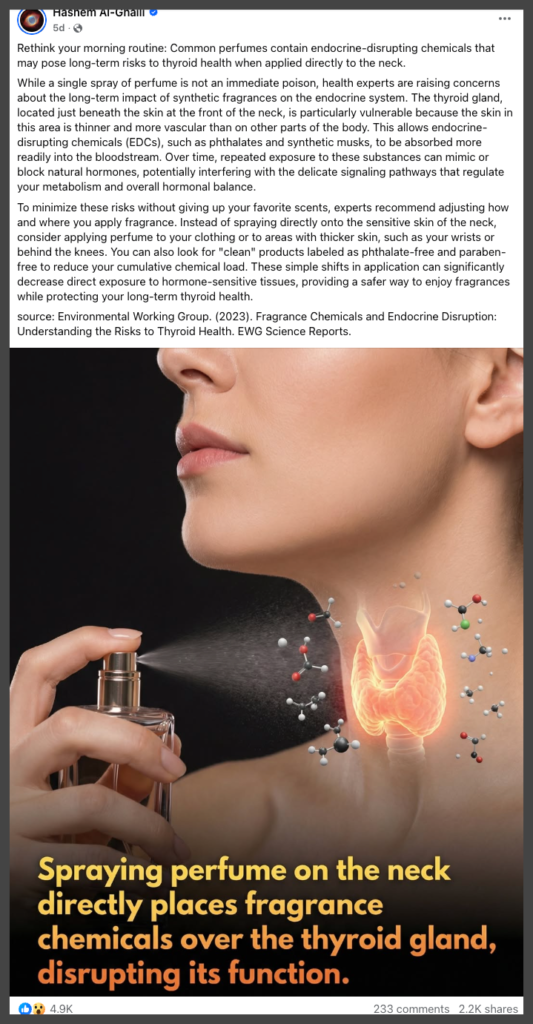
A claim circulating widely on social media platforms alleges that spraying perfume on the neck is dangerous because it places fragrance chemicals “directly over the thyroid gland,” disrupting hormone signaling and thyroid function. However, after reviewing, we found this claim to be misleading.
Social Media Posts
The viral posts typically state that spraying perfume on the neck directly places fragrance chemicals over the thyroid gland, disrupting its function.

What Science Says About Perfume and Thyroid Function
Some ingredients commonly discussed in relation to fragrances, such as certain phthalates and parabens, have been classified as endocrine-disrupting chemicals. Laboratory and population studies have explored potential associations between these chemicals and hormone systems, including thyroid hormones. A review published in Environmental Research summarizes research on phthalate exposure and changes in thyroid hormone levels in some populations.
However, this broader toxicology research does not establish a direct causal link between spraying perfume on the neck and thyroid disease. Clinical guidelines and medical reviews on thyroid disorders do not currently list perfume use, neck spraying, or fragrance application as recognized causes of abnormal thyroid-stimulating hormone (TSH) levels or thyroid dysfunction. A medical review summarizing current clinical guidance found no evidence linking normal perfume use to thyroid disease in humans.
The Thyroid Is Not Directly Under Neck Skin
The thyroid gland sits deep in the front of your neck, about 5–15 millimeters below the skin surface. Between the skin and the thyroid lie several protective layers: neck skin (1-2 mm thick), subcutaneous fat (2–5 mm), the platysma muscle, connective tissue, and the sternohyoid and sternothyroid muscles (each 3–6 mm thick). The gland itself is 13–20 mm thick and is positioned in front of the windpipe, between the fifth cervical and first thoracic vertebrae. (Source: KenHub, TeachMeAnatomy, PubMed: StatPearls)
Because of this multi-layered anatomy, perfume sprayed on the neck cannot physically “sit on” the thyroid or expose it directly. While the skin can absorb small amounts of certain chemicals, this absorption occurs into the bloodstream and contributes to overall systemic exposure rather than delivering chemicals directly to a specific organ beneath the application site. Reviews on dermal absorption emphasize that endocrine effects, when observed, relate to cumulative whole-body exposure from many sources, including food packaging, household products, and personal care items, rather than localized application over a particular gland.
What Are the Real Health Risks of Perfume?
The most common health effects from perfume use involve the skin and respiratory system, not hormones. Research shows that fragrances can trigger skin irritation, allergic reactions (contact dermatitis), headaches, and breathing difficulties in people who are sensitive to them, particularly with regular or heavy use.
Public health experts recommend reducing overall exposure to potential endocrine-disrupting chemicals by using fewer scented products or choosing fragrance-free alternatives, rather than simply avoiding perfume on the neck.
Phthalates in Perfumes: What the Research Shows
Phthalates are synthetic chemicals commonly added to perfumes to make scents last longer. They work by slowing down how quickly the fragrance evaporates. On ingredient labels, phthalates are usually hidden under the term “fragrance,” as explained in toxicology reviews. The most common types in perfumes are diethyl phthalate (DEP) and dimethyl phthalate (DMP), which help stabilize the scent in many consumer products. U.S. cosmetic regulations permit manufacturers to simply list “fragrance” without revealing specific chemicals, according to the FDA.
Studies have linked phthalate exposure to various health concerns, including effects on reproduction, development, and metabolism. Some research has also found potential connections to changes in thyroid hormones. A 2024 meta-analysis of 23 studies with over 10,000 participants found that people with higher phthalate levels in their urine had higher T3 (triiodothyronine) and lower T4 (thyroxine) levels, with varying effects on TSH.
Crucially, these findings do not prove that spraying perfume on your neck causes thyroid disease. Scientific reviews note that the associations found in studies are often weak, vary between studies, and are influenced by many factors like diet and plastic use. A direct cause-and-effect relationship has not been established.
Bottom Line: Is It Safe to Spray Perfume on the Neck?
For most people, spraying perfume on the neck is generally considered safe when used in moderation. Medical reviews and dermatology sources indicate that the primary documented risks involve skin irritation or allergic reactions, rather than thyroid disruption . Neck skin is thin and often sun-exposed, which may make frequent perfume application contribute to contact dermatitis, hyperpigmentation, or photosensitivity reactions in some individuals . Fragrance allergies affect a subset of the population, and respiratory irritation may occur in individuals with asthma when perfumes are heavily sprayed near the face. (Source: Medindia, Cosmopolitan, Reston Dermatology and Cosmetic Center)
Conclusion
The claim that spraying perfume on the neck directly disrupts thyroid function is misleading. While some fragrance ingredients like phthalates have been studied for potential endocrine effects, there is no clinical evidence that typical perfume use on the neck causes thyroid disease. The thyroid gland sits deep beneath multiple layers of tissue, and any chemical absorption occurs systemically through the bloodstream rather than directly affecting the gland below the application site.

Title:Does Spraying Perfume on the Neck Disrupt Thyroid Function?
Fact Check By: Cielito WangResult: Misleading