
Subscribe to our WhatsApp Channel
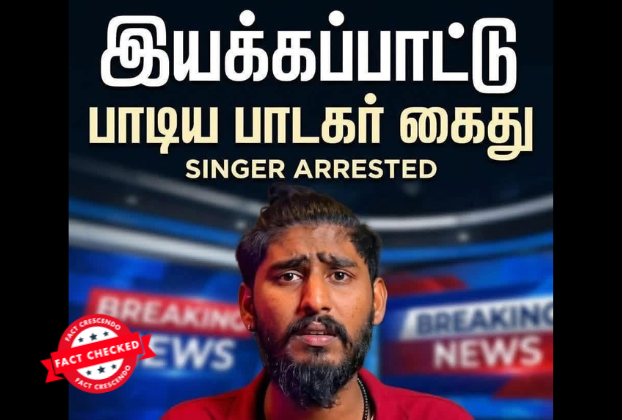
A 24-year-old Tamil rapper from Kilinochchi performed at a Hindu temple festival in northern Sri Lanka on a May evening. Days later he was in Jaffna Prison, facing allegations that a song he wrote was an attempt to revive a designated terrorist organization. The arrest of Sangeethsan Ganeskumar, known to his fans as Hip-hop Sangee, set off a chain of events that drew condemnation from Amnesty International, Tamil Nadu politicians, a Canadian mayor, members of parliament across Sri Lanka’s ethnic divide, and ultimately forced a legal reckoning over what a song can and cannot mean under Sri Lankan law. Fact Crescendo examined the claims that spread on social media following the arrest, tracked every development through to his release, and presents this full account.
Background: The PTA and Why This Arrest Matters
Sri Lanka’s Prevention of Terrorism Act (PTA), enacted in 1978, grants police extraordinarily broad powers to detain individuals for extended periods without charge. Detainees can be held for over a year under its provisions. The law has long been condemned by international human rights organizations for its vague definitions and disproportionate use against Tamil civilians, journalists, activists and now artists. The current NPP government of President Anura Kumara Dissanayake came to power with a commitment to repeal the PTA and replace it with rights-compliant legislation. The arrest of Sangeethsan under this same law triggered immediate accusations that the government was failing to honour that promise.
What Was Claimed on Social Media
A Facebook reel uploaded on 4th June 2026, archived here, stated: “A singer has been arrested for allegedly singing revolutionary LTTE songs at a music event held during a temple festival in Navatkuli, Jaffna. The singer arrested by the District Crime Prevention Division in the Chavakachcheri area is a singer from the Kilinochchi area who performs on TikTok under the name ‘Hip Hop Sangee’. This is the first time a singer has been arrested under the NPP government.” The post spread widely, with many users treating it as confirmed fact without examining the underlying details.
What Actually Happened: The Arrest
On 31st May 2026, Sangeethsan performed at a music event held during a Hindu temple festival in Navatkuli, Chavakachcheri, Jaffna district. According to the Jaffna Divisional Criminal Investigation Bureau, videos of his performance were subsequently edited and uploaded to social media in a form that authorities alleged promoted the Liberation Tigers of Tamil Eelam (LTTE), a group designated as a terrorist organisation in Sri Lanka and several other countries.
He was arrested on 2nd June 2026 and produced before the Chavakachcheri Magistrate’s Court the following day, charged under Section 03(g) of the Prevention of Terrorism Act No. 48 of 1978. The court remanded him in custody until 17th June 2026 while investigations continued. He was 24 years old and had built a following on TikTok and social media performing Tamil hip-hop under the name Hip-hop Sangee.
We investigated whether Sangeethsan had in fact sung LTTE-related songs live at that performance. A video of the event shared on his Instagram page was obtained and reviewed carefully. Upon examination, the footage did not match the setting or appearance of a live stage performance, raising questions about the nature of the content that had been shared online.
Lawyer Kesavan Siyanthan: The Defense
Defense lawyer Kesavan Siyanthan, representing Sangeethsan in court, gave a media statement outlining his submissions:
Lawyer Siyanthan explained that Sangeethsan had performed at the temple festival and that a video of his live performance was subsequently dubbed with a revolutionary poem that Sangeethsan himself had written, before being uploaded to social media. Crucially, he argued that the poem contained no words glorifying the LTTE, no LTTE symbols, no reference to Prabhakaran, and not even the phrase ‘Liberation Tigers of Tamil Eelam’. The police had pointed to the word ‘Tamil Eelam’ appearing in the lyrics. In response, Siyanthan noted that two legals, registered political parties – the Tamil Eelam Liberation Organisation (TELO) and the Tamil Makkal Viduthalai Pulikal (TMVP), both carry that phrase in their names and are duly registered with Sri Lanka’s Elections Commission. His submission asked directly: how can a song that does not name the LTTE constitute an attempt to revive it?
Sri Lanka Police: The Prosecution’s Position
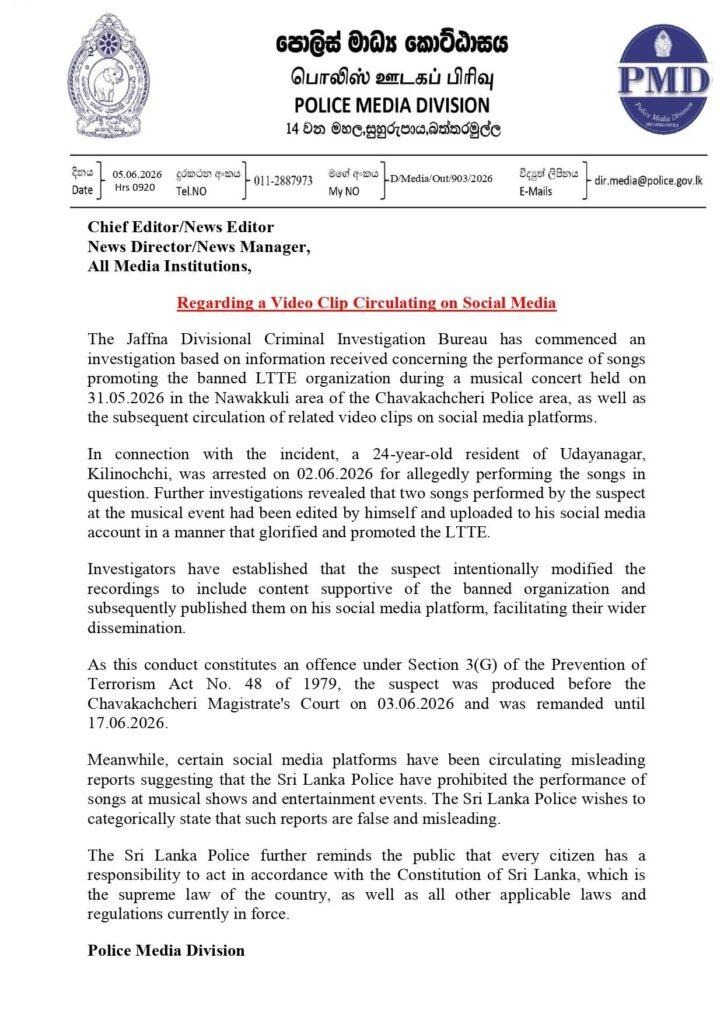
The Sri Lanka Police Media Division issued an official statement providing the prosecution’s account. According to police, Sangeethsan sang two songs at the event. He subsequently edited the videos of those performances to add content that glorified and promoted the LTTE and uploaded the edited versions to social media. The police stated that he provided a statement about this effect during the investigation.
The arrest was also raised in parliament. Minister Wijepala informed the house that discussions would be held between the Inspector General of Police and the Attorney General regarding the circumstances of the arrest, and that further action would be taken based on those consultations.
The Claim That Music Was Banned: Police Refutation
Following the arrest, a separate false claim spread across social media stating that a complete ban had been imposed on music performances at entertainment events throughout Sri Lanka. The police issued an official statement refuting this directly, reaffirming that citizens must act in accordance with the Constitution and all applicable laws, and urging the public not to be misled by false information on social media. No such ban existed or was introduced.
Legal Developments: From PTA to Bail
What followed Sangeethsan’s remand was a rapid and significant legal escalation driven by growing public pressure.
President’s Counsel M.A. Sumanthiran, one of Sri Lanka’s most prominent lawyers and a Tamil politician, visited Sangeethsan at Jaffna Prison and met with his legal team and mother. Sumanthiran announced that a fundamental rights petition would be filed before Sri Lanka’s Supreme Court, arguing that the allegations against Sangeethsan did not fall within the scope of the PTA and that his detention violated his fundamental rights. The petition added a constitutional dimension to what had begun as a Magistrate’s Court case.
A bail petition was subsequently filed at the Jaffna High Court. Following that petition, the Attorney General made a significant legal move: rather than proceeding under the PTA, the AG chose to proceed under Section 120 of the Penal Code, a substantially less severe provision. This represented a meaningful downgrade of the charges and signaled that the initial invocation of counter-terrorism law had come under serious legal strain.
A bail application was then filed at the Chavakachcheri Magistrate’s Court. It was initially rejected on procedural grounds; the relevant documentation was not before the court at that hearing. A subsequent application succeeded. Sangeethsan Ganeskumar was granted bail and released, approximately ten days after his arrest.
Latest Update (12 June 2026): Sangeethsan has been released on bail. The charges have been reframed from PTA provisions to Section 120 of the Penal Code. Legal proceedings continue.
Political Responses
Members of Parliament
The arrest prompted an unusually broad political reaction across ethnic lines.
ITAK Jaffna District MP Sivaganam Sritharan was the most active respondent. He visited Sangeethsan in Jaffna Prison and met with his mother. He wrote a formal letter to President Dissanayake calling for Sangeethsan’s release, stating that the arrest had caused “deep disappointment and pain” among Tamils and that many viewed the detention as another example of the restrictions Tamils face in exercising freedom of expression. He appealed for release through presidential powers, arguing it would strengthen democratic values and reconciliation efforts.
▶ Facebook Reel — MP Sritharan statement 1
▶ Facebook Reel — MP Sritharan statement 2
ITAK Batticaloa District MP Shanakiyan Rasamanickam also issued a strong condemnation, stating: “We strongly condemn the arrest and detention of Tamil rapper Hip-hop Sangee under the Prevention of Terrorism Act.” He reminded the government of its campaign promise to repeal the PTA and called on it to “honour this promise without delay.” He said the PTA “must be repealed and should not be used against artists, journalists, activists, or any individual exercising their fundamental freedoms.”
Former Minister Douglas and MP Namal Rajapaksa, both representing Sinhala constituencies, also commented publicly, an indication of how far the controversy had spread beyond Tamil political circles:
▶ Facebook Reel — Former Minister Douglas
▶ Facebook Reel — MP Namal Rajapaksa
President Anura’s Response
MP Sritharan held a telephone conversation with President Anura Kumara Dissanayake regarding Sangeethsan’s release. The President informed Sritharan that since no PTA remand order had formally been issued, his lawyers could apply for bail through the ordinary court process. Following this, a meeting took place between Minister Chandrasekara and MP Sritharan in the parliamentary complex. Chandrasekara conveyed the President’s position and also contacted Sangeethsan’s mother by telephone. MP Sritharan published details of these conversations on his official Facebook page. ▶ Facebook Post — MP Sritharan’s official update
Protests Across the North-East
Public demonstrations demanding Sangeethsan’s release were held in multiple towns across Sri Lanka’s Tamil homeland. Protests in Kilinochchi drew significant attendance:
▶ Facebook Reel — Kilinochchi protest 1
▶ Facebook Reel — Kilinochchi protest 2
A separate demonstration was organised in Vavuniya by a collective of artists, drawing musicians, civil society activists, political representatives and members of the public. Protesters marched from the old bus stand to the clock tower junction, carrying placards and calling for freedom of expression. They condemned the use of anti-terrorism legislation against cultural figures. Similar protests were held in Valvettithurai. The demonstrations reflected a widespread sense across Tamil communities that the case was not simply about one artist but about a pattern.
International Reactions
The case drew significant international attention. In Tamil Nadu, India, Naam Tamilar Katchi leader Seeman called for Sangeethsan’s immediate release, questioning how a song could be treated as terrorism. Tamil Nadu Minister Vanni Arasu described the arrest as “state terrorism,” arguing that the Dissanayake government’s stated commitment to equality was contradicted by the detention. Brampton, Canada Mayor Patrick Brown also issued a public condemnation.
Amnesty International issued a formal statement calling for Sangeethsan’s immediate release and renewing demands for the repeal of the PTA. The organisation expressed concern over “continued arrests and detentions carried out under the Prevention of Terrorism Act,” describing it as a law that “has long been criticized for its overly broad provisions and incompatibility with international human rights law and standards.” Amnesty stated that the PTA’s “broad and vaguely defined offences do not align with international law standards” and called on authorities to “immediately release Sangeethan Ganeskumar unless he is promptly charged with an internationally recognizable offence in proceedings consistent with international fair trial standards.”
The Wider Pattern: Tamil Cultural Expression Under Scrutiny
Sangeethsan’s case did not emerge in isolation. In the weeks surrounding his arrest, a broader pattern drew increasing attention: Sri Lankan police questioning musicians, interrupting performances, and launching investigations into songs associated with Tamil homeland identity, memories of the armed conflict, and Tamil cultural heritage performed at temple festivals and public events across the North-East.
One prominent example involved Gokulan, the son of the late Tamil musician S.G. Santhan, who was summoned and questioned by police following a performance in Urumpirai. Legal observers and civil society organisations described these incidents as part of an escalating crackdown on Tamil cultural expression, raising concerns about the space available to Tamil artists to engage with their own history and community experiences through music.
Follow Us on Social Media
Facebook Page | Twitter | Instagram | Google News | TikTok | YouTube
Conclusion
The social media claim that a singer was arrested merely for singing LTTE songs at a live performance was an oversimplification that missed the legal and factual details of the case. Sangeethsan Ganeskumar was arrested on 2nd June 2026, initially charged under the PTA, for videos edited and uploaded after his temple festival performance in Navatkuli. His defense challenged the entire basis of the PTA charge, arguing the song contained no reference to the LTTE whatsoever. The Attorney General subsequently chose to proceed under the Penal Code rather than the PTA, a significant legal retreat. He was released on bail on 12th June 2026.
The case exposed deep tensions between Sri Lanka’s counter-terrorism framework and the rights of Tamil artists to express their community’s experiences. Amnesty International, multiple MPs, civil society organisations, and members of the Tamil diaspora raised their voices. The NPP government’s pre-election commitment to repeal the PTA was held up to scrutiny. Legal proceedings continue.
In such situations, contact us on our WhatsApp number (+94771514696) to verify the authenticity of similar claims before sharing them.

Title: A Tamil Rapper, a Terror Law, and a Song: The Arrest and Release of Hip-hop Sangee
Fact Check By: S.G. Prabu
Result: Insight