

Subscribe to our WhatsApp Channel
Rental housing has become one of Sri Lanka’s quiet crises, with more families squeezed into rented rooms and houses every year, often with little legal protection. So, when a certificate began circulating on social media warning that fake agents were collecting money and fraudulent documents from desperate tenant families, under the promise of cheap government housing, it spread fast and struck a nerve. Fact Crescendo investigated.
Social Media Claims
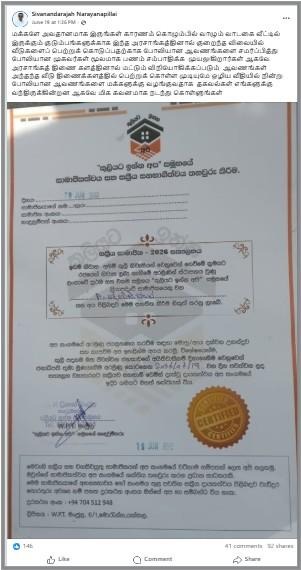
A Facebook post, archived here, warned the public to be careful, alleging that fake agents were submitting fraudulent documents and collecting money from rental families in Colombo under the promise of securing low-cost government housing. The post stated that legitimate government housing documents could only be obtained from the relevant housing department and urged readers to be cautious. It was posted on 19th June 2026.
Fact Check
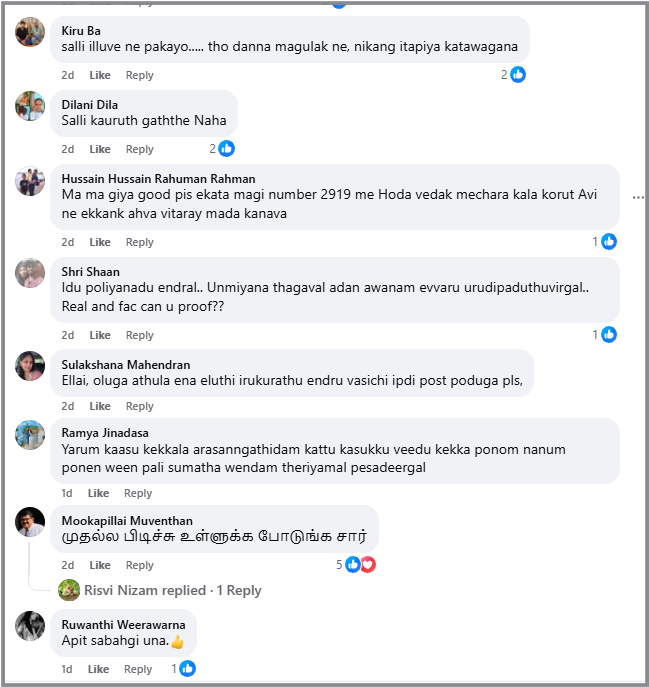
Several commenters to these posts said they had personally attended the event in question and stated that no applications had been collected and no money had changed hands there and that the post’s claim was false.
Working from that lead, we set out to determine for which the certificate shown in the post was actually issued. We found a video uploaded to the Facebook page Plat Form Nittambuwa that explained the certificate directly.
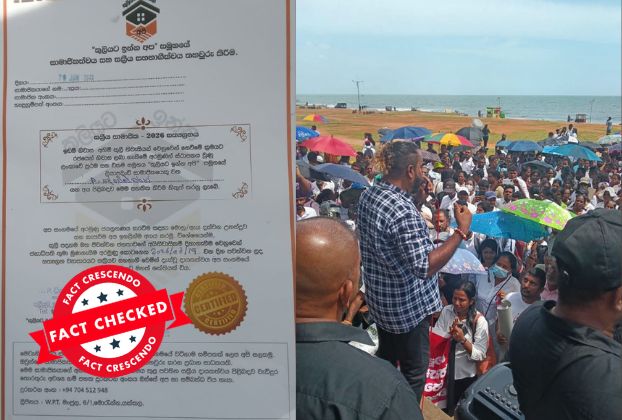
The video had been uploaded by Trishan Manjula, coordinator of an organisation called ‘Kuliyata Inna Api’, which translates as “We Who Live on Rent.” According to the video, this organisation, formed to represent people living in rented housing, had organised a large-scale satyagraha protest at Galle Face on 19th June 2026. The stated purpose of the protest was to petition the President to provide rental families with their own homes on a monthly instalment payment basis. The certificate, the video explained, was issued to honour participants for taking part in that protest, and no fee of any kind was charged for it.
We then examined exactly what the certificate itself said. It turned out to be a membership certificate issued by an organisation formed to advocate for the rights of Sri Lankan tenants and to lobby the government for instalment-based housing, not a document related to any housing allocation. The certificate’s actual contents, translated, read as follows.
What the Certificate Actually Says
1. Document title: Confirmation of membership and active participation in the organisation “Kuliyata Inna Api” (We Who Live on Rent), dated 19th June 2026.
2. Purpose of the organisation and the certificate: The document describes Kuliyata Inna Api as the first and only coalition in Sri Lanka formed to secure instalment-based housing from the government for people without their own land or homes who are currently living on rent. The certificate confirms that the named individual, whose signature appears on the document, was an active member in the “2026 Satyagraha” protest.
3. Event details included the following: The document commends the named member’s active participation in the satyagraha protest held on 19th June 2026, aimed at meeting the President to secure the rights of rental families, describing that participation as a significant strength for the organisation’s future growth.
4. Contact details listed at the bottom: The document carries the coordinator’s details and an official seal, naming the coordinator as W.P. Trishan Manjula, with a contact number and an address in Yakkala.
On this basis, it became clear that this document is solely a membership certificate, not a document related to obtaining housing.
What the Organisation’s Coordinator Told Us
We called the coordinator’s number listed on the certificate and asked about the claims being shared on social media. Trishan Manjula confirmed that the organisation has never at any point claimed to provide housing and has never distributed documents to that effect. He further stated that the organisation does not collect money from the public for any of its activities.
He explained that the protest’s sole purpose was to petition the President to provide instalment-based housing for tenant families and that the certificate circulating online with false claims attached to it was the very certificate issued to participants of the 19th of June protest. The document issued that day, he said, was nothing more than a participation certificate, and no money was collected from anyone who took part.
We also asked whether the organisation was formally registered. Manjula said it was not yet registered, explaining that the group currently lacks a fixed address to provide for registration purposes, but that they intend to register with the organisation soon. He confirmed that the protest itself was not illegal, stating that police permission had been obtained in accordance with the law and that the protest was conducted without causing any inconvenience to the public.
Asked whether the organisation was limited to tenants in the Colombo district, Manjula said no. He described it as a nationwide organisation representing rental tenants across the country, with the protest carried out on behalf of all of them.
He told us the organisation was founded in 2019 and that this was its sixth protest of this nature, with five previous ones having already taken place. He said that if the government took no action, some members of the organisation were prepared to begin a fast-unto-death protest within two days. He stressed that the protest’s only goal was to place their request before the President, and that some parties were attempting to misrepresent it on social media. He also noted that despite providing information to several media outlets, no one had carried the story.
In the course of our research, we found multiple other social media posts discussing the protest, which can be viewed here, here, and here.
It is worth being clear: this is an independent certificate issued by a civil organisation, or a tenants’ association, to its own members. It is not a certificate issued by any official government department.
The Law Governing Tenants and Landlords in Sri Lanka
Sri Lanka has long regulated the rights of tenants and landlords in rented houses and buildings through the Rent Act, No. 7 of 1972. With that law now considered out of step with the country’s current social and economic needs, the government has moved to repeal it and replace it with new legal reforms.
Towards that end, a significant piece of legislation, the Protection of Occupants Bill, 2026, was gazetted around September 2025 and tabled in parliament in January 2026, alongside a separate bill to repeal the existing Rent Act.
The previous 1972 law heavily favoured tenants, which left landlords facing significant legal hurdles and delays in reclaiming their own properties. The new Protection of Occupants Act aims to prevent landlords from arbitrarily or forcibly evicting tenants, while at the same time creating a balanced legal framework that allows property owners to reclaim their properties fairly and swiftly through the courts.
Key Protections for Tenants
Under the new law, a person who has lawfully entered a property and lived there continuously for more than three months gains certain protection. They cannot be evicted without a court order. A landlord cannot remove a tenant arbitrarily, forcibly, or by employing others to do so; eviction can only occur through an order or judgment from the relevant District Court. Cutting off essential services with the intent of forcing a tenant out, including electricity, water supply, toilet and sanitation facilities, cooking gas, or access to common pathways, is entirely prohibited. Landlords are also barred from damaging property to force a tenant out, such as removing roofing, breaking down walls, or damaging a tenant’s belongings.
Legal Avenues for Landlords
The new bill also simplifies the legal process for landlords seeking to reclaim their properties. Where eviction cases previously took years to resolve through the courts, the new law sets firm timelines. Cases that can be decided on the basis of submitted petitions and documents alone must be resolved within three months. Where objections are filed and a fuller inquiry becomes necessary, the case must be concluded within a maximum of nine months. The law also prescribes strict penalties for occupants who unlawfully remain on a property after a lease has ended, or who attempt to mislead the court with false claims to continue occupying a property without legal basis.
Penalties for Violations
The new law provides for serious criminal penalties against landlords who attempt to forcibly evict a tenant without a court order or who cut off essential services. These include a fine of up to Rs. 500,000, imprisonment of up to one year, or both. Attempting to forcibly evict a person who has been reinstated by court order, within one year of that reinstatement, will be treated as contempt of court.
Given this changing legal landscape, both landlords and tenants are advised to take care over a few key points when renting or letting a property: maintain a formal, written, and properly signed lease or tenancy agreement rather than relying on verbal arrangements, and ensure that rent payment receipts and the terms of tenancy are properly documented. Further reading is available here and here.
Follow Us on Social Media
Facebook Page | Twitter | Instagram | Google News | TikTok | YouTube
Conclusion
Our investigation shows that the claim about fake agents submitting fraudulent documents and extorting money from tenant families in Colombo under the promise of low-cost government housing is false. The document being shared in the viral post was confirmed to be a membership certificate issued by an organisation called ‘Kuliyata Inna Api’, or ‘We Who Live on Rent’, to participants of a protest it organised on 19th June 2026.
We further confirmed that no documents or money were collected at the Galle Face protest that day for the purpose of providing low-cost housing. The event was, by all available evidence, simply a protest aimed at meeting the President and petitioning him to provide instalment-based housing for rental families.

Title: Is Money Being Extorted Using Fake Documents Promising Low-Cost Housing?
Fact Check By: Suji Shabeedharan
Result: Misleading