

Subscribe to our WhatsApp Channel
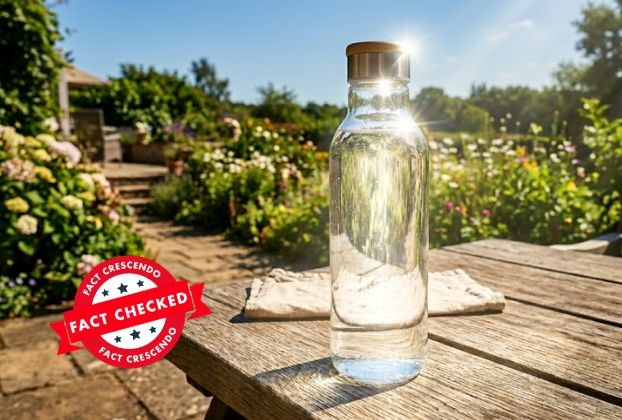
Home remedies and health hacks spread fast on social media, and they spread even faster when they arrive dressed in the language of science. A video recently circulating in Sri Lankan and Tamil diaspora circles makes exactly this kind of claim: that filling a glass bottle three-quarters with water, placing it in direct sunlight for an entire day, and drinking it in the evening will give the body all the Vitamin D it needs.
The claim might sound plausible to anyone who knows that sunlight plays a role in Vitamin D production. That surface plausibility, however, is where the truth ends. Fact Crescendo investigated.
Social Media Posts:
A Facebook video went viral, showing what appeared to be a female physician demonstrating the method step by step: fill a glass bottle three-quarters with water, rest it on a wooden board in direct sunlight for a full day, and drink it in the evening to easily meet your vitamin D requirements. The video was shared widely, with many users treating it as credible medical advice.
Fact Check
To evaluate this claim, we began with the basic biology of how the body produces vitamin D. According to Harvard Health Publishing, when the sun’s ultraviolet B (UVB) rays strike human skin, they convert a compound in the skin called 7-Dehydrocholesterol into vitamin D3. This D3 is carried to the liver, then to the kidneys, where it becomes the biologically active form of Vitamin D that the body can actually use. Every step of this process happens inside living human tissue. The essential ingredient is not sunlit water. It is bare skin exposed to UVB rays.
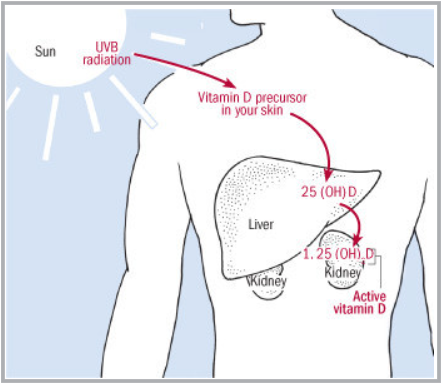
Vitamin D synthesis cannot occur in water or glass
However, the viral method claimed in the video fails on a more immediate level before the biology even matters; glass blocks UVB radiation. The NIH Office of Dietary Supplements confirms that UVB, the specific wavelength responsible for triggering Vitamin D synthesis, does not penetrate glass. A study in the British Journal of Dermatology further confirmed that standard glass transmits the longer UVA wavelengths while substantially blocking UVB. This is why sitting beside a glass window on a sunny day provides no meaningful Vitamin D benefit. The same physics applies to glass bottles. The UVB never reaches the water inside.
Even setting the glass problem aside, Vitamin D cannot exist in water. It is a fat-soluble vitamin, meaning it dissolves in fat, not in water. It occurs naturally in fatty foods such as salmon, sardines, and egg yolks. The NIH Vitamin D factsheet is unambiguous: there is no mechanism by which water can carry, absorb, or transfer Vitamin D. No matter how many hours a bottle of water sits in sunlight, it is chemically impossible for that water to generate or accumulate any Vitamin D.
The full synthesis pathway makes the impossibility even clearer. UVB rays convert 7-dehydrocholesterol in the skin into Vitamin D3. The liver converts D3 into 25-hydroxyvitamin D. The kidneys then convert that into 1,25-dihydroxyvitamin D, the active hormone the body uses. As Harvard Health explains, this is a multi-organ biological process. It is exclusive to living tissue. It cannot occur in water, glass, or any inanimate container.
Solar Water Disinfection has no links with vitamin D.
There is one scientifically validated use for sunlight on bottled water, and it is not Vitamin D. It is Solar Water Disinfection (SODIS), a technique used in resource-limited settings where placing water in a clear bottle under sunlight for six or more hours can kill bacteria and viruses through UV radiation and heat. SODIS adds no nutrients, vitamins, or minerals to the water. It only disinfects. The viral claim appears to have borrowed the visual template of SODIS and attached a fabricated health benefit to it.
This type of claim belongs to a wider category of wellness misinformation sometimes called “solar-charged water” or “sun water”, in which various curative properties are attributed to sunlight-exposed water. None of these claims has peer-reviewed support. The National Centre for Complementary and Integrative Health advises the public that health claims circulating on social media frequently use scientific-sounding language to lend false credibility to practices with no evidence base.
Experts Reject the Viral Hoax!
Fact Crescendo contacted Professor Ananda Chandrasekara of the Department of Applied Nutrition at Wayamba University of Sri Lanka, whose research specialises in functional food science and dietary bioactives, for an independent assessment.
Professor Chandrasekara described the claim as “entirely farcical”. He explained that sunlight does not itself contain Vitamin D. What sunlight provides is the UVB stimulus that initiates the conversion of 7-dehydrocholesterol in the skin. The liver and kidneys then complete the process. This process is a biological sequence that can only occur inside the human body, and no version of it can take place in a bottle of water.
AI-generated footage
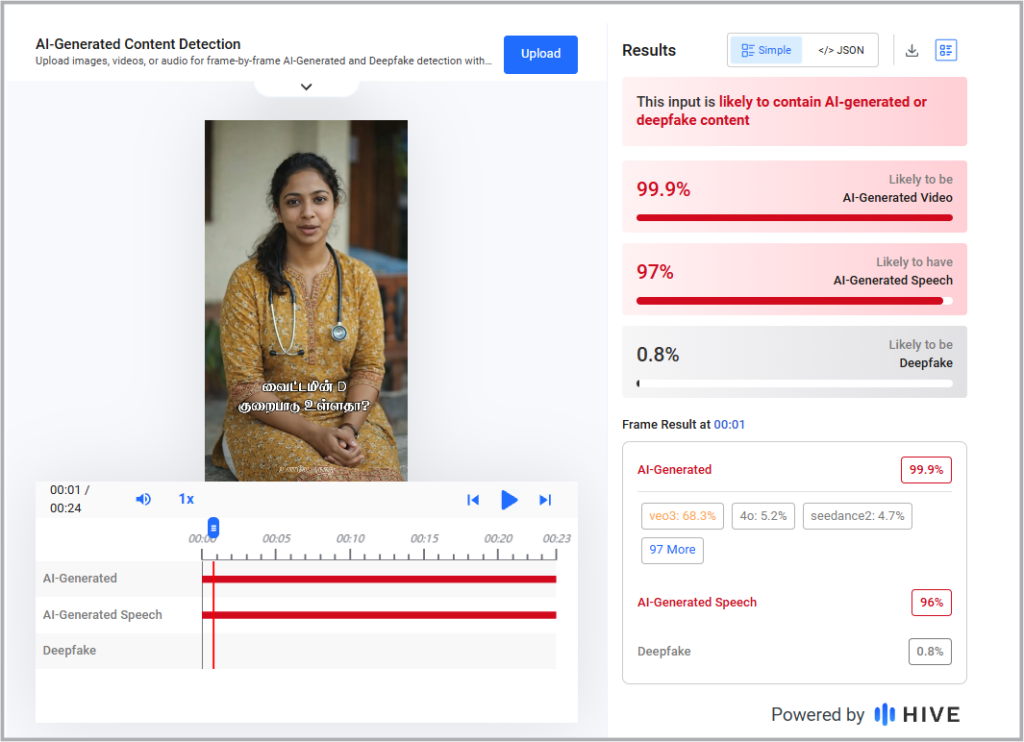
The viral video reinforced its false claim by featuring a female physician presenting the method with medical authority, a presentation style that encouraged many viewers to share it as reliable health advice. When Fact Crescendo analysed the video using Image Detector and Undetectable AI, both tools confirmed that the video had been generated using artificial intelligence. The use of a synthetic doctor avatar to deliver health misinformation is a well-documented tactic designed to manufacture credibility where none exists.
Why This Claim Resonates: Vitamin D Deficiency in Sri Lanka
Part of what makes this claim credible to so many people is that Vitamin D deficiency is a genuine and widespread concern, including in tropical countries where sunlight is abundant. A study published in the Sri Lanka Journal of Diabetes, Endocrinology and Metabolism found significant rates of Vitamin D deficiency among Sri Lankan adults, driven by factors such as indoor working conditions, cultural dress practices, and skin pigmentation. When people know they have a real deficiency and discover what looks like an easy, free solution, they are more inclined to share it without question.
Skin pigmentation is a particularly important factor for South Asian audiences. Melanin, the compound responsible for darker skin tones, reduces the skin’s efficiency in synthesising Vitamin D from UVB radiation. Research published in the American Journal of Clinical Nutrition has documented that people with darker skin tones require significantly longer sun exposure to produce equivalent amounts of Vitamin D compared to those with lighter skin. This explains why Vitamin D deficiency is paradoxically common in sun-rich South Asian populations and why accessible-sounding remedies like the one in this video gain such traction.
The Advised Ways to Address Vitamin D Deficiency
Even though the viral claim is false, the underlying concern about Vitamin D levels is entirely valid and worth addressing properly.
Direct sun exposure remains the most natural method. Spending 15 to 30 minutes in sunlight between 10 a.m. and 3 p.m., two to three times a week, with the face and arms exposed directly to the sun (not through glass and not filtered by heavy clothing) is sufficient for most people to produce adequate Vitamin D. The process requires UVB rays landing on bare skin. Nothing else replicates it.
Dietary sources that naturally contain or are fortified with Vitamin D include fatty fish such as salmon, sardines, and mackerel; egg yolks; mushrooms that have themselves been sun-exposed; and Vitamin D-fortified dairy products and plant milks. These provide the fat-soluble form of the vitamin that the digestive system can absorb and the body can use.
Where deficiency is clinically confirmed through a blood test, supplementation with Vitamin D3 under medical supervision is the safe, evidence-based approach. However, because Vitamin D is fat-soluble, it accumulates in body fat and does not flush out the way water-soluble vitamins do. Taking high doses without medical guidance carries a real risk of Vitamin D toxicity (hypervitaminosis D), which can cause hypercalcemia, nausea, kidney damage, and, in severe cases, cardiac complications. Supplementation must be guided by a doctor, not by a viral video.
Follow Us on Social Media
Facebook Page | Twitter | Instagram | Google News | TikTok | YouTube
Conclusion
Based on our investigation, the claim that drinking water stored in a glass bottle under direct sunlight for a full day will provide the body with Vitamin D is false.
Vitamin D synthesis is a multi-step biological process that only happens in the human body. UVB rays must hit bare skin to start the process, which then goes on through the liver and kidneys. UVB radiation does not penetrate glass, so it never reaches the water inside the bottle in the first place. Vitamin D is fat-soluble and cannot exist in or be transferred through water under any circumstances.
These findings are backed by peer-reviewed research from Harvard Health, the NIH, and the British Journal of Dermatology, and corroborated by Professor Ananda Chandrasekara of Wayamba University’s Department of Applied Nutrition. Anyone concerned about Vitamin D deficiency should seek diagnosis through a blood test and follow medical advice.

Title: Will Drinking Water Kept in a Glass Bottle Under the Sun All Day Give Your Body the Vitamin D Needs?
Written By: Suji Shabeedharan
Result: False