
දිනපතා සත්ය කරුණු දැන ගැනීමට අපගේ WhatsApp චැනලයට මෙතනින් එකතුවන්න.
Social media posts have been circulating claiming that the current Archbishop of Colombo, Malcolm Cardinal Ranjith, will step down from his position by the end of this year. The following is a fact-check conducted in response to these claims.
Social Media Posts:
Several social media posts titled “Archbishop resigns…?” have been circulating, suggesting a potential leadership change within the Catholic Church in Sri Lanka. The Sri Lanka Guardian reports that Malcolm Cardinal Ranjith is likely to step down by the end of this year, citing internal sources within the Colombo Archdiocese and information from the Vatican.
The Cardinal, who has served as the ninth Archbishop of Colombo since 2009, will turn 79 this year. Although ecclesiastical regulations require bishops to submit their resignation at the age of 75, he retains the right to participate in the election of the Pope until the age of 80.
However, the Cardinal has reportedly indicated his willingness to retire voluntarily after his 79th birthday. This development comes amid growing unease within certain quarters of the Vatican regarding his recent conduct and the direction of the Church’s leadership.
The report further highlights an apparent inconsistency between the Venerable’s statements—particularly his calls for justice following the Easter attacks—and the position on reconciliation more recently emphasized by Monsignor Andre Josvovich.
Church sources indicate that four names are currently being considered as the Cardinal’s successor.
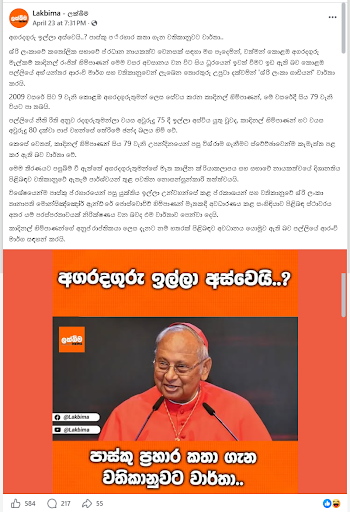
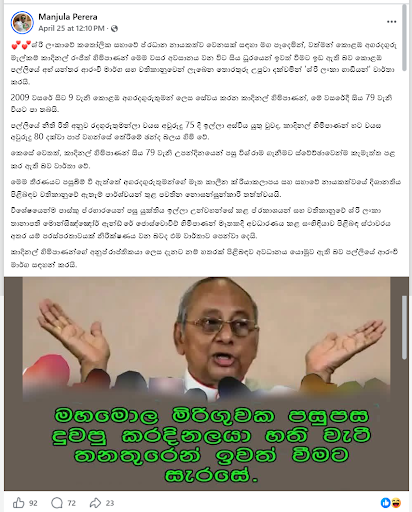
We have undertaken an investigation into this matter in response to requests to verify its accuracy.
Fact-Check:
As noted above, sources indicate that there is increasing discontent within the Vatican regarding the recent activities of the Archbishop of Colombo, Malcolm Cardinal Ranjith, and his leadership of the Colombo congregation. Individuals close to him further state that he is preparing to voluntarily resign upon reaching his 79th birthday, according to the report by the Sri Lanka Guardian. Archived Link.
Director of Public Communications of the Archbishopric
Nevertheless, addressing this matter, the Archbishop’s Director of Public Communications, Jude Chrysantha, stated that decisions concerning the archbishopric rest with the Holy See. He further noted that, while canon law contemplates retirement at the age of 80, the final determination lies with the Pope.
Accordingly, he further stated that although Malcolm Cardinal Ranjith will attain the age of 80 next year, no official decision regarding his retirement has been announced.
The process of retiring an archbishop or bishop
According to the Vatican Code of Canon Law, the process of retiring an archbishop or bishop is governed primarily by Canon 401.
Its main steps are as follows:
Age limit and submission of resignation: A bishop (including archbishops) who has reached the age of 75 must submit his letter of resignation to His Holiness the Pope.
The Pope’s Decision: Once the resignation is received, the Pope will consider the circumstances and decide whether to accept it immediately, or to delay it by asking for further service.
Residency: The bishop continues to exercise the duties of his office until the Pope officially accepts the resignation.
Emeritus Status: Once the resignation is accepted, the person concerned holds the honorary title of “Archbishop Emeritus” or “Bishop Emeritus” of that office.
Retirement for health reasons: According to Canon 401 §2, if a bishop is unable to fulfill his duties due to illness or other serious reason, he may request to submit his resignation even before the age of 75. Information on this can be found here, is located here and pointed here.
The process of selecting a new successor after the retirement of an archbishop
This process comprises several highly confidential and systematically structured stages. In accordance with Vatican regulations, its principal phases are as follows:
Consultation Phase: When a position becomes vacant due to retirement or death, the Apostolic Nuncio of the Holy See in Sri Lanka prepares a confidential report on the needs and current situation of the relevant archdiocese. Here, the Apostolic Nuncio secretly consults with other bishops in the region, leading clergy, and sometimes laypeople. Further information is here.
Preparation of the list of nominations (The Terna) Following these consultations and examinations, the Apostolic Nuncio prepares a list of three priests or bishops who he considers suitable. This is called the “Terna”. The Apostolic Nuncio forwards these three names and a report on them to the Dicastery for Bishops in the Vatican.
3. Review by the Dicastery: A panel of cardinals and bishops in the Vatican will study in depth the reports and the three names sent by the Apostolic Nuncio. They may approve the list or, if necessary, ask the Apostolic Nuncio to submit new names.
The Pope’s Decision The head of the department presents the final recommendations to the Pope personally. The Pope alone has the final decision and authority on any episcopal appointment. The Pope chooses one of the three recommended names, or he can appoint someone else entirely.
Announcement: Once the chosen person agrees to take up the position, the Vatican officially announces the appointment. This process can usually take between 6 months and a year.
Basic qualifications that a person appointed to the office of bishop or archbishop must possess
According to Canon 378 of the Vatican Code of Canon Law, the basic qualifications are as follows:
Deep faith and good character: He must have unwavering faith, good morals, fear God, and be an exemplary character to the people.
Age: Must be at least 35 years of age at the time of appointment.
Priestly Service Period: Must have completed at least 5 years of service after receiving ordination.
Higher Educational Qualifications: He must have obtained a Doctorate or at least a Licentiate in Holy Bible, Theology or Canon Law. Otherwise, he must have good expertise in those subjects.
Leadership Ability: The management ability, good personality, and ability to deal with the general public required to manage a position are considered.
Special point: When selecting for an archbishopric, much attention is often paid to an experienced bishop already serving in another diocese or an Auxiliary Bishop of the same diocese.
Comprehensive details regarding the ecclesiastical governance and the selection criteria for bishops are available in the Vatican Code of Canon Law. Additional procedural insights can be examined via this legal reference guide and through the Voice of the Faithful selection analysis.
In 2022, there were reports that Cardinal Malcolm Ranjith was preparing to retire from the position of Archbishop of Colombo, and below is a fact-check we conducted on the matter.
Is Cardinal Malcolm Ranjith preparing to retire from the position of Archbishop of Colombo?
We invite you to follow our fact-checking efforts.
Facebook | Twitter | Instagram | Google News | TikTok | Youtube
Conclusion:
Our investigation indicates that social media posts claiming that the Archbishop of Colombo, Malcolm Cardinal Ranjith, will retire from the archdiocese at the end of this year are misleading. The Archbishop’s Director of Public Communications, Jude Chrysantha, stated that decisions regarding the archdiocese are the responsibility of the Holy See.
He further explained that, in accordance with Catholic Church regulations, an archbishop is considered for retirement upon reaching the age of 75, though he may continue serving until 80; however, the final decision rests with the Pope. He also emphasized that the claim that Archbishop Malcolm Ranjith will retire this year is false.

Title: Claims about Archbishop Malcolm Cardinal Ranjith’s Resignation are Misleading
Fact Check By: Pavithra Sandamali
Result: Missing Context