

දිනපතා සත්ය කරුණු දැන ගැනීමට අපගේ WhatsApp චැනලයට මෙතනින් එකතුවන්න.
A recent poll titled “Mood of the Nation” released by Verité Research has become a widely discussed topic in society. Several claims and interpretations relating to this survey were circulated on social media. We conducted a fact-check regarding a number of those posts.
Social Media Posts :
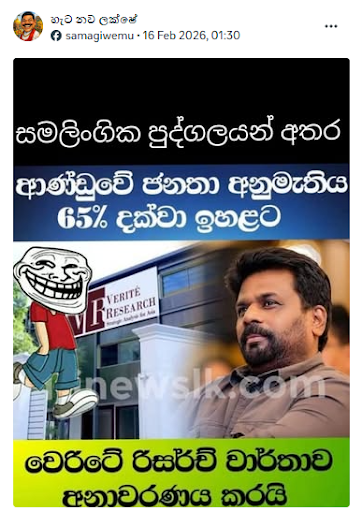
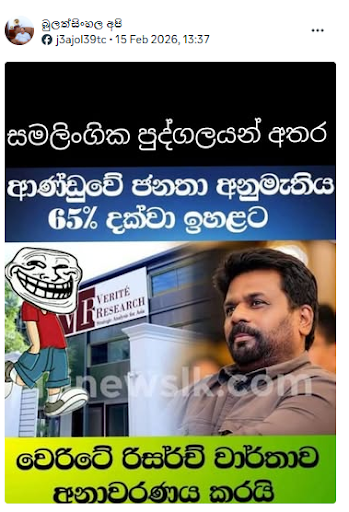
A post circulating on social media claimed that a report by Verité Research revealed that public approval of the government among homosexual individuals had risen to 65 percent. The claim was shared online in the following manner.
This post was widely circulated on social media in the following manner.

In addition, another post shared on TikTok claimed that Verité Research is a private institution operated by the Secretary of the NPP, along with several similar assertions.
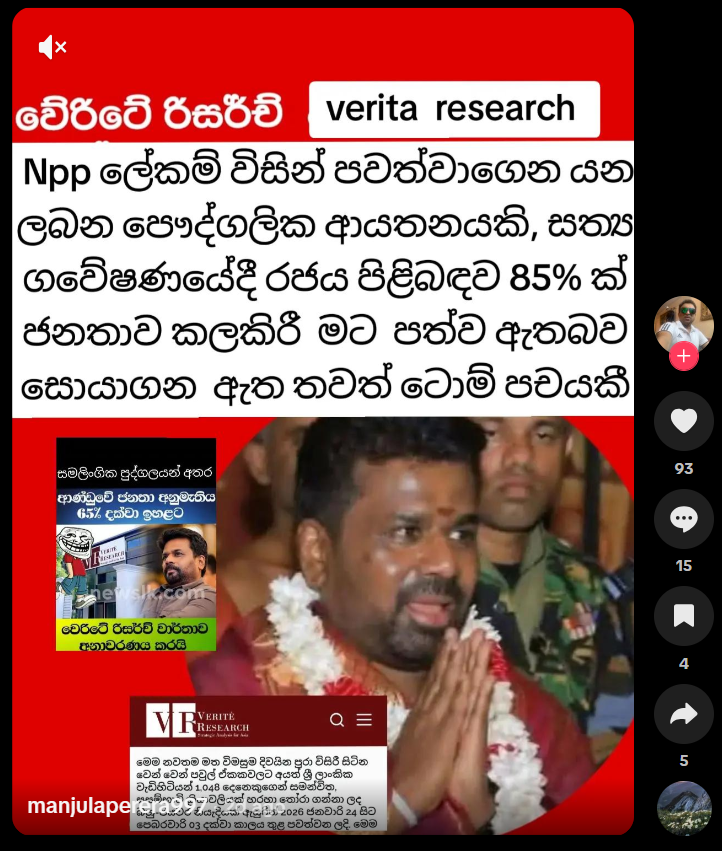
This post was shared on Facebook in the following manner.
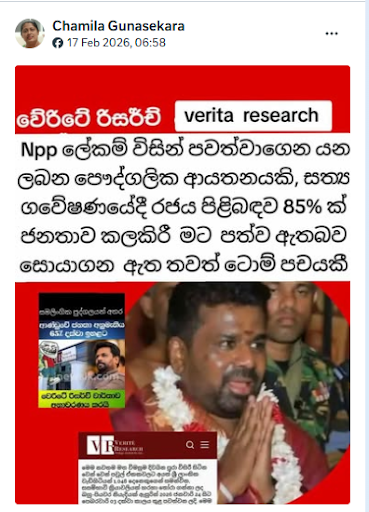
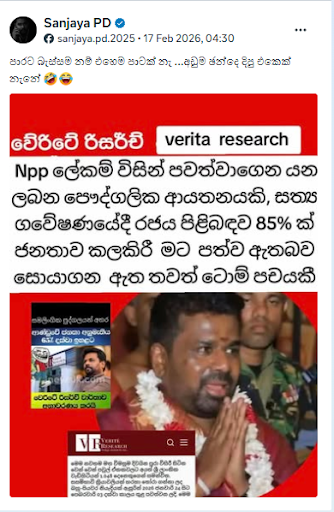
We took steps to verify the accuracy of these posts.
Fact Check :
Verité Research released the results of its Mood of the Nation poll to the media on February 15. Archived Link
According to posts circulating on social media, this poll examined whether respondents identified themselves as LGBTQ+ individuals.
However, the poll was based on a multi-stage sampling process conducted among 1,048 Sri Lankan adults from separate households across the country, according to the report.
The latest poll indicates that, as of early February 2026, public approval of the government stood at 65%. It also shows that the percentage of people who believe the country’s economy is improving rose from 55% a year ago to 64%.
A majority of respondents (59%) expressed satisfaction with the way the country is currently being governed. The report notes that this is the first time in the past four years of polls that public satisfaction with the country has exceeded 50%.
When compared across different sectors, the government received its highest positive ratings for minimizing drug use and crime, surpassing even its performance in reducing corruption.
However, since the poll only involved 1,048 adults, questions have been raised on social media about whether it represents the views of the entire Sri Lankan population. Some posts have suggested that the poll favored the National People’s Power (NPP) government, highlighting photographs allegedly connecting the Verité Research institute to the NPP secretary. These claims were investigated for accuracy.
[The Secretary of the National People’s Power](https://elections.gov.lk/web/wp-content/uploads/pdf/pol_party_list/Officers/13_31_JathikaJanaBalawegaya.PDF#:~:text=බත්තරමුල්ල යන ස්ථානයේ රැස්වූ ජාතික ජන බලවේගයේ,ලාල් විජේනායක යන අය පත්කර ගන්නා ලදී.) is Specialist Dr. Nihal Abeysinghe, a Member of Parliament for the Kalutara District. The Secretary of the Janatha Vimukthi Peramuna (JVP) is Tilvin Silva.
The Executive Director of Verité Research is Nishan de Mel. It was not evident that any member of the NPP serves on the board of directors of the institute.
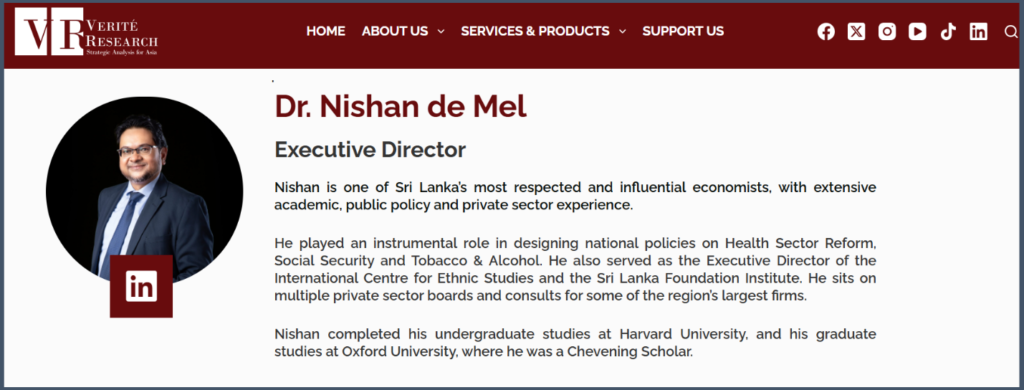
A background check of the photographs also showed that the NPP secretary appeared alongside Nishan de Mel and others. These images were reportedly taken before the 2024 presidential election, during a study by Verité Research when recommendations to form a 15-member cabinet were submitted to the leaders of the main political parties.
A note published in May 2024 shows that the report was also presented to Sajith Premadasa, the leader of the Samagi Jana Balawegaya (SJB).
Verité Research Media Coordinator Statement
When asked by our team, the head of communications at Verité Research stated that the poll currently trending on social media is not a newly launched poll. Rather, it is part of a recurring survey conducted once or twice a year since 2022.
The official confirmed that the last poll was conducted in February 2025. Since provincial council elections followed that year, no second poll was conducted, and the next round of polling was carried out in February 2026.
She also noted that some individuals who do not fully understand the methodology of randomized polling have spread false information on social media. This includes claims that the institute is linked to a political leader, which she denied.
She further explained that the Executive Director of Verité Research is Nishan de Mel, not the secretary of the National People’s Power (NPP). Some social media posts have misused photographs taken during a 2024 study by Verité Research, when recommendations to form a 15-member cabinet were presented to members of the NPP, to suggest political bias.
Mood of the Nation Poll
Nishan de Mel, Executive Director of Verité Research, stated that because the sample used in this recurring poll since 2022 is relatively “small,” it cannot fully reflect the characteristics of the national population. He emphasized, however, that the poll follows the Gallup-style methodology to ensure its validity.
Data for this poll was collected by Vanguard Survey (Pvt) Ltd, a company experienced in conducting surveys to international standards, and the data was subsequently analyzed and presented by Verité Research.
He pointed out that even though the sample in this Gallup-style poll is relatively small, if it is selected using proper scientific methods, the data may have a margin of error of around 3%, with approximately 95% confidence in its accuracy.
The Verité Research director further explained that the Gallup style methodology is widely used internationally for polling. He noted that obtaining accurate results does not necessarily require an excessively large sample. By scientifically selecting a representative sample through local government officials across relevant districts, and using a multi-stage stratified random sampling method, reliable statistical calculations can be made. While larger samples are possible, the additional benefit relative to cost is often minimal.
The institute’s official clarification on this matter can be found here.
What is a Gallup Poll?
Gallup, Inc., based in the United States, is a global analytics and polling organization. A Gallup, Inc. survey or poll gauges public opinion by asking people questions to understand their thoughts, feelings, and experiences. It is a scientifically recognized method for estimating national opinions worldwide.
According to Gallup methodology, most national polls use a sample of around 1,000 respondents, randomly selected to ensure representation across age, gender, region, and other key demographics.
For example, the Gallup World Poll surveys approximately 1,000 people per country across 30+ nations, with a margin of error of ±3–5%. Experts note that such a sample can accurately represent populations ranging from tens of thousands to millions, as proper random selection is statistically more important than sample size.
According to Gallup’s methodology, the accuracy of random selection is more important than the total population size. Reports explaining this can be found here and here.
Similarly, the Gallup World Poll, which is used in major global reports like the World Happiness Report, collects data from nationally representative samples in over 140 countries. In countries including the U.S., India, the U.K., and Brazil, Gallup style surveys typically use around 1,000 respondents per country to produce statistically reliable national estimates.
When conducted properly, a survey with around 1,000 participants can reliably estimate national trends even though not every individual is included. Credible sources confirm this, with supporting reports available here, here, here, and here.
National U.S. Polls: Standard sample sizes involve approximately 1,000 adults, providing a margin of error of about ±4%. Increasing the sample beyond this typically yields minimal gains in accuracy.
Gallup World Poll: Surveys around 1,000 people per country. In very large countries like China, India, or Russia, the sample is often increased to 2,000 or more.
Gallup Panel: For bigger or specialized studies, Gallup keeps a panel of over 100,000 U.S. adults.
Examples of Gallup’s trusted international use
1. World Happiness and Well-being Report (UN):
The UN ranks countries by happiness using the Gallup World Poll. Gallup applies a consistent 0–10 scale (“Cantril Ladder”) across cultures, allowing accurate measurement of life satisfaction over decades. For instance, it correctly tracked Afghanistan’s life satisfaction years before the 2021 government collapse. The OECD and World Bank also use this data to measure social progress beyond GDP.
2. Global Financial Inclusion (World Bank Findex):
Gallup conducts polls for the Global Findex database to track how many people have bank accounts. In 2011, 51% of adults worldwide had accounts; by 2021, it rose to 76%. Surveys reach rural areas through digital methods, providing economists with reliable data.
3. Global Risk Network (Lloyd’s Register Foundation):
Gallup surveys risks like climate change, safety, and AI. Using 1,000 respondents per country, they compare perceived vs. actual risks. For example, people in developing countries often fear road accidents more than natural disasters, helping NGOs prioritize spending. Resources can be found here and here.
4. U.S. Economic Confidence Index:
Gallup’s economic confidence index is trusted even during election years. Daily or weekly surveys show how Americans feel about their finances, which closely matches official CPI and inflation data months later. It acts as a leading indicator of public sentiment before official data is released.Reports on this can be found here and here.
Gallup Method Limitations
Even though Gallup surveys are scientifically strong, researchers warn that results can be misinterpreted or misused. Risks in public opinion research include influence from study design and question wording, non-response, and misinterpretation of results, as highlighted by the American Association for Public Opinion Research. Surveys give useful insights but may not perfectly represent the entire population and can be misused politically. Any country or organization using the Gallup method relies mainly on probability-based sampling, sometimes with quota weighting, which experts note can still lead to potential inaccuracies in results.
1. Sample selection and representation:
Surveys may not fully represent the population. Excluding certain groups creates coverage bias. Small or minority groups may be underrepresented, and non-response can skew results. AAPOR Code of Ethics.
Sampling Frame Errors: Incomplete lists (like phone or voter registries) can exclude people without internet or landlines, biasing results toward wealthier or urban populations.
Underrepresentation of Minorities: Small or marginalized groups are hard to capture accurately, so results may not reflect the views of the entire population.
Nonresponse Bias: Low response rates (around 9–10%) can skew results if non-respondents differ in opinion from respondents, introducing systematic bias.
2. Access and Safety Issues:
Gallup itself acknowledges that in some countries, areas that are difficult to access or unsafe may be excluded. In particular, when the safety of face-to-face interviewers is at risk or infrastructure is limited, this can affect national representativeness. A report regarding that can be found here.
Security and Infrastructure Constraints: Conflict zones or underdeveloped regions may be skipped to protect surveyors, meaning results may not reflect the entire population.
Field Worker Limitations: Poorly trained interviewers may unintentionally misrecord responses or fail to follow sampling instructions, affecting data accuracy.
3. Measurement and Psychological Errors:
According to the Pew Research Center, the wording, order, and context of questions can significantly influence responses, regardless of how well the sample is selected, which constitutes a measurement error. Respondents may feel social pressure not to answer unpopular or sensitive questions, such as political views or financial situations. Poorly designed questions can also bias answers.
4. Scientific vs. Commercial Limitations
Experts warn that many surveys can be misinterpreted, confusing correlation with causation. Critics, including Nate Silver, note that Gallup’s methodology often overrepresents certain groups, such as older or white voters in this way. Researchers from the University of Michigan and The Urban Institute have also questioned its validity like this, this and this. After decades of review, Gallup announced in February 2026 that it would completely stop publishing observed presidential approval ratings, noting that their methods left little room for public misinterpretation of election results.
Join us to learn about our fact-checking investigations.
Facebook | Twitter | Instagram | Google News | TikTok | Youtube
Conclusion :
Our investigation shows that social media claims stating “Verité Research report reveals 65% government approval among LGBTQ+ individuals” and linking Verité Research to the NPP Secretary are false. The “Mood of the Nation” poll surveyed 1,048 randomly selected Sri Lankan adults across households nationwide. The national secretary of the poll is Dr. Nihal Abeysinghe, and the executive director of Verité Research is Nishan de Mel.

Title:Debunking Misleading Claims Linked to Verité Research’s ‘Mood of the Nation’ Poll!
Fact Check By: Fact Crescendo TeamResult: Misleading