

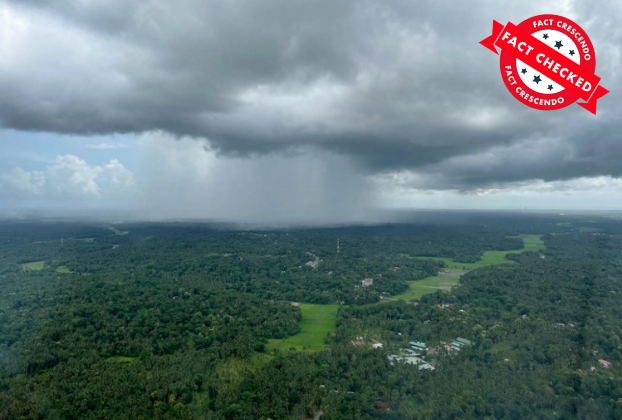
A viral message circulating across social media claims that natural disasters in Sri Lanka and Southeast Asia are being caused by a “climate weapon,” possibly linked to HAARP, NATO’s “Beast computer,” or the Pentagon. The post urges the public to “ask NATO to unplug HAARP” to stop floods and storms. Such claims typically emerge during periods of extreme weather when communities seek simple explanations for complex climate events. However, our investigation finds this claim to be false.
Social Media Posts
We found circulating message on WhatsApp states: “Disasters in your country and in South-East Asia are caused by climate weapon (may be by HAARP) and NATO Beast computer. To stop disasters, ask them to stop causing disasters in your country!”
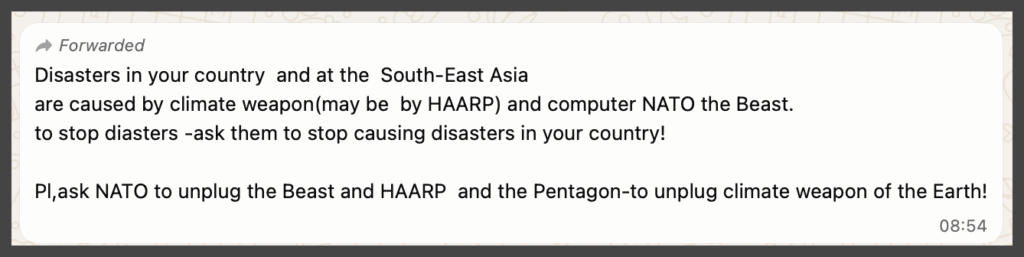
Moreover, we found the similar claim on Facebook also.

Fact Check
The core claim and why it is a conspiracy theory
The message that disasters in “your country and South-East Asia” are being caused by a “climate weapon” such as HAARP and a “NATO Beast computer” belongs to a well-known conspiracy narrative rather than to evidence-based science. There is no scientific study, technical documentation or credible government record showing that any state or military alliance possesses a machine capable of steering monsoons, creating cyclones or triggering earthquakes on demand. By contrast, research in geology, meteorology and climate science consistently finds that earthquakes, tsunamis, volcanic eruptions and most storms are driven by plate tectonics, ocean–atmosphere dynamics, and natural climate variability, with human-driven climate change now amplifying some extremes such as heatwaves, heavy rainfall and coastal flooding. This influence is diffuse and global, tied to greenhouse-gas emissions, not to a targeted “weapon” that can be switched on and off over specific countries. (Source)
What HAARP actually is, and what it can and cannot do
The High-frequency Active Auroral Research Program (HAARP) is a scientific research facility near Gakona, Alaska. According to its own documentation and independent reference works, HAARP uses high-frequency radio waves to study the ionosphere, the electrically charged layer of the upper atmosphere that affects radio communication and navigation signals. The main instrument is an array of 180 antennas capable of radiating several megawatts of power upward into a small patch of ionosphere for a short time, allowing scientists to examine how this region responds and how it influences radio propagation.
Crucially, weather systems form much lower, in the troposphere and lower stratosphere. The energy HAARP deposits is confined to a limited volume of the ionosphere and is tiny compared with natural energy flows from the sun or from latent heat released in storms. Scientific reviews, the HAARP FAQ and AAP all reach the same conclusion: the facility cannot control the weather, cannot create or steer hurricanes, and cannot trigger earthquakes or tsunamis. Its radio waves are simply too weak, act too high in the atmosphere and over too small an area to have those effects. (Source)
Scientific view on disasters and extreme weather
Mainstream earth and climate sciences explain natural disasters through established physical mechanisms. Earthquakes and many tsunamis are caused by the movement of tectonic plates and fault ruptures. Volcanic eruptions arise from magma dynamics within Earth’s crust and mantle. Storms, cyclones, heavy rainfall and droughts result from large-scale circulation patterns in the atmosphere and oceans, including monsoons, trade winds, jet streams, and phenomena such as El Niño and the Indian Ocean Dipole. (Source)
Climate change adds an additional layer by warming the oceans and the atmosphere. Warmer seas provide more energy and moisture to tropical cyclones, while a warmer atmosphere can hold more water vapour, which leads to more intense downpours when that moisture condenses. Peer-reviewed studies and international assessments find that human-driven greenhouse-gas emissions are increasing the frequency and severity of some types of extremes, particularly heatwaves, heavy precipitation and coastal flooding. However, this is a global, statistical influence distributed across many events, not a precise “aimed” weapon that targets specific countries at specific times.
In Sri Lanka and Southeast Asia specifically, extreme rainfall and floods are linked to monsoon variability, sea-surface temperature anomalies, shifts in the Intertropical Convergence Zone (ITCZ) and local geography. Sri Lanka’s steep hill country and low-lying plains, for example, make it particularly vulnerable to rapid runoff and flash flooding when heavy rain occurs. These drivers are well documented in climatological and geological literature and are monitored by national meteorological agencies; none require secret climate weapons to explain the observed impacts.
“Climate weapon” and HAARP conspiracies
Despite the extensive scientific record, HAARP-related conspiracy theories often resurface on social media following major hurricanes, floods or earthquakes. Fact-checking organizations and communication scholars have documented how these narratives spread: they typically emerge in online communities and then circulate widely during crises, when fear and uncertainty are high.
Empirical studies of HAARP-related discourse show that claims about weather control share characteristics with other conspiracy theories: they rely on speculation and reinterpret technical information in ways that diverge from mainstream scientific understanding. Official denials are sometimes viewed with skepticism, which can reinforce rather than weaken the beliefs. Researchers note that these narratives may appeal to people seeking clear causal explanations during complex events. Rather than being grounded in peer-reviewed measurements, the HAARP climate-weapon narrative spreads through repetition, anecdote and perceived patterns across unrelated events.
The “NATO Beast computer” myth
The message also refers to a “NATO Beast computer,” suggesting the existence of a digital system that some believe can control weather or trigger disasters. No evidence for such a system has been found in NATO’s public documentation, defence-technology literature or independent research. NATO’s actual information systems, as described in official reports and academic analyses, are designed for command-and-control, communications, situational awareness and cyber security, rather than geophysical manipulation. (Source)
The “Beast computer” concept has a longer history in apocalyptic and conspiracy folklore. Scholars of religion and media have documented legends about a large computer called “the Beast,” reportedly located in Brussels, that allegedly assigns identification codes to all humans and forms part of a totalitarian order. These narratives originated in the late twentieth century and spread through pamphlets, sermons and later the internet. According to researchers, they represent modern myths that combine technology, biblical imagery and concerns about surveillance, rather than descriptions of an operational NATO device. (Source)
How and why these rumours spread in Sri Lanka and Southeast Asia
Sri Lanka has become a regional focal point for climate-weapon rumours partly because it sits in a highly vulnerable Indian Ocean zone with intense monsoon cycles and repeated floods. When communities experience several disasters within a short period, many people feel that official explanations about monsoons, sea-surface temperatures or climate oscillations are too abstract or unsatisfying. In that emotional context, messages blaming a foreign military or a secret computer can feel more concrete and morally clear, even though they lack evidence.
Once such a message gains traction in local chat groups, it often spreads to neighbouring countries that are experiencing similar weather events, such as cyclones in the Bay of Bengal or heavy flooding in Southeast Asia. The text is then adapted, with country names modified while retaining references to HAARP and NATO. This pattern of a consistent narrative framework applied to different local events is characteristic of widely circulated conspiracy claims rather than location-specific investigative reporting.
Conclusion
The claim that natural disasters in Sri Lanka and Southeast Asia are caused by HAARP, a “NATO Beast computer,” or any other climate weapon is false. Scientific evidence demonstrates that these disasters result from natural geological and meteorological processes, including tectonic activity, monsoon patterns, and climate variability amplified by human-driven climate change. There is no credible evidence that any technology exists capable of creating or directing earthquakes, tsunamis, floods, or storms as a targeted weapon.
An explainer on the same was published on Climate Fact Checks. You can read it here: Climate Fact Checks.
Source:
More than 50 killed in deadly Sri Lanka floods: What we know so far
HAARP, Weather, Natural Disasters and the Human Mind
HAARP research attracts conspiracies, misunderstandings
Conspiracy theories and misinformation about climate change
Landslide Disaster Risk Reduction Strategies and Present Achievements in Sri Lanka
What Is Behind Sri Lanka’s Weather Anxiety and the Theories It Sparks

Title:No, HAARP and a “NATO Beast Computer” Are Not Causing Natural Disasters in Sri Lanka and Southeast Asia
Fact Check By: Cielito WangResult: False