

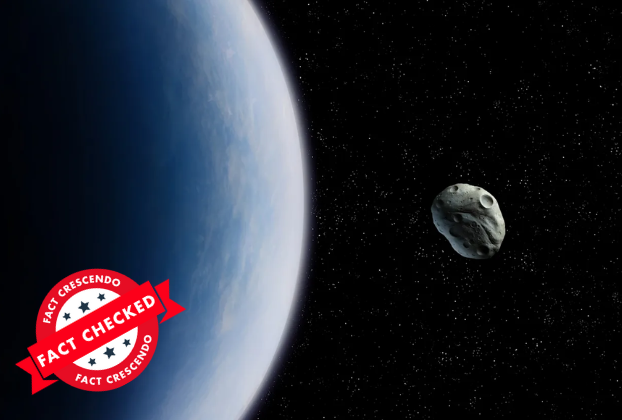

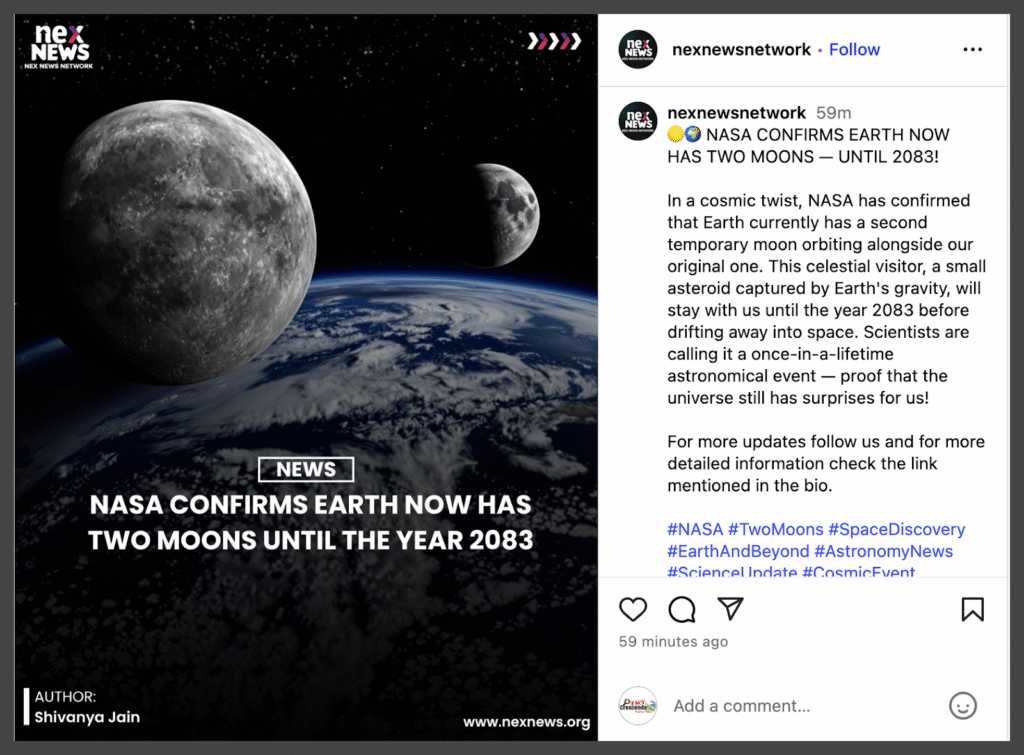
In October 2025, social media platforms erupted with claims that NASA had confirmed Earth now possesses two moons, a celestial companion destined to orbit our planet until 2083. However, our investigation found that this claim misinterprets scientific data, NASA did not announce that Earth has two moons.
Social Media Posts
A viral claim circulating on platforms such as Facebook, X, and Instagram alleges that “NASA confirms Earth now has two moons until 2083.” The posts feature space-related imagery and emphasize that a second moon will orbit Earth for several decades.


Fact Check
What NASA Actually Confirmed
In August 2025, astronomers from the University of Hawaii’s Pan-STARRS Observatory, working with NASA, identified asteroid 2025 PN7. This small object, roughly 18 to 36 meters across, has likely been traveling alongside Earth’s orbit since the 1960s. Orbital models from NASA’s Jet Propulsion Laboratory (JPL) Horizons system predict it will maintain this Earth-like path until around 2083, when it will separate and follow its own independent orbit around the Sun.
Importantly, NASA has not released an official statement declaring Earth has a second moon. The information comes from scientific studies of the asteroid’s trajectory, not from any formal NASA announcement. (Source: azcentral, Economic Times)
Despite widespread references to NASA in headlines, no official statement about “two moons” exists on NASA’s website. Reports citing NASA rely on publicly accessible JPL orbital data used by astronomers to classify the asteroid’s motion, not on a press release.
The scientific analysis of 2025 PN7’s orbit appeared in the Research Notes of the American Astronomical Society (AAS), where researchers used NASA JPL Horizons ephemerides to model the asteroid’s position (Source). In short, NASA provides the data infrastructure that allows independent researchers to track near-Earth objects but did not proclaim Earth to have “two moons until 2083.”
Why It Is Not a “Second Moon”
A true moon is gravitationally captured by Earth and orbits our planet directly. 2025 PN7, by contrast, orbits the Sun, not Earth. It follows a solar trajectory that closely mirrors Earth’s own path around the Sun. From our viewpoint on Earth, this synchronized motion creates the impression that the asteroid is accompanying us through space.
According to NASA’s orbital calculations, 2025 PN7 stays at least 4 million kilometers away, roughly ten times the distance to our actual Moon—and exerts no influence on Earth’s tides, gravitational field, or motion (Source).
What a “Quasi-Moon” Is
Astronomers describe 2025 PN7 as a quasi-moon (or quasi-satellite), a body that shares Earth’s orbital period around the Sun but is not gravitationally captured. Quasi-moons move in near-synchrony with Earth, sometimes ahead, sometimes behind, while both complete a solar orbit in roughly one year. From our vantage point, their motion appears looping or tadpole-shaped around the planet due to the combined gravitational influences of the Sun and Earth (Source).
Such relationships are temporary. A quasi-moon can remain in resonance for decades or centuries before gravitational shifts pull it away. Other known examples include Kamo‘oalewa (2016 HO₃), which has followed Earth for centuries, and 2025 PN7, predicted to stay until about 2083.
Quasi-moons demonstrate how gravitational resonance allows asteroids to move in sync with planets without becoming true satellites. These objects orbit the Sun, not Earth, but their orbital period matches ours, creating the illusion of companionship. Earth’s gravity only slightly affects their path, and because they never enter true orbit around our planet, they have no impact on Earth’s tides, climate, or environment.
Studying these objects is valuable for several reasons. They help scientists understand orbital mechanics, improve planetary defense strategies against potentially hazardous asteroids, and refine long-term predictions of near-Earth object behavior. Data from 2025 PN7 and similar quasi-moons improve the models used by NASA’s Center for Near Earth Object Studies (CNEOS), which monitors asteroids that could pose risks to Earth. (Source)
Conclusion
The viral claim that “NASA confirms Earth now has two moons until 2083” is misleading. While NASA’s Jet Propulsion Laboratory provides orbital data showing that asteroid 2025 PN7 will follow a path similar to Earth’s until around 2083, NASA has not officially declared that Earth has acquired a second moon. The asteroid is classified as a quasi-moon, a small body that orbits the Sun in synchrony with Earth but is not gravitationally bound to our planet and therefore cannot be considered a true natural satellite.

Title:No, NASA Did Not Confirm That Earth Now Has Two Moons
Fact Check By: Cielito WangResult: Misleading