

A viral claim states that a new toxicology study confirmed every lipstick sample across major global brands contains measurable levels of cadmium, a known human carcinogen. After investigation, we found that this claim is inaccurate.
Social Media Posts
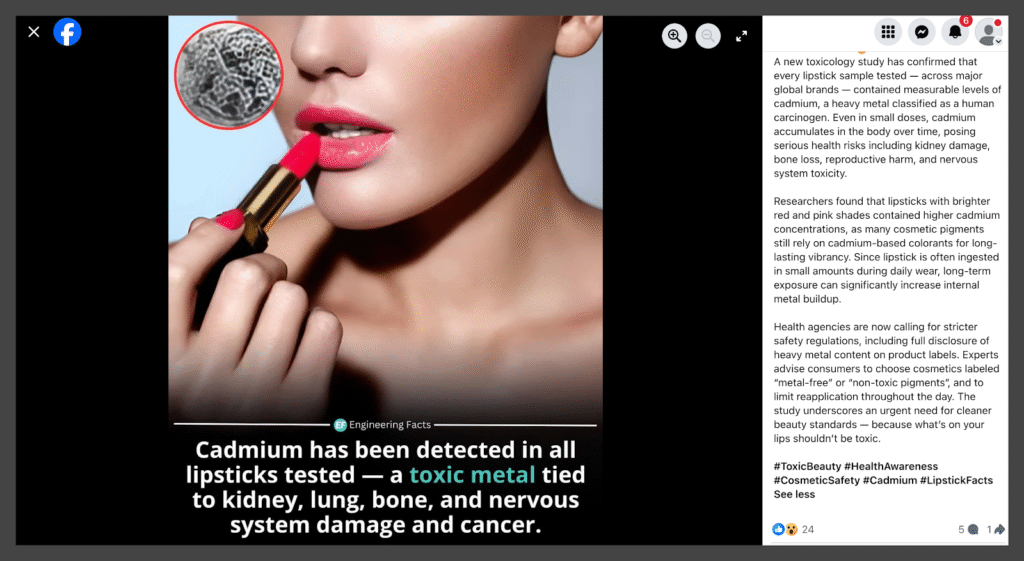
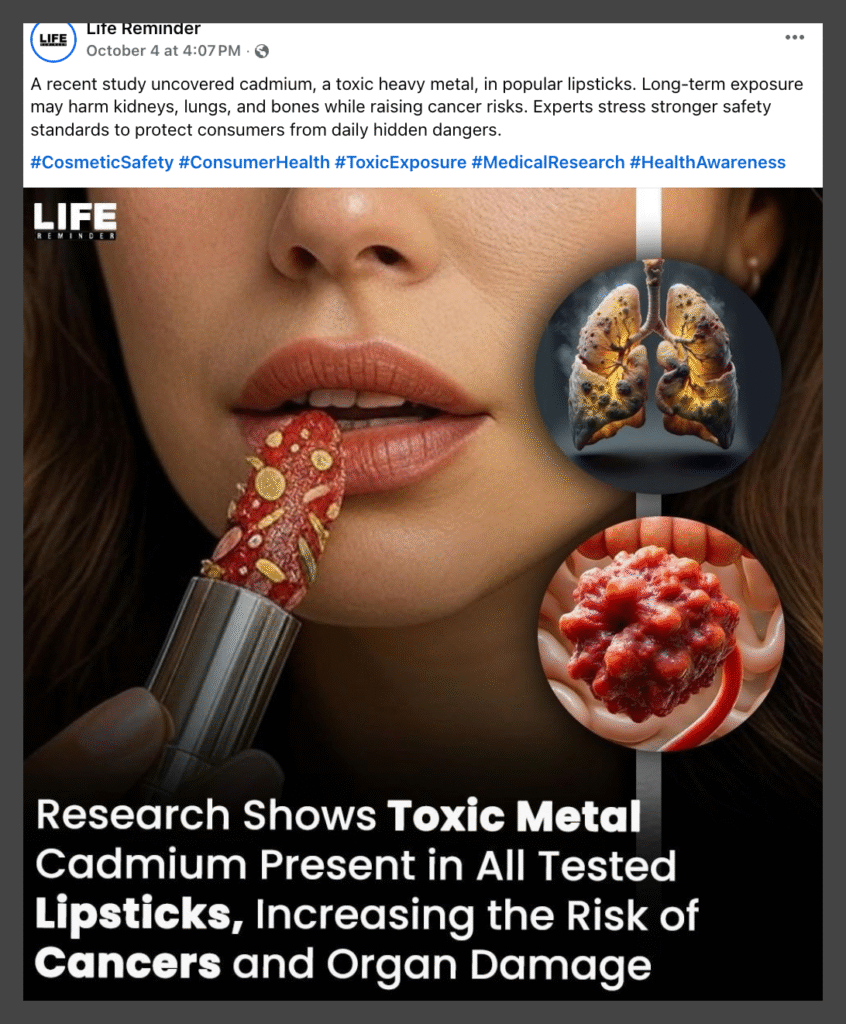
Several social media pages have shared graphics claiming that cadmium has been detected in all lipsticks tested, calling it a toxic metal linked to kidney, lung, bone, and nervous system damage, as well as cancer.
Detection of cadmium in lipsticks
Peer-reviewed studies show that some lipsticks contain trace amounts of cadmium, but no study has confirmed that every lipstick across major brands contains it. A 2024 study from Ghana tested 12 lipsticks using X-ray fluorescence and found that cadmium levels in most samples exceeded the FDA’s reference value of 3 mg/kg. However, the calculated non-cancer hazard quotients (HQ) for typical use were below the threshold of concern (HQ <1). For heavy users who apply lipstick frequently, the oral “relative intake indices” for cadmium, chromium, and lead exceeded acceptable daily intakes (ADI), suggesting potential risk at high use levels. A broader review of cosmetics found that cadmium levels in lipstick are generally lower than in some other cosmetic product types, and most calculated safety margins fell within accepted limits under normal use patterns.se.
In the United States, the FDA periodically surveys cosmetics for metals (arsenic, cadmium, chromium, cobalt, lead, mercury, nickel). The agency reports the amounts found in market surveys are typically very small and has stated it has no evidence these trace levels pose a health risk under normal use.
Global testing update. In 2025, Consumer New Zealand tested 25 lipsticks and 15 bronzers for lead, cadmium and mercury. None of the products had levels that were a safety concern (one sample per product).
In short, cadmium is sometimes detected, but evidence does not support the claim that it is present in all lipsticks across major brands.
Toxicological profile and bioaccumulation
Cadmium is a toxic heavy metal that bioaccumulates, particularly in kidneys and bones, with a biological half-life measured in years to decades. Chronic exposure at higher doses is linked to kidney damage and bone loss; IARC classifies cadmium and its compounds as Group 1 human carcinogens, a classification driven largely by inhalation data from occupational settings rather than low-dose oral/dermal cosmetic exposure (Source).
Exposure from lipstick use
Heavy metals are poorly absorbed through skin; for lip products the primary route is incidental ingestion. The UC Berkeley team (Environmental Health Perspectives) assumed average ingestion of ~24 mg/day of lip product (87 mg/day at the 95th percentile) to model intakes of multiple metals (including cadmium and chromium). They concluded that some products could approach levels of concern with long-term, heavy use, but did not claim that all lipsticks or all users face such risks. Health Canada likewise notes dermal absorption is minimal relative to ingestion for lip products (Source).
Quantitative risk metrics
Recent studies provide concrete risk measurements. In Iran (2024), researchers tested 50 lipsticks from 5 brands and found maximum cadmium levels of 0.037 mg/kg and lead levels of 2.31 mg/kg. Interestingly, chromium posed the greatest calculated risk in this study: its non-cancer hazard quotient was HQ = 14.98 (values above 1.0 indicate potential concern) and its lifetime cancer risk was LCR = 4.5 in 1,000 (well above typical safety benchmarks of 1 in 10,000 or lower). By contrast, cadmium and lead HQs stayed below 1 in these samples.
In Ghana (2024), testing of 12 lipsticks found non-cancer HQs below 1 for typical use. However, for people who apply lipstick very frequently, the relative intake indices (RII), a measure of daily exposure, for chromium, cadmium, and lead exceeded acceptable daily intake levels, pointing to possible risk with heavy, long-term use.
These findings illustrate two key points: first, risk varies by which metal is present, how much, and how often the product is used; and second, in some product samples, chromium, not cadmium, drives the greatest modeled risk.
Brand-specific findings
The viral claim centers on cadmium, but editors asked for brand-level evidence. The most authoritative brand-specific data involve lead, not cadmium:
- FDA expanded survey (2010; 400 lipsticks, published 2012): maximum lead level 7.19 mg/kg (ppm) in Maybelline Color Sensational “Pink Petal”; average across 400 was 1.11 ppm. FDA authors also found statistically significant associations between lead level and parent company in the dataset (without concluding health risk at typical use) (Source).
- FDA’s subsequent guidance recommends ≤10 ppm lead as an impurity in lip products; FDA concluded that up to 10 ppm would not pose a health risk based on exposure assessment and market data.
It is important to note that these brand-level results address lead, not cadmium. They do not show that “every lipstick” contains cadmium.
Regional brand data (India). A Delhi-NCR study reported Lakme Enrich 13.063 ppm Pb and Elle 18 Red 12.382 ppm Pb among the highest values in that local sample set (2015) .
Regulatory and safety standards
Regulations differ worldwide. In Canada, heavy metals such as lead, arsenic, cadmium, mercury, antimony and chromium are prohibited as intentional ingredients but may occur as trace impurities under limits and good manufacturing practice. In the EU, certain metals are restricted under the Cosmetics Regulation; full on-label disclosure of measured metal content is generally not required. In the U.S., FDA recommends ≤10 ppm lead in lip products and surveys the market for contaminants; heavy-metal content disclosure on labels is not mandated, with regulators focusing on safety and impurity limits (Source).
Asia
India: cosmetics are governed by the Drugs & Cosmetics Act (1940) and Cosmetics Rules (2020); imports require registration with documentation on contaminants. National standard IS 16913:2018 specifies test methods/limits for As, Cd, Pb, Hg in finished products .
Sri Lanka: the Consumer Affairs Authority sets maximums for heavy metals in cosmetics (Cd ≤ 3 mg/kg; Pb ≤ 10 mg/kg; As ≤ 3 mg/kg; Hg ≤ 1 mg/kg) under SLS 743 / SLS ISO 21392 (enforcement varies).
Conclusion
The claim that every lipstick contains cadmium is misleading. While cadmium has been detected in some lipstick samples, scientific studies show that levels vary significantly by brand, region, and manufacturing practices, not all lipsticks contain it, and most tested products fall within accepted safety limits for typical consumer use.
Title:No, Not All Lipsticks Contain Dangerous Levels of Cadmium
Fact Check By: Cielito WangResult: Misleading