

Subscribe to our WhatsApp Channel
Sri Lanka crashed out of the upper-middle-income bracket during the worst economic collapse in its history, and in the World Bank’s latest classification, it has climbed back in, this time by a margin of just thirty-four dollars. Yet with prices still elevated, wages below pre-crisis levels and the middle class starved of cash, readers wrote in asking a simple question: if the country has been upgraded, why does daily life feel harder than ever? Here is our detailed explainer.
Social Media Posts
Even as Sri Lanka was promoted to upper-middle-income status, viral social media posts pointed to the severe financial strain still gripping ordinary citizens, as shown below.

Facebook | Facebook | Archived | FB
Explainer
Sri Lanka Has Been Reinstated as an Upper-Middle-Income Nation
The World Bank’s development data group has reclassified Sri Lanka as an upper-middle-income country in its annual country rankings. The upgrade was driven mainly by a post-crisis rebound in industry, tourism and financial services, which pushed Real GDP up by 5% in 2025 and lifted Gross National Income (GNI) per capita along with it.
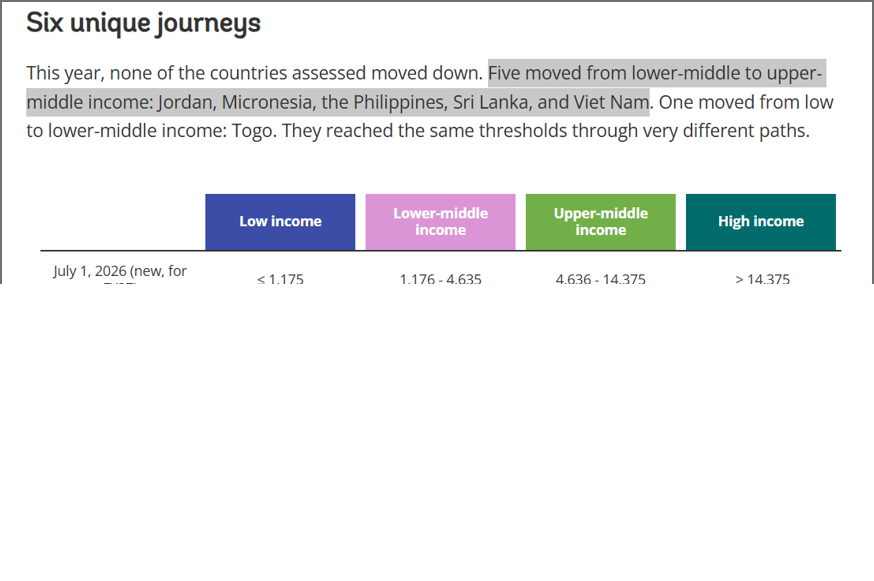
Sri Lanka, along with Vietnam, the Philippines, Jordan and Micronesia, moved up from lower-middle to upper-middle-income status. With this latest classification, Sri Lanka and the Maldives are now the only two South Asian nations in the upper-middle-income bracket.
Other South Asian countries, including India, Bangladesh, Bhutan and Pakistan, remain classified as lower-middle-income economies. Further details are available here and here.
The Technical Limits of the World Bank Classification (GNI vs. GDP)
The World Bank classifies countries on the basis of GNI per capita, calculated through the World Bank Atlas Method.
The World Bank’s Development Data Group states plainly that income classification is only an indicator of income level, not a comprehensive assessment of a country’s economic development or general standard of living.
The World Bank’s Development Economics Data Group notes that the institution has for years relied primarily on GNI per capita to classify countries.
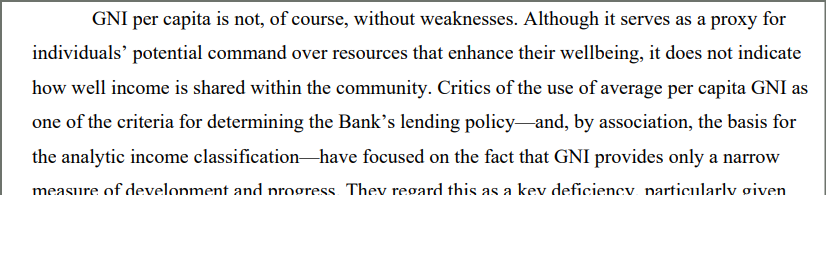
While it serves as a rough gauge of people’s command over resources, the Bank has explicitly stated that this metric says nothing about how income is actually distributed within a country.
It also points out that although GNI per capita correlates strongly with development indicators such as access to healthcare, it is not a complete measure of well-being. The main purpose of the classification is to group countries for analytical work and data presentation.
Beyond the World Bank itself, the classification is widely used by international institutions and governments for operational purposes such as allocating aid and shaping trade policy.
Sri Lanka Crossed the Upper-Middle-Income Threshold by an Extremely Narrow Margin
For 2026 (FY27), the upper-middle-income threshold is set at a GNI per capita above US$4,636 a year, roughly Rs. 116,000 a month at current exchange rates. Sri Lanka cleared the bar by a razor-thin margin, recording US$4,670, just US$34 above the line.
Upper-Middle-Income Status Does Not Mean the Average Sri Lankan Is Financially Better Off
The World Bank’s 2025 Sri Lanka Development Update lays out the toll of the crisis: a 24.5% poverty rate, sharply higher food prices and more than 535,000 people leaving the country. Despite 5% macroeconomic growth, the report notes that falling wages have left households struggling with nutritional deficits. Archived Link
| Indicator | Current value / status | Official source |
|---|---|---|
| Poverty (below $3.65 per person per day) | 24.5%, more than double the 2019 level. | World Bank Sri Lanka Development Update |
| Food prices | More than doubled between 2021 and 2024. | World Bank consumer welfare and food security data |
| Real wages | As of 2024 and 2025, it is still below the pre-crisis 2019 level. | World Bank labour market analysis data |
| Labour force participation rate | Has slipped to 49.2%. | Department of Census and Statistics (DCS) Labour Force Survey |
| Debt-to-GDP | 91.60%. Down from the 2022 peak of 120.9%, but still a heavy drag on the macroeconomy. | Central Bank of Sri Lanka (CBSL) |
| National poverty line | Rs. 17,315, per the latest DCS report. | Department of Census and Statistics (DCS) official data |
Four Reasons Ordinary Citizens Feel None of the 5% Growth
I. High base effect of prices
Prices of goods and services, which surged more than 70% during the 2022/2023 crisis, remain elevated, per the Colombo Consumer Price Index (CCPI). Because nominal incomes have not kept pace, earnings go entirely toward daily expenses, leaving no room for savings or liquidity.
Per the World Bank’s Sri Lanka Development Update, food prices more than doubled between 2021 and 2024, fueling malnutrition and eroding food security. Higher taxes and prices, along with lost jobs and income, keep household budgets under severe strain. Real wages in the private and public sectors have collapsed by 16.9% and 22% respectively, and both remain below 2019 levels. Archived Link
II. Fiscal consolidation through tax reform and subsidy cuts
To meet the conditions of the IMF’s Extended Fund Facility (EFF), the government has run a tight fiscal policy. Higher Advance Personal Income Tax (APIT) and VAT have sharply cut disposable income, especially for fixed-salary middle-class professionals. Removing electricity, water and fuel subsidies has driven up monthly fixed costs, pulling liquid cash out of household hands and toward the state. The Central Bank of Sri Lanka’s Annual Economic Review likewise notes that fiscal consolidation and subsidy cuts have rapidly pushed up the cost of living for ordinary people.
III. Income inequality
Although the economy grew by roughly 5%, World Bank data show the income gap widening further, with the Gini Index rising from 37.7 to 39.8. Archived Link
The UNDP’s Multidimensional Vulnerability Index report finds that 55.7% of Sri Lanka’s population, some 12.34 million people, are multidimensionally vulnerable. The biggest challenge facing ordinary families is mounting household debt from mortgaging property to buying essentials, coupled with an inability to cover education and healthcare costs. Archived Link
IV. Credit crowding out in the banking system.
After domestic debt restructuring, local banks have taken a stringent line on lending to the private sector.
With businessmen and the middle class no longer able to secure personal loans as easily as before, the velocity of money in the market has slowed, creating an active cash crunch in the economy. More details can be found here. Further reading is available here and here.
This Is Not the First Time Sri Lanka Has Held Upper-Middle-Income Status
Sri Lanka was first classified as upper-middle-income in July 2019. But shifting tax policy and missteps in its economic path meant it slipped back to lower-middle-income by July 2020. That history shows the current classification alone cannot be read as proof that the public’s economic hardship is over, and without sustained structural reform the gain could just as easily reverse.
So, while the World Bank’s upgrade is technically and statistically accurate, it does not describe an economy where ordinary people have more cash in hand or a lighter cost-of-living burden. High taxes and expenses may well be pushing ordinary citizens, the middle class included, into a liquidity crisis.
What Classification Actually Changes in Practice
Investor confidence: It acts as a positive signal, strengthening the country’s ability to raise international loans and win investor confidence.
A benchmark for international institutions: Researchers, development partners and international organisations use the classification as an indicator when allocating aid and planning development projects.
Risk of losing World Bank IDA eligibility: With the move into the upper-middle-income bracket, Sri Lanka’s eligibility for the World Bank’s International Development Association (IDA) loans may diminish. IDA loans go to the world’s economically weaker nations at very low or zero interest.
Additional details are available here, here and here.
Professor of Economics Wasantha Athukorala
To understand why ordinary Sri Lankans are struggling despite the upper-middle-income classification and 5% GDP growth, we spoke to Professor of Economics Wasantha Athukorala of the Department of Economics and Statistics at the University of Peradeniya. He explained:
“Sri Lanka’s place in the upper-middle-income category rests mainly on our GNI per capita, which is the criterion the World Bank uses. Under the Bank’s Atlas Method, any country with a GNI per capita above US$4,635 is treated as upper-middle-income. Sri Lanka’s GNI per capita for 2025 stands at US$4,670, which is why we were placed in this bracket as of 2025.
What we have to understand is that the upper-middle-income band runs from about US$4,635 up to roughly US$12,000 in GNI per capita. So, we are still sitting at the very bottom of it and need to climb steadily. Looking at the country as a whole, we managed 5% GDP growth in each of the past two years. But GNI per capita says nothing about how that income is shared. A handful of people can contribute disproportionately and lift the country’s overall standing, inflating the per-capita figure without it meaning that everyone has reached a higher income level.
Sri Lanka’s problem is that a heavy tax burden falls on the middle class, while income inequality stays high. A limited group generates most of the income, and the benefits do not trickle down to everyone. There are real problems at the grassroots of the economy, but we have to work through them and keep moving forward steadily. That is what is required. Alongside this, the gains from rising income need to reach the people. That kind of redistribution does not happen overnight; it has to unfold over time, and it will take a defined period to materialize.”
Mr. Athukorala has also shared his views on Sri Lanka’s upper-middle-income classification, which can be seen here.
MP Harsha de Silva
MP Harsha de Silva has also weighed in on the World Bank naming Sri Lanka an upper-middle-income country for the second time since 2019, in remarks that can be seen here. He points out that poverty has climbed roughly 22% relative to 2019, close to double. On that basis, he argues that the current situation cannot be presented as sustainable national development. What is needed instead is to ensure the benefits of growth reach the whole of society, not just a narrow segment. Rather than risk sliding back to the previous state, he says, every arm of government should be working to improve the indicators that affect the entire population, poverty and food security among them.
Summary
The picture that emerges is clear. The World Bank’s latest classification, moving Sri Lanka from lower-middle to upper-middle-income status, is a positive development, but ordinary people in the country are still under real economic pressure.
With GNI per capita rising to US$4,670, Sri Lanka has been named an upper-middle-income country. Sri Lanka entered this category in 2019, and this is the first time since then that the country has regained the status. Yet it cleared the required minimum of US$4,636 by a razor-thin US$34, which leaves it at the very bottom rung of the bracket. Therefore, the living standards seen in most upper-middle-income nations cannot fairly be compared with everyday life in Sri Lanka.
High tax rates, unequal income distribution and various grassroots economic problems mean the benefits of rising income do not always reach the public. Even so, the classification offers grounds for cautious optimism about an economy still rebuilding from a massive crisis.
Join us to learn more about our fact-check investigations.
Facebook | Twitter | Instagram | Google News | TikTok

Title: A Nation Reclassified, a People Still Squeezed: The Story Behind Sri Lanka’s Economic Upgrade
Written By: B.P. Hansani
Result: Insight