

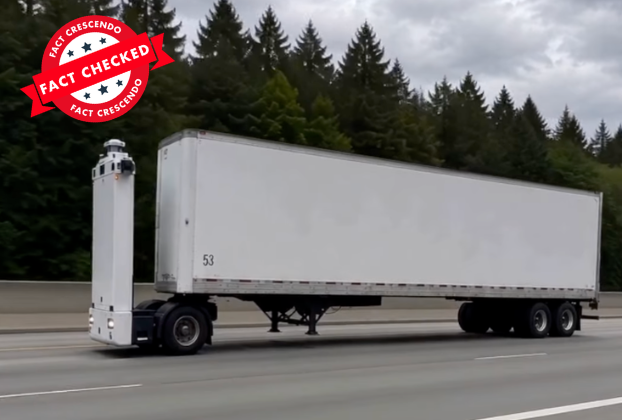
A viral video circulating claims that “China’s T-Mover truck is fully self automated” and that driverless semi-trucks are “taking over China’s roads” without human drivers. The footage has been widely shared as evidence that China has already achieved fully autonomous freight transport on public highways. However, the viral caption exaggerates what the video actually demonstrates. Current evidence shows that most autonomous truck operations remain limited to specific operational environments, approved routes, or supervised deployments rather than unrestricted, fully autonomous driving everywhere. Therefore, we found the claim to be misleading.
Social Media Posts
A video circulating shows what appears to be a heavy-duty truck driving without a visible driver behind the wheel. The accompanying captions claim that China’s “T-Mover” truck is “fully self automated” and suggest that driverless trucks are already “taking over China’s roads.”
Fact Check
The Viral Video Was Generated Using Artificial Intelligence
It is essential to clarify that the viral video itself is inauthentic before evaluating any assertions regarding autonomous trucking. Rather than being actual footage of a self-driving truck on public highways, the video has been determined to be AI-generated. Analysis by the AI content detection tool Hive Moderation indicates a 99.9% probability that the footage was created using artificial intelligence.
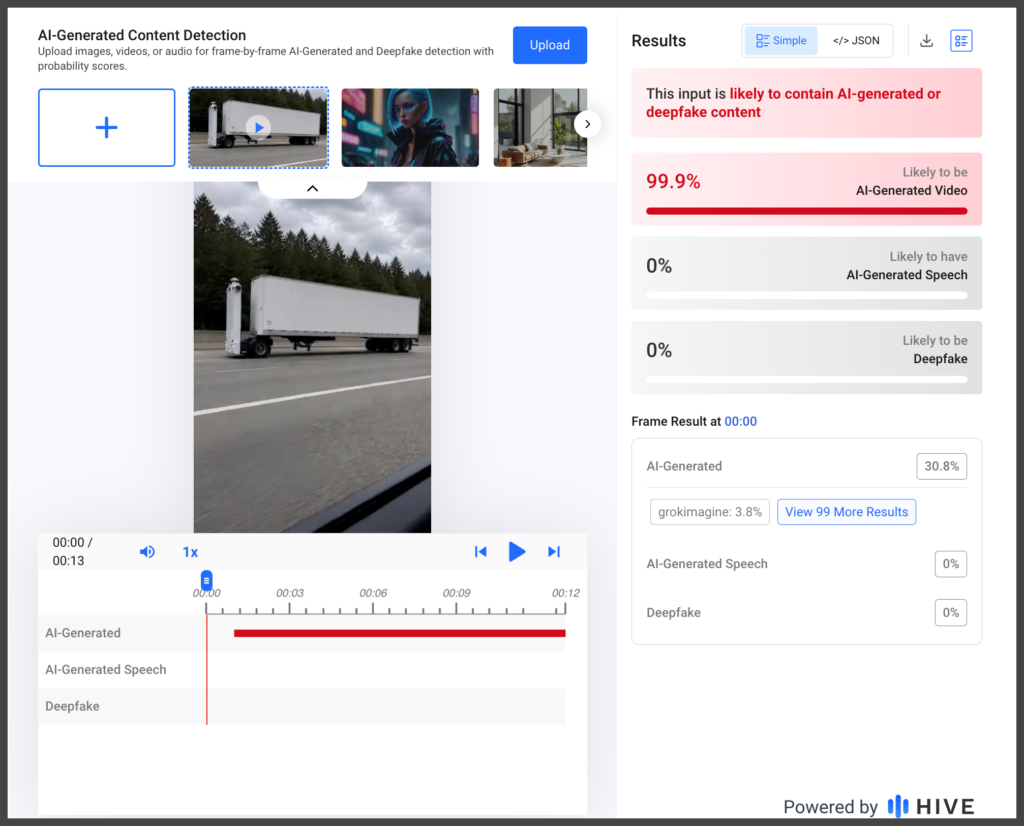
While China is actively developing and deploying autonomous freight vehicles, the AI-generated video cannot be used as evidence that fully autonomo
The video is based on a real technological development, but it overstates the current state of autonomous trucking in China.
For instance, Level 4 (L4) autonomous trucks are undergoing routine testing on the Tianjin Port-Xiong’an logistics corridor along a designated route. This marks progress in autonomous logistics, but it does not mean fully driverless trucks are operating freely nationwide. (Source)
Similarly, autonomous vehicles at Tianjin Port’s smart zero-carbon terminal utilize AI, 5G, and BeiDou navigation to manage containers within a strictly controlled logistics setting, rather than on public city streets or highways.
Level 4 Autonomous Driving Is Not the Same as Full Self-Driving
The viral caption is misleading because it blurs the distinction between levels of automation. Most autonomous trucks in China are Level 4 (L4) vehicles, not fully autonomous ones capable of driving anywhere. According to the SAE International J3016 standard, Level 4 vehicles perform driving tasks only within a defined Operational Design Domain (ODD), such as specific highways, ports, or weather conditions. Outside this domain, they require intervention.
This differs from Level 5 automation, which handles all conditions without human intervention; no company has commercially deployed Level 5 trucks on public roads. China’s regulations reflect this: in February 2026, the MIIT released draft safety rules for Level 3 and 4 systems, requiring performance comparable to human drivers and strict operational oversight.
Furthermore, most Level 4 robotrucks still require onboard safety drivers under current frameworks. Fully unmanned operations remain restricted to specific pilot zones, such as Beijing’s High-Level Autonomous Driving Demonstration Zone. (Source)
In other words, an L4 truck can be driverless within its approved operating environment without being capable of driving anywhere under all circumstances.
Most Autonomous Truck Deployments Still Operate Under Supervision or on Designated Routes
While autonomous trucking is advancing in China, deployments remain within controlled environments rather than unrestricted public roads. JD Logistics‘ July 2026 L4 pilot in Beijing operates on a 31-km expressway route within a demonstration zone, utilizing in-cab safety drivers and a three-layer safety system comprising onboard AI, cloud monitoring, and remote intervention. ช
Similarly, Plus and SF Express utilize supervised L4 systems for long-haul freight to improve efficiency while maintaining human oversight. China’s regulatory framework mandates this caution; guidelines generally require in-cabin operators, restrict driverless modes to approved zones, and enforce continuous data monitoring.
These deployments prove that Chinese autonomous trucking relies on designated routes and human supervision, contradicting claims that driverless trucks have broadly “taken over” the country’s roads. (Source: China Daily, TechCrunch)
The Video Does Not Prove China Has Achieved Fully Driverless Trucking
The viral claim misinterprets footage of autonomous trucks as proof of unrestricted, driverless operations. A recent BBC report highlights that while trucks can autonomously navigate Beijing-Tianjin expressways, current regulations mandate an onboard safety driver who acts as a “last line of defence” and takes manual control outside designated routes.
Industry leaders focus on these predictable logistics corridors to advance commercial viability while maintaining regulatory oversight and gradually expanding operational domains.
Further, companies like Pony.ai and SANY are adopting “1+4” truck platooning, where one lead truck guides four autonomous followers, to improve efficiency within existing legal frameworks rather than pursuing fully independent, driverless fleets. (Source)
Industry Experts Say Fully Driverless Trucking Is Still Years Away
Industry experts emphasize that autonomous trucking’s rollout is a gradual, regulated process, not a sudden nationwide takeover. In May 2026, CNBC interviewed leaders from Pony.ai and Inceptio Technology, who clarified that generative AI breakthroughs haven’t accelerated timelines, as autonomous driving relies on specialized perception and vast real-world data rather than language models. Inceptio targets mid-2028 for major commercial milestones
Inceptio notes that it must accumulate roughly 5 billion kilometres of driving data before its models can support trucks without human intervention in approved areas, a goal contingent on government approval, partnerships, and manufacturing readiness. Furthermore, following recent incidents, Chinese authorities have introduced stricter safety rules for Level 3 and 4 systems, reinforcing that regulators still treat autonomous driving as an emerging, supervised technology rather than a fully matured, unrestricted one . Consequently, while China is making steady progress through controlled deployments, the claim that fully driverless trucks are “taking over” the roads remains inaccurate.
(Source: MEXC, News Minimalist, AV America)
What the Research and Current Evidence Actually Show
China is a global leader in autonomous trucking, currently transitioning from pilots to commercialization. Rather than a nationwide takeover, companies are gradually expanding approved routes and partnerships.
Autonomous line-haul trucking is ideal for long-haul highways due to stable conditions. A 2022 KPMG China report projected large-scale L4 commercialization between 2026 and 2030, noting it follows earlier adoption in controlled environments like ports.
In February 2026, the MIIT released draft safety rules for Level 3 and 4 systems, requiring performance equivalent to human drivers and mandatory operator training, highlighting continued regulatory oversight.
By July 2026, the MIIT mandated stricter safety checks and prohibited “exaggerated or false advertising” regarding vehicle autonomy. Regulators emphasize distinguishing assisted driving from full autonomy to prevent public misinterpretation.
Evidence indicates a more nuanced reality than the viral video suggests. While China has advanced autonomous freight and expanded Level 4 truck deployments, these operations remain restricted by specific domains, regulations, and safety oversight. Thus, a video showing a driverless truck does not prove that fully self-driving trucks are operating freely across all public roads in China.
(Source: Investing.com, Marketscreener)
Conclusion
The claim that China’s “T-Mover” truck is “fully self automated” and “taking over” roads is misleading. While China is a global leader in autonomous freight, with trucks operating commercially in ports, mines, and designated corridors, these deployments are typically Level 4 systems requiring specific operational domains or human supervision.
The viral video misrepresents technological progress as unrestricted Level 5 capability. Current deployments remain in a transition phase, with ongoing challenges regarding regulations, safety frameworks, and complex traffic navigation. The video shows genuine innovation but inaccurately implies that fully driverless, independent trucks are already operating freely across China’s public road network.

Title: No, Viral Video Does Not Show Fully Self-Driving Trucks Taking Over China’s Roads
Fact Check By: Pranpreeya
Result: Misleading