
Subscribe to our WhatsApp Channel
A social media post has been circulating claiming that, following the removal of Aswesuma benefits from a group of beneficiaries since June, Minister of Transport Bimal Rathnayake stated that the Aswesuma benefit would have to be granted again when an election approaches. We carried out a fact check regarding this claim.
Social Media Posts :
A social media post has been circulating claiming that Minister Bimal Rathnayake stated that Aswesuma benefits were discontinued for 700,000 families because they were not interested in receiving them, and that the benefit would have to be granted again when an election approaches.
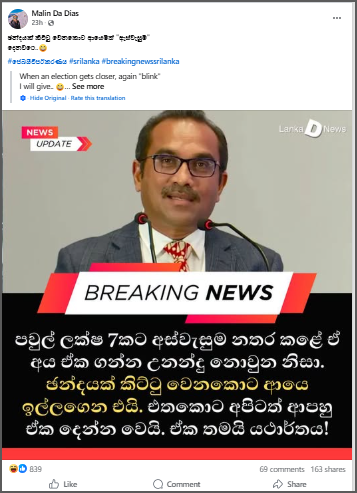
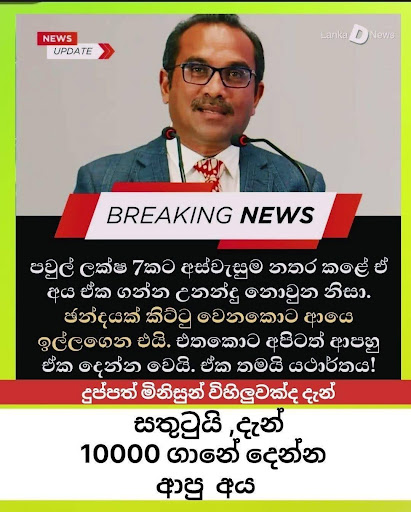
We therefore carried out an investigation to verify this claim.
Fact check :
No credible media reports or official statements were found indicating that the Minister of Transport, Highways, Ports and Civil Aviation, Bimal Rathnayake, had stated that Aswesuma benefits were discontinued for 700,000 families because they were not interested in receiving them, or that the benefits would have to be granted again when an election approaches. We also reviewed the Minister’s recent public statements, but found no evidence that he had made such a remark.
Furthermore, the Aswesuma Welfare Benefits Programme is implemented by the Welfare Benefits Board under the Ministry of Finance, Planning and Economic Development. Minister Bimal Rathnayake is not the Minister responsible for this programme.
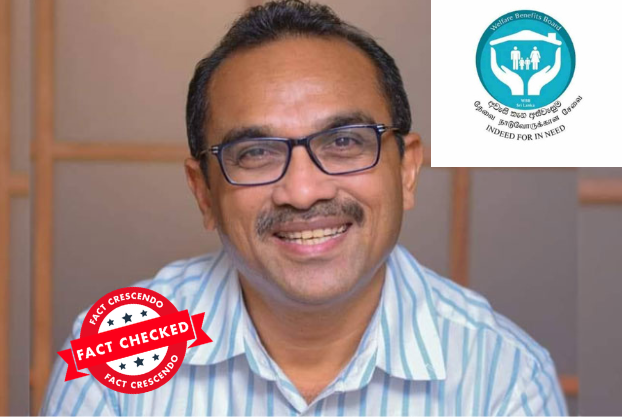
Minister of Transport, Highways, Ports and Civil Aviation, Bimal Rathnayake
When we inquired into this matter, the Media Secretary to Minister Bimal Rathnayake also confirmed that the social media post is completely false and that the Minister has never made such a statement.
Why Were Aswesuma Benefits Discontinued for a Group of Beneficiaries from April and June?
These social media posts began circulating following the decision to discontinue Aswesuma benefits for around 700,000 beneficiaries from April and June. We therefore looked into the reasons behind the decision to discontinue these benefits.
The suspension of Aswesuma benefit payments for a section of beneficiaries was a policy measure implemented by the government based on the recommendations of the International Monetary Fund (IMF). Aswesuma is not a permanent, long-term allowance but a welfare scheme that is subject to change depending on beneficiaries’ economic circumstances. In response to the severe economic crisis faced by Sri Lanka, the Aswesuma Welfare Benefit Programme was launched on 1 July 2023 with the objective of providing financial support and stabilizing the livelihoods of low-income and vulnerable groups affected by the crisis. More information is available here, here, and here.
Under the Aswesuma programme, six criteria and 22 indicators were used to assess the poverty level of each household. Based on this assessment, beneficiaries were classified into four main categories, and welfare benefits were provided accordingly. More information is available here.
- Extremely Poor: The most economically disadvantaged households received LKR 15,000 per month for three years. This amount was later increased to LKR 17,500 per month.
- Poor: Low-income households received LKR 8,500 per month for three years. This amount was later increased to LKR 10,000 per month.
- Vulnerable: Economically unstable households received LKR 5,000 per month.
- Transitional: Households requiring temporary financial assistance received LKR 2,500 per month.
From the outset, the “Transitional” and “Vulnerable” categories under the Aswesuma programme were introduced as short-term assistance categories. These benefits were intended to provide temporary financial support until beneficiaries became economically stable following the economic crisis.
According to the original programme design, benefits for the Vulnerable category were scheduled to end in December 2025. However, in view of the prevailing economic conditions, the government extended these payments until June 2026. That extended period has now come to an end.
The discontinuation of these benefit payments was carried out in two phases.
Phase One (April 2025): Benefit payments for 315,000 households in the Transitional category were discontinued after April 2025.
Phase Two (from June 2026): Benefit payments for 425,000 households in the Vulnerable category were discontinued with effect from June 2026.
However, the Welfare Benefits Board is currently carrying out its annual data update process. Households that experience financial hardship again may re-establish their eligibility by submitting the required verification and may qualify to receive benefits once more.
Who continues to receive Aswesuma benefits?
The Welfare Benefits Board has decided that, going forward, Aswesuma benefits will be limited to households classified as “Poor” and “Extremely Poor.” These benefits are currently planned to continue until June 2027. More information is available here and here.
The Welfare Benefits Board has also clarified this matter during a media briefing on the payment of Aswesuma welfare benefits.
During the media briefing, Nimal Kotawalagedara (Chairman, Welfare Benefits Board) stated that Aswesuma is only one component of a broader social protection programme. He emphasized that beneficiaries are not selected based on individual discretion or personal preference, but through a data driven scoring system used to assess eligibility.
Ashan Darshaka (Assistant Commissioner, Welfare Benefits Board) stated that payments under the Transitional category ended in April 2025, while payments under the Vulnerable category concluded in June 2026. However, he noted that individuals from these categories who continue to experience financial hardship may reapply and regain eligibility through the updated information verification process. He also confirmed that benefit payments for the Poor and Extremely Poor categories will continue until June 2027.
A video containing the key statements made during the media briefing is available here.
The full media briefing is available below.
Join us to learn more about our fact checking investigations.
Facebook | Twitter | Instagram | Google News | TikTok
Conclusion
Our fact check shows that the social media post claiming that Minister Bimal Rathnayake stated that Aswesuma benefits were discontinued for 700,000 families because they were not interested in receiving them, and that the benefits would have to be granted again when an election approaches, is false. The discontinuation of Aswesuma benefits for a group of beneficiaries from April and June is part of the process being implemented in line with IMF recommendations.

Title: Did Minister Bimal state that Aswesuma benefits were discontinued for 700,000 households because they were not interested in receiving them?
Fact Check By: B.P Hansani
Result: False