

Subscribe to our WhatsApp Channel
A claim built around real courtroom testimony, a real corruption case, and a real public health controversy is the hardest kind to fact-check, because it sounds far too specific to be made up. That is exactly what happened when social media posts began alleging that a top Sri Lankan medical regulator had told a Colombo court that expired anti-rabies vaccines were injected into the public in place of COVID-19 vaccines. The claim leaned on a genuine ongoing corruption trial and a real witness statement. Fact Crescendo investigated where the story bends the facts.
What Was Claimed
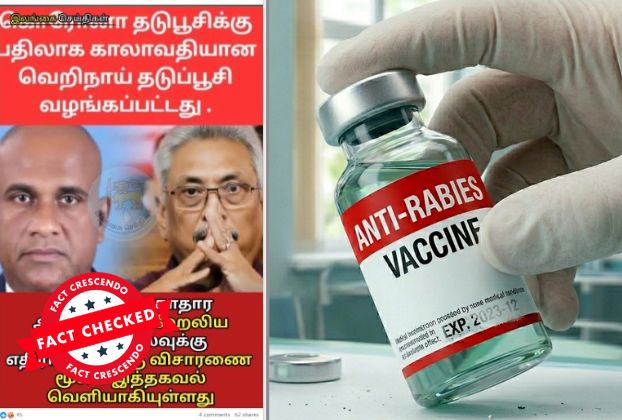
During ongoing proceedings at the Colombo High Court against former Health Minister Keheliya Rambukwella and several health ministry officials, accused of procuring substandard medicines and vaccines, Dr. Saveen Semage, former Chief Executive Officer of the National Medicines Regulatory Authority (NMRA), testified before the court. A Facebook post, archived here, claimed that this testimony revealed one of the most shocking incidents the health sector has faced in recent history.
According to the post, Dr. Semage stated in his testimony that expired anti-rabies vaccines were administered to patients in place of the vaccine meant to control COVID-19, during the period when Gotabaya Rajapaksa served as President. The post was shared on 14th June 2026 and circulated widely thereafter.
Fact Check
If Dr. Semage had genuinely testified that expired rabies vaccines were administered in place of COVID-19 vaccines, this would have been major national news covered extensively by mainstream Sri Lankan media. We searched comprehensively and found no mainstream media report stating that he made any such claim in his testimony.
What we did find was media coverage of testimony Dr. Semage gave on 11th March 2026, in proceedings related to a separate case concerning the procurement of substandard human immunoglobulin vaccines, at the Colombo Permanent High Court. As former Chief Executive Officer of the NMRA and a public health specialist, Dr. Semage’s testimony that day did concern expired anti-rabies vaccines, but not in the way the viral post described.
Why Were Expired Vaccines Authorized for Continued Use?
According to the testimony, anti-rabies vaccines held in government hospitals at the time had passed their listed expiry dates. A special panel of medical experts was consulted, and a decision was made to authorize continued use of these expired vaccines with patient consent, based primarily on two considerations: importing fresh vaccines from abroad would take a long time, and the vaccines were expensive enough that discarding them would represent a significant waste of public funds.
The Legal Basis Dr. Semage Cited
Responding to cross-examination from Senior Counsel Nuwan Jayawardena, who appeared for Dr. Janaka Sri Chandraguptha, the former Health Ministry Secretary named as the sixth defendant in the case, Dr. Semage explained that under the provisions of the National Medicines Regulatory Act, using expired medicines on the recommendation of a medical expert panel during a genuine shortage does not constitute a legal offence. He clarified that only the commercial sale of expired medicines, or their unlawful storage for that purpose, carries criminal liability.
How the Decision Was Made
Dr. Semage testified that the decision was taken at a Drug Evaluation Committee meeting he chaired on 24th May 2022. With the approval of the medical panel, continued use of the expired vaccines to address the shortage was authorized, and the decision was forwarded to the Director General of Health Services. He noted that rabies carries a fatality rate exceeding 99 percent once symptoms develop, making it an unusually sensitive vaccine, and that the authorization was a direct response to a severe vaccine shortage in the country at the time. He stated, however, that he had no personal knowledge of whether the vaccines were ultimately administered to patients in hospitals.
The Underlying Court Case
The case stems from allegations that substandard vaccines supplied to the Health Ministry’s Medical Supplies Division resulted in the fraudulent loss of more than Rs. 140 million in public funds. The Attorney General filed 13 charges against 12 defendants, including former Health Minister Keheliya Rambukwella, with Dr. Semage named as the second witness in the case.
Cross-Examination and Dr. Semage’s Tenure
Dr. Semage also told the court that medicines imported into Sri Lanka from India must be approved and registered with the Indian regulatory authority. On his own departure from the NMRA, he said he was appointed to lead the authority in November 2021 on merit while still serving in the military and resigned for personal reasons on 30th May 2022.
He further testified that during a medicine review meeting chaired by then Prime Minister Ranil Wickremesinghe, where officials reported a severe medicine shortage in the country, he was not given the opportunity to clarify the actual situation, and that this was a contributing factor in his resignation. Further reporting on this testimony can be found here.
The Doctors’ Union Calls for a Public Explanation
Separately, the Federation of Health Professionals, also referred to as the Doctors’ Union for Medical and Civil Rights, demanded an urgent and public explanation from the Health Ministry regarding the use of expired anti-rabies vaccines in government hospitals. Union President Dr. Samal Sanjeewa addressed reporters on the matter, and his comments were also reported in the media.
This information first came to light through Dr. Semage’s own court testimony. He had acknowledged that the NMRA panel authorized the continued use of expired anti-rabies vaccines in hospitals during the shortage, a point Dr. Sanjeewa confirmed to reporters.
The Union’s Concerns
The union raised several serious points. Rabies carries a fatality rate of roughly 99 percent once contracted, making any failure of the vaccine due to expiry a matter of life and death. The union asked who would bear responsibility if any patient suffered harm or died as a result of being administered an expired vaccine. It also pointed to a recent Supreme Court ruling in a separate case concerning the procurement of substandard human immunoglobulin and other medicines through fraudulent documentation, in which the court imposed a fine of Rs. 75 million on former Minister Rambukwella and health ministry officials and found that the fundamental rights of the public had been violated.
What the Union Wants Disclosed
Dr. Sanjeewa called on the Health Ministry to immediately and publicly disclose which hospitals received the expired anti-rabies vaccines, how many patients were administered them, and who the officials and expert panel members were that recommended and approved the decision. He stressed that the public deserved full transparency on these points and on the current state of the health sector. This media report was itself based directly on Dr. Semage’s court testimony.
It is worth noting that the union’s concern centers on accountability for the use of expired rabies vaccines during a shortage, a serious issue in its own right, but a different matter entirely from the viral claim that these vaccines were substituted for COVID-19 vaccines. Based on the available media reporting, it is clear that the claim circulating on social media rests on a misunderstanding. Dr. Semage’s testimony concerned the NMRA panel’s authorization to use already-expired anti-rabies vaccines, with patient consent, during a domestic shortage. It did not concern COVID-19 vaccines in any way.
Clarification from the NMRA Chairman
To obtain further clarity, we contacted Dr. Ananda Wijewickrama, Chairman of the National Medicines Regulatory Authority, and a specialist physician.
Dr. Wijewickrama confirmed that it is true the NMRA panel authorized the continued use of already-expired anti-rabies vaccines in hospitals, with patient consent, during a period of vaccine shortage in the country. However, he stated firmly that the claim being shared, that Dr. Semage testified these vaccines were administered to the public in place of COVID-19 vaccines, is entirely false.
He explained that at the time, some anti-rabies vaccines were nearing or past their expiry dates, and with no new stock available, the question arose of whether the existing supply could continue to be used. He noted that vaccine manufacturers typically store batches and evaluate their stability at intervals, allowing them to confirm whether potency remains intact beyond the listed expiry date. The Health Ministry sought this information from the manufacturer but did not receive a timely response, and as a result could not grant official approval on that basis alone.
He added that because rabies is fatal if a vaccine is not administered at all, and because vaccine potency does not vanish the moment an expiry date passes but instead declines gradually, the advisory committee’s meeting minutes recorded that the risk of withholding the vaccine entirely outweighed the risk of using an expired dose, provided patients were informed and gave their consent.
Dr. Wijewickrama confirmed that Dr. Semage’s court testimony was consistent with this account, and that at no point did Dr. Semage state that anti-rabies vaccines were administered in place of COVID-19 vaccines. He further pointed out that the official meeting records only show that the advisory committee discussed authorizing the use of expired anti-rabies vaccines with patient consent. Whether those vaccines were, in fact, subsequently administered to any patients remains unconfirmed, since no further information on that point has emerged to date.
Follow Us on Social Media
Facebook Page | Twitter | Instagram | Google News | TikTok | YouTube
Conclusion
Our investigation found that the claim circulating on social media, that Dr. Saveen Semage, former Chief Executive Officer of the National Medicines Regulatory Authority, testified in court that expired anti-rabies vaccines were administered to the public in place of COVID-19 vaccines, is false.
Based on media reports and the clarification provided by NMRA Chairman Dr. Ananda Wijewickrama, it is clear that during testimony given on 11th March 2026 at the Colombo Permanent High Court, in a case concerning the procurement of substandard human immunoglobulin vaccines, Dr. Semage stated only that the NMRA panel had discussed and authorized the continued use of already-expired anti-rabies vaccines with patient consent, due to a vaccine shortage in the country. He stated explicitly that he did not know whether these vaccines were in fact subsequently administered to patients. At no point did his testimony reference COVID-19 vaccines.
In such situations, contact us on our WhatsApp number (+94771514696) to verify the authenticity of similar claims before sharing them.

Title: Expired Rabies Vaccines Administered Instead of the COVID19 Vaccine? Find out the truth…
Fact Check By: Suji Shabeedharan
Result: Misleading