
Subscribe to our WhatsApp Channel
A number can travel a long way once it leaves its original context. This week, posts began circulating claiming the IMF had confirmed that USD 808 million simply went missing from Sri Lanka in 2025, under the NPP government. The figure itself is real and appears in an official IMF report. What it actually represents is something else entirely. We investigated it.
Social Media Posts :

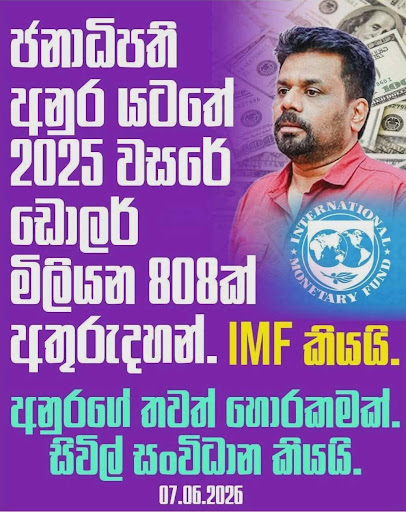
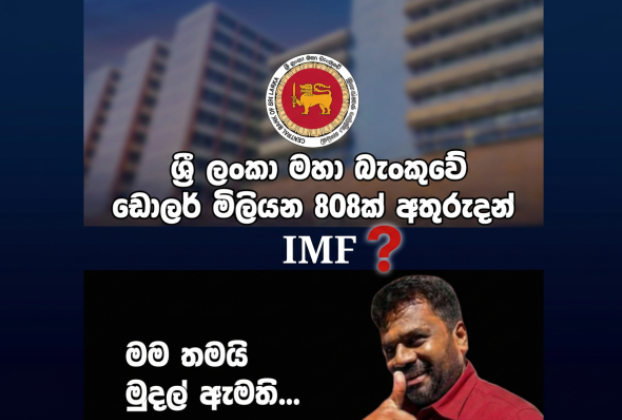
We set out to find out whether USD 808 million had gone missing from Sri Lanka in 2025.
Fact-Check :
Opposition MP Dayasiri Jayasekara and former Minister Patali Champika Ranawaka stated at a recent press briefing that, according to IMF data, USD 808 million appeared to have vanished from the country in 2025. Both called on the Central Bank to break its silence and clarify the matter publicly. Their full statements are available here and here.
In May 2026, the IMF released a 143-page report covering the combined fifth and sixth reviews of Sri Lanka’s Extended Fund Facility (EFF), clearing the release of USD 695 million in financial assistance. The full report is available here. Archived.
Within that report, Country Report No. 26/111, the negative figure of USD 808 million appears on page 35, in the main data table “Table 4a. Sri Lanka: Balance of Payments.” It is recorded for 2025 under a line item called “Errors and Omissions.”
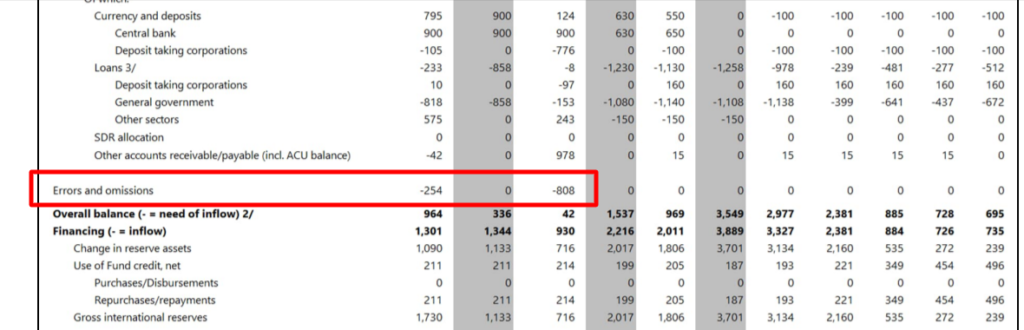
This figure is not unique to the IMF report. The Central Bank of Sri Lanka’s 2025 Annual Economic Review records the identical negative figure of USD 808 million, on page 48, under its own “Net Errors and Omissions” line. This is not an outside observation by the IMF. The Central Bank itself published this number.
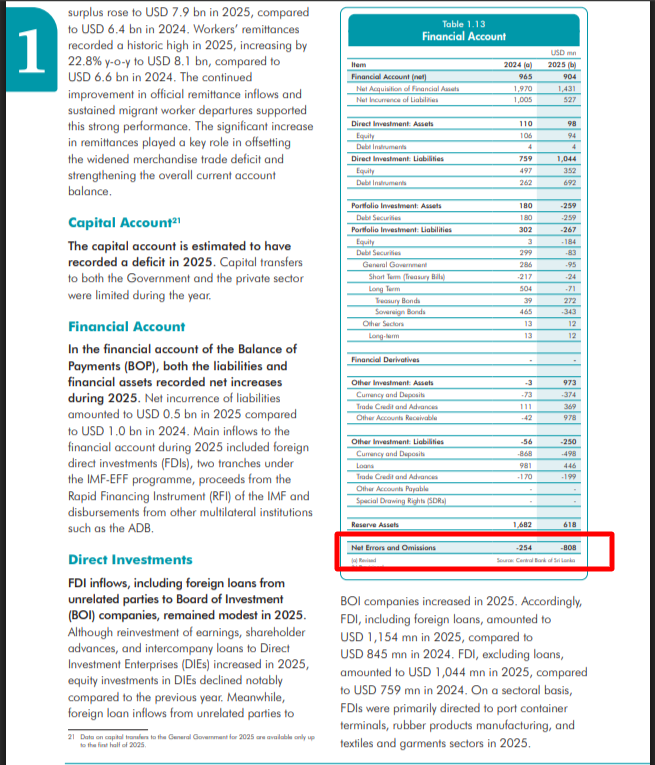
Why the Central Bank Governor Was Asked to Explain This in Parliament
Citing the IMF report, various groups alleged that USD 808 million had flowed out of Sri Lanka under the current administration. Dr. Harsha de Silva, Chairman of the Committee on Public Finance (COPF), directly questioned the Central Bank Governor on this during a committee session.
De Silva noted that social media often spreads misinformation quickly, citing the varied interpretations of this USD 808 million figure as an example. He said non-technical commentary should not be allowed to dominate public conversation and asked the Governor for a clear technical explanation.
What the Central Bank Governor Said
“Many people do not understand why this is recorded as ‘errors and omissions.’ I don’t know why someone took this figure and spread it on social media the way they did. This relates to basic knowledge about errors and omissions that arise during the compilation of the balance of payments. Any economics student understands this. It is even taught in school. The problem is that not every citizen is familiar with it.
When we compile a country’s foreign exchange transactions for a given year, we categories them into imports, exports, interest payments, and remittances. That large group of transactions makes up the current account. Inflows are then recorded as credits and outflows as debits in the financial account. In any accounting system, private or institutional, debits and credits must balance, and the net value should be zero.
But recording a country’s transactions relies heavily on data and estimation. Customs gives us accurate trade data but matching that against the millions of corresponding financial transactions, moving through the banking system is genuinely difficult, because banks only report aggregate figures. No country in the world can balance its payments to the last cent. A gap always opens up from estimation differences, under-invoicing, or over-invoicing. It is never truly zero.
Looking at our own pattern, this figure was minus USD 254 million last year and minus USD 800 million this year. The year before that, it was close to zero. In some years it is even positive. This is not something to be alarmed about. It is a completely natural phenomenon. For example, customs may record USD 12 billion in annual exports, but the actual payment for some of that might only arrive two months later. That creates a mismatch within that fiscal year, even as the previous year’s delayed payments are arriving now. That timing gap is exactly what shows up as a statistical discrepancy.
I want to state clearly that the claims circulating on social media and in some media programmers, suggesting the Central Bank has lost millions, are entirely baseless. Nothing has been lost. This is purely a statistical gap in how the data is reported.”
How the IMF Defines “Net Errors and Omissions”
The IMF’s Balance of Payments and International Investment Position Manual, Sixth Edition (BPM6) defines Net Errors and Omissions as follows: under the double-entry system used in balance of payments accounting, all credits and debits should, in principle, sum to zero, meaning a country’s inflows and outflows should balance perfectly. In practice, gaps in data sourcing always disrupt this balance. The resulting statistical gap is recorded as Net Errors and Omissions.
The IMF attributes these discrepancies mainly to four factors:
Data source incompleteness: standard data collection methods fail to capture every transaction.
Reporting deficiencies: institutions or clients provide inaccurate or incomplete data.
Timing differences: the two sides of a transaction get recorded in different reporting periods, for example when a shipment and its payment fall into different fiscal years.
Valuation differences: the same transaction gets recorded using different valuations or exchange rates by each party.
Under BPM6, Net Errors and Omissions are nowhere defined as missing or lost capital. It is a purely statistical residual arising from data gaps and collection errors during the compilation of the balance of payments.
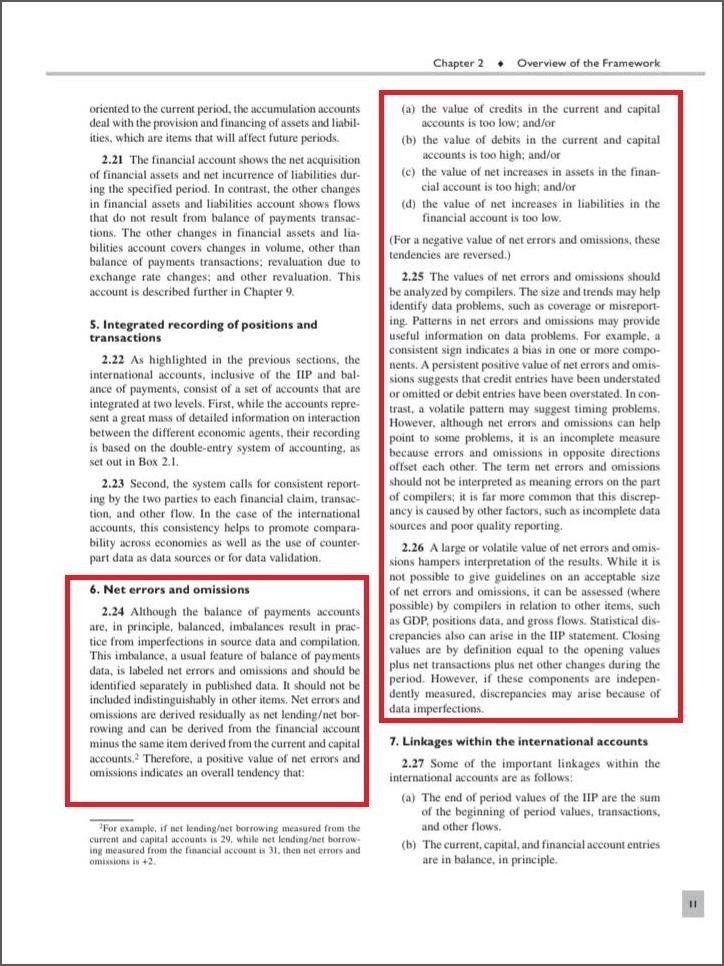
This Has Happened Before, Under Earlier Governments Too
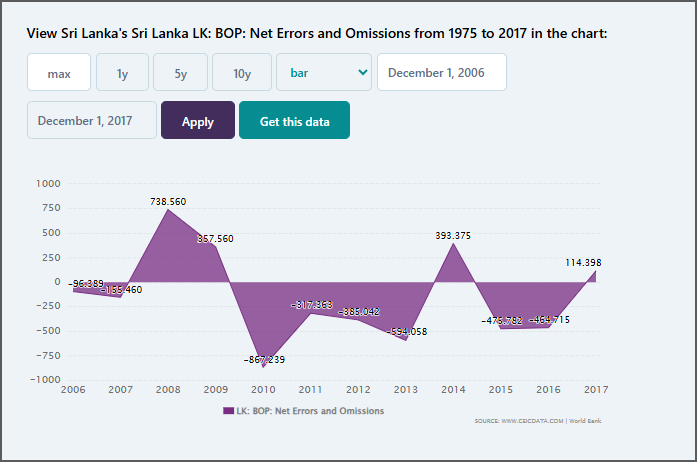
This is not the first time Sri Lanka has recorded a negative Errors and Omissions figure, and it is not unique to the current administration. ISI Markets (ISI Emerging Markets Group), an international financial data platform specializing in macroeconomic data for developing economies, tracked the fluctuations in Sri Lanka’s balance of payments errors and omissions from 1975 to 2017. Looking at 2006 to 2017 alone, Sri Lanka’s Net Errors and Omissions fell to an estimated minus USD 867 million in 2010, a steeper negative figure than the minus USD 808 million recorded in 2025.
https://srilanka.factcrescendo.com/wp-content/uploads/2026/06/image-106.png
(A positive value indicates an unrecorded inflow of foreign exchange, meaning more capital is actually present in the country than the documented data shows. A negative value indicates an unrecorded outflow, meaning some foreign exchange leakage went undocumented.)
A Sri Lanka Chronicle report noted that the 2025 deficit of minus USD 808 million was more than triple the minus USD 254 million recorded in 2024, calling it a “statistical anomaly that has drawn the close scrutiny of professional analysts and economic experts.” The report also stated clearly that the Net Errors and Omissions figure alone does not prove capital flight or reporting malpractice, since multiple factors could be driving the variance. The full report is available here.
A Former Deputy Governor Confirms: No Money Was Lost
W.A. Wijewardena, a former Deputy Governor of the Central Bank of Sri Lanka, said the USD 808 million recorded under Errors and Omissions in 2025 does not represent a financial loss to the Central Bank. Since the figure functions as a credit entry, he explained, it actually implies that foreign exchange entered the banking system, just without being properly recorded on the receipts side.
Because the balance of payments runs on double-entry accounting, debits and credits should be theoretically balanced. Wijewardena said the gap arises from reporting lags, deficiencies, or recording inaccuracies when aggregating data from sources like customs, commercial banks, and other institutions. His full commentary is available here.
Join us to learn more about our fact-check investigations.
Facebook | Twitter | Instagram | Google News | TikTok
Conclusion :
Our investigation found that the claims circulating on social media, alleging that USD 808 million went missing or was stolen from Sri Lanka in 2025 under President Anura Kumara Dissanayake’s administration, are misleading. This figure is Net Errors and Omissions, a standard accounting line that appears in both the IMF’s 2025 country report and the Central Bank of Sri Lanka’s own 2025 Annual Report.
It reflects a routine part of balance of payments accounting worldwide, used to reconcile official inflow and outflow data when the two sides do not perfectly match. It is not unique to Sri Lanka and not unprecedented even here. A steeper deficit of minus USD 867 million was recorded back in 2010. However, analysts have noted the figure roughly tripled compared to 2024, which is worth understanding, but both the Central Bank Governor and a former Deputy Governor have confirmed this is a statistical reconciliation, not lost or stolen funds.

Title: No, USD 808 Million Did Not Go Missing in 2025 — Here Is What the IMF Figure Actually Means
Fact Check By: B.P. Hansani
Result: Misleading