
Subscribe to our WhatsApp Channel
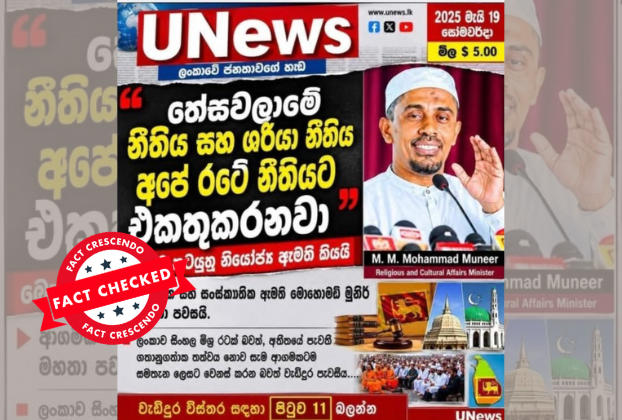
The claim that Deputy Minister of Religious and Cultural Affairs Mohamed Muneer had publicly announced the incorporation of Thesawalamai and Sharia law into Sri Lanka’s national legal system, spread rapidly across social media, framed as a legitimate newspaper article. But is it true? We investigated.
Social Media Posts :
The post was designed to look like a legitimate news article from a publication called ‘Unews,’ making it appear credible to some users, at first glance. Here is exactly how it was presented.
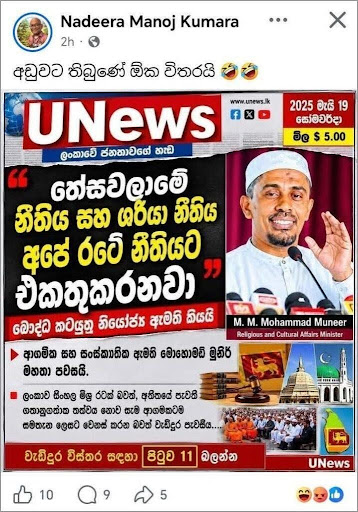
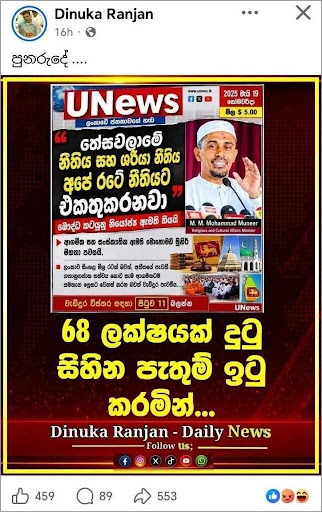
We investigated whether the Deputy Minister had actually made such a statement.
Fact-Check :
We searched every mainstream media outlet and checked every official, credible source. No mainstream media organization had reported that Deputy Minister of Religious and Cultural Affairs Mohamed Muneer made any such statement. The claim had no foundation.
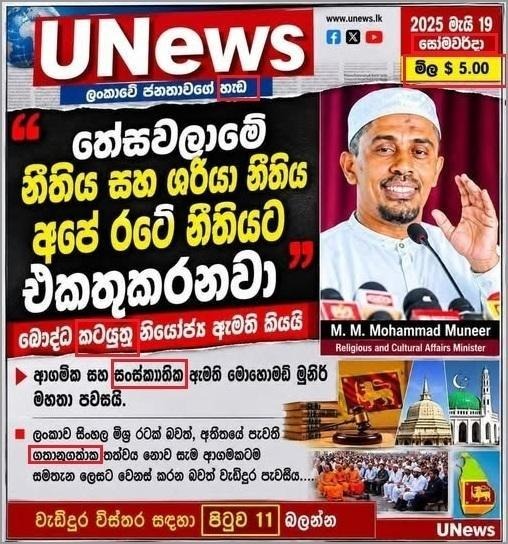
The post was designed to resemble a newspaper article, but no national newspaper called ‘U News’ exists in Sri Lanka. The purported newspaper article in Sinhala also contains clear spelling errors. In addition, the same article refers to Deputy Minister Muneer by two completely different titles in two separate places, once as the Deputy Minister of Buddhist Affairs, and again as the Minister of Religious and Cultural Affairs.
The likelihood of such errors appearing in a genuine national newspaper is extremely low, indicating a high probability that the post was digitally generated or edited using artificial intelligence.
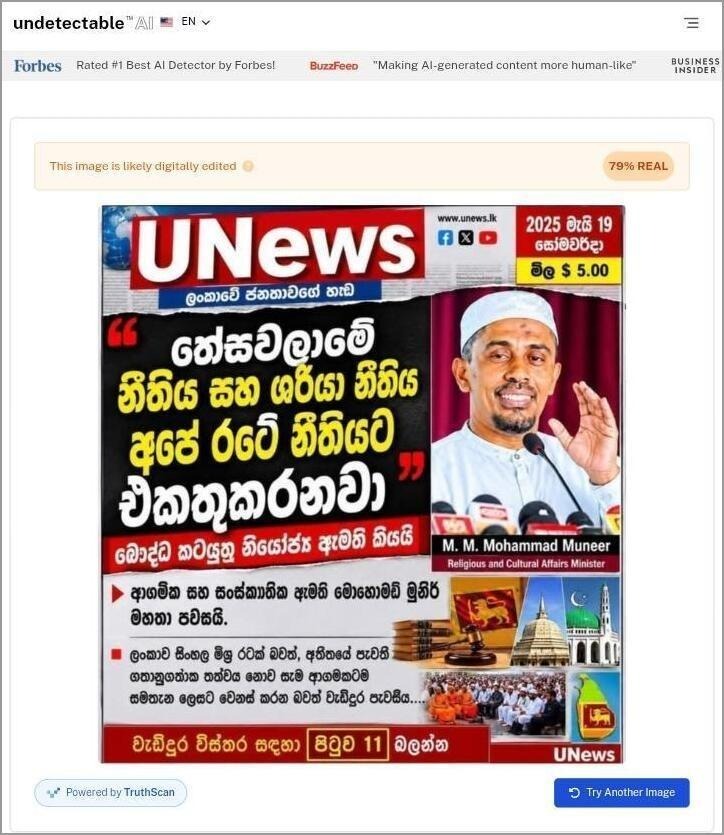
AI Detection Tools Confirm the Post Is Artificially Generated
Several tools used to detect AI-generated content confirmed that the photo post in question was created using artificial intelligence.
Mohamed Muneer Is the Deputy Minister of Religious and Cultural Affairs, Not the Deputy Minister of Buddhist Affairs
The circulating post refers to Mohamed Muneer in two different ways: as the Deputy Minister of Buddhist Affairs in one place, and as the Minister of Religious and Cultural Affairs in another. In reality, Mohamed Muneer serves as the Deputy Minister of Religious and Cultural Affairs. He does not hold the Buddhist Affairs portfolio. Facebook
Also Read: Did Mohamed Muneer Really Take Oaths as Deputy Minister of Buddha Sasana?
Media Secretary : Deputy Minister Mohamed Muneer
We contacted the Deputy Minister’s Media Secretary regarding this matter. He confirmed that the post is false and that the Deputy Minister has made no such statement.
Media Secretary, Ministry of Justice
We also reached out to the Media Secretary of the Minister of Justice; response was equally decisive: no discussion of any kind has ever taken place regarding the claims made in that post.
Thesawalamai and Muslim Personal Law: Separating the Facts from the Fiction
What exactly are these laws, and are they already in operation?
Both laws are not new, nor are they foreign imports. They are already firmly codified in Sri Lanka’s national legal framework. Thesawalamai (Tamil for “customs of the land”) has been in force since 1806 under British colonial rule, specifically Regulation No. 18, governing matrimonial property, inheritance, and the right of pre-emption for the Jaffna Tamil community. A 1988 Supreme Court ruling extended its application to all Tamils of Northern Province origin, wherever they live across the island.
The Muslim Marriage and Divorce Act (MMDA) of 1951 covers the entire Muslim community in Sri Lanka, approximately 9.7% of the population, and governs marriage, divorce, polygamy, and property inheritance through 65 Kathi (Quazi) courts. The MMDA is not direct Sharia law. It is an internationally recognised colonial hybrid that incorporates Sharia principles, Dutch-era Islamic law, and English procedural law.
Are These National Laws?
Both laws are firmly part of Sri Lanka’s existing national legal code, but they function as personal laws, applying exclusively to their defined communities. As Global Press Journal notes, Sri Lanka operates a system of legal pluralism: Roman Dutch common law for all citizens, Kandyan law for the Kandyan Sinhalese, Thesawalamai for Northern Tamils, and the MMDA for Muslims.
The viral claim that the minister announced these laws would be added to the country’s legal system is entirely false, for a simple reason: these laws are already part of Sri Lanka’s legal framework and have been for well over a century.
Muslim personal law has never applied to non-Muslims. Thesawalamai has never applied beyond the Tamil community. No proposal has ever existed, past or present, to extend either law in any way that would affect other communities including the majority, Sinhalese or Buddhist community.
Join us to learn more about our fact-check investigations.
Facebook | Twitter | Instagram | Google News | TikTok
Conclusion :
Our investigation confirms that the posts circulating on social media, claiming that Deputy Minister of Religious and Cultural Affairs Mohamed Muneer stated that Thesawalamai and Sharia law would be added to Sri Lanka’s national legal system, are false and fabricated. Both the Deputy Minister’s office and the Ministry of Justice categorically denied the claim.
Thesawalamai and Muslim Personal Law already operate in Sri Lanka as personal laws applicable only to their respective communities. They are not new, not foreign, and no proposal to extend them has ever been made. The post itself bears the hallmarks of AI generation, including a fictional newspaper name, spelling errors, and contradictory information about the minister’s own title.

Title: No, Deputy Minister Muneer Did Not Call for Sharia or Thesawalamai Laws to Be Added to Sri Lanka’s Legal System
Fact Check By: B.P. Hansani
Result: False