

Subscribe to our WhatsApp Channel
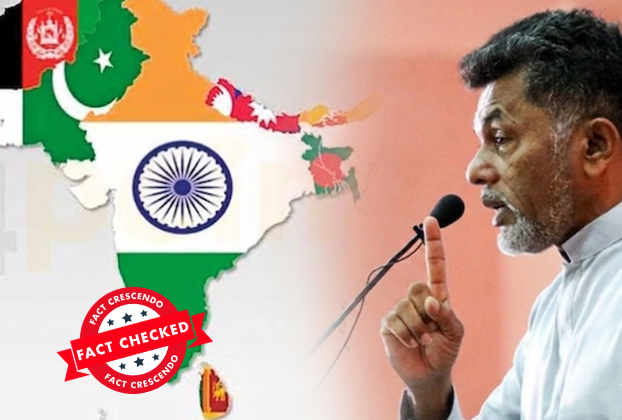
For a country still climbing out of economic collapse, it was a flattering headline: Deputy Minister of Housing, Construction and Water Supply, T.B. Sarath said international bodies including the World Bank had certified Sri Lanka as South Asia’s fastest-growing economy, ahead of India and Pakistan. Mainstream and social media carried it widely. We checked whether the World Bank said any such thing, and what its data actually shows.
Social Media Posts
The Deputy Minister’s claim was reported through mainstream media as follows.
He made the claim again in a further statement, asserting that Sri Lanka had surpassed both India and Pakistan. Facebook
Related posts then circulated widely on social media.


Facebook | Facebook | Facebook | Facebook
Some mainstream outlets also ran headlines along the lines of “World Bank says Sri Lanka’s economy is South Asia’s fastest-growing.” However, the body of those reports said something narrower: that on the World Bank’s latest data, Sri Lanka led the region on per-capita growth, rising from US$4,545 in 2024 to US$5,002 in 2025 on the figures they cited, ahead of the Maldives, Pakistan and India on that measure alone. Facebook
We therefore set out to verify these claims.
Fact Check:
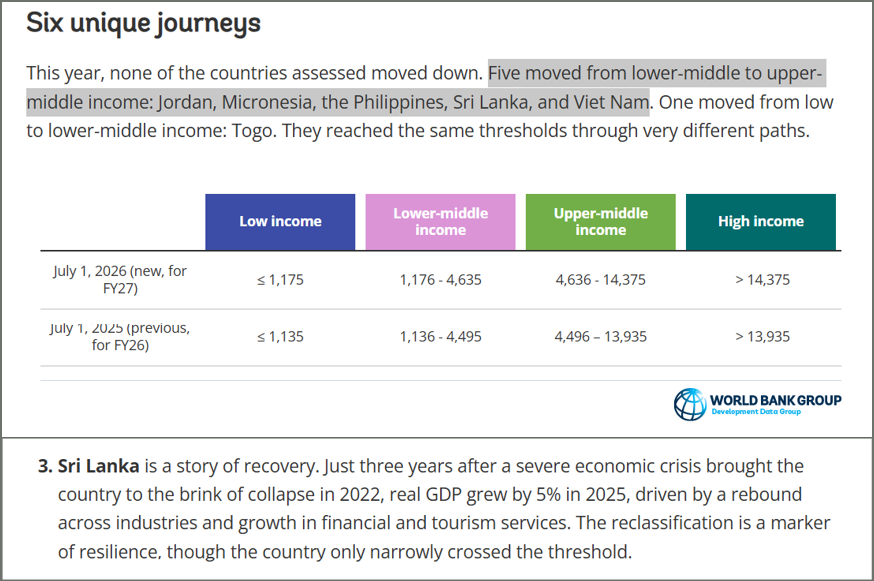
The main classification the World Bank issued for Sri Lanka on July 1, 2026, valid through June 30, 2027, is its reclassification as an upper-middle-income country, for the first time since 2019, following recovery in 2024 and 2025. That upgrade followed 5% real GDP growth in 2025, driven by post-crisis progress in industry, services and tourism. World Bank, 2026-2027 income classifications.
To qualify as upper-middle-income, per-capita income must fall between US$4,636 and US$14,375. Sri Lanka recorded US$4,670 in 2025, narrowly clearing the threshold. Only two South Asian nations now sit in this bracket: Sri Lanka and the Maldives. World Bank, Country & Lending Groups.
World Bank | Archived Link | more here | and here
Note: GNI per capita measures the average income earned by a resident over a year and is the World Bank’s primary yardstick for a country’s economic strength relative to its population. It is not an actual salary, only the average that would result if total national income were divided equally among the population.
Sri Lanka Did Lead South Asia in GNI-per-Capita Growth
| Country | 2024 (USD) | 2025 (USD) | Net growth | Growth rate |
|---|---|---|---|---|
| Sri Lanka | 3,870 | 4,670 | +800 | +20.67% |
| Maldives | 11,540 | 12,950 | +1,410 | +12.22% |
| Bhutan | 3,910 | 4,310 | +400 | +10.23% |
| India | 2,550 | 2,760 | +210 | +8.24% |
| Nepal | 1,480 | 1,570 | +90 | +6.08% |
| Pakistan | 1,430 | 1,500 | +70 | +4.90% |
| Bangladesh | 2,820 | 2,840 | +20 | +0.71% |
Official source: World Bank, GNI per capita, Atlas method (current US$) | Archived Link
Under the Atlas method, Sri Lanka (20.67%) took South Asia’s top spot for percentage growth in GNI per capita from 2024 to 2025. This does not mean Sri Lanka is South Asia’s fastest-growing economy.
The World Bank’s Development Data Group explicitly states that income classification is merely an indicator of income level, not a comprehensive assessment of a country’s macro-economic development or overall living standards.
Sri Lanka Is Not South Asia’s Fastest-Growing Economy
The World Bank has never stated that Sri Lanka is South Asia’s fastest-growing economy, and its data does not support the description. The classification rests on GNI per capita, not on the rate of economic growth (GDP growth rate).
India Is South Asia’s Fastest-Growing Economy
In its latest regional analysis, the World Bank states clearly that South Asia is the world’s fastest-growing region, with India as its primary engine of growth, and that India ranks first in growth rate among both the region’s and the world’s major economies. World Bank, India among fastest-growing economies.
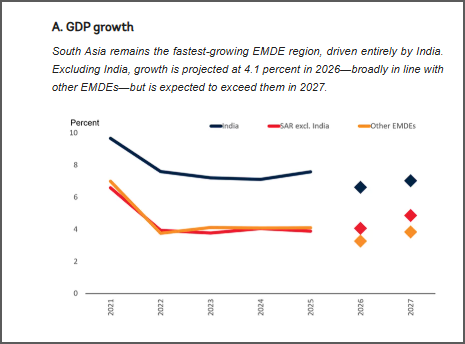
The World Bank characterizes Sri Lanka’s 5% GDP growth in 2025 not as the fastest development, but as a collapsed economy recovering toward stability. More details here, here and here.
South Asian Real GDP Growth Rates (Latest World Bank Data)
| Country | WDI 2025 (%) | GEP forecast (%) | Current status |
|---|---|---|---|
| Bhutan | 8.0% | 7.0% | Region’s highest rate, driven by hydropower (small economy) |
| India | 7.6% | 7.2% | World’s fastest-growing major economy; the region’s growth engine |
| Maldives | 6.3% | 4.2% | Tourism recovery: wide source gap may warrant revision |
| Sri Lanka | 5.0% | 4.6% | A strong post-crisis recovery (not the fastest) |
| Nepal | 4.4% | 4.6% | Services and tourism reviving, though political risk persists |
| Pakistan | 3.7% | — | Gradual recovery amid challenges (outside SAR grouping since July 2025) |
| Bangladesh | 3.5% | 3.7% | Slowed by political transition and weak investment |
Official sources: World Bank, GDP growth (annual %) | World Bank, Global Economic Prospects, South Asia (Jan 2026)
Methodology notes: all figures are official World Bank data. WDI 2025 reflects World Development Indicators (updated July 13, 2026); the GEP column reflects Global Economic Prospects, January 2026. The 2025 figures are estimates and subject to revision.
Key finding: Bhutan ranks highest by WDI and India by GEP forecast, but no World Bank source ranks Sri Lanka as the region’s fastest-growing economy. India, the region’s leading economic power, drives most of South Asia’s growth, while Bhutan and the Maldives are small economies whose growth rates naturally register at elevated levels.
Professor of Economics Wasantha Athukorala
For further clarity we consulted Professor of Economics Wasantha Athukorala of the University of Peradeniya, who explained:
“No. The World Bank has never stated that Sri Lanka is South Asia’s fastest-developing country or economy. That is the first point.
The second point is that these are conceptually different measures. Economic growth refers specifically to real GDP growth. On real GDP, India’s growth exceeded 7% while Sri Lanka’s stood at roughly 5%, so Sri Lanka simply cannot be identified as South Asia’s fastest-growing economy.
On per-capita figures there are two distinct concepts. Sri Lanka sometimes calculates GDP per capita, which stood at US$3,253 last year. The World Bank, however, calculates GNI per capita using the Atlas method, factoring in inflation and exchange rates to enable meaningful cross-country comparison. Under the Atlas method our figure was US$3,870 in 2024, rising to US$4,670 by 2025, a 21% increase, roughly US$800 in a single year. Over the same period India grew about 8%, Bhutan 11%, the Maldives 12%, Nepal 6% and Pakistan 5%. On that measure, it’s true that Sri Lanka leads.
So, calling Sri Lanka ‘South Asia’s fastest-growing economy’ is incorrect. Describing it as the country with the highest economic growth rate is likewise incorrect. But describing Sri Lanka as the South Asian country that recorded the highest growth in GNI per capita is accurate. That is precisely the clarification needed here.”
Under the World Bank’s latest classification Sri Lanka is upper-middle-income while India remains lower-middle-income, yet the World Bank identifies India as the fastest-growing economy in South Asia and the world. We asked Professor Athukorala to explain that apparent discrepancy. He said:
“The World Bank classifies countries based on GNI per capita, meaning total gross national income divided by population. India, with its enormous population, sees its per-capita figure kept relatively low precisely because that population is so large.
India’s GNI per capita in 2024 was US$2,550 against Sri Lanka’s US$3,870. By 2025 India’s had risen to US$2,760 while Sri Lanka’s reached US$4,670. Under World Bank criteria, a country with GNI per capita between US$4,636 and US$14,375 is upper-middle-income, so Sri Lanka’s US$4,670 places us squarely within that bracket. India, owing to its enormous population, has a lower per-capita income and thus remains lower-middle-income.”
Join us to learn more about our fact-check investigations.
Facebook | Twitter | Instagram | Google News | TikTok
Conclusion
Our fact-check finds that describing Sri Lanka as South Asia’s fastest-developing nation, or as having the region’s fastest-growing economy, is inaccurate. The World Bank has never identified Sri Lanka as such.
India, with the region’s highest growth rate, drives South Asia’s overall economic growth and stands as the fastest-growing major economy both regionally and globally. Bhutan does show a higher growth rate than Sri Lanka, but on a very small economy.
What Sri Lanka’s upgrade to upper-middle-income status actually reflects is the highest growth in GNI per capita among South Asian nations between 2024 and 2025. This news gave rise to the mistaken conclusion that Sri Lanka is the region’s fastest-growing country. GNI-per-capita growth is not a comprehensive assessment of a country’s overall economic development or general living standards. We rate the claim as false.
Also read: Sri Lanka’s Upper-Middle-Income Milestone: Unpacking the Numbers Behind a Nation Still Under Pressure.

Title: Fastest-Growing, or Fastest-Recovering? The Truth Behind Minister Sarath’s Statements on Sri Lanka’s Economy!
Fact Check By: B.P. Hansani
Result: False